 |
by Wink on (#PMZ4)
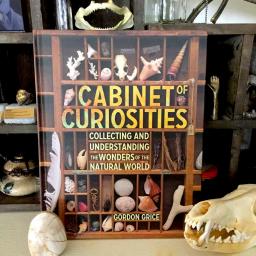
See sample pages at Wink.The term "cabinet of curiosities" means different things to different people. For the author of this wonderful book for kids, it was a cigar box full of treasures that he started accumulating at the age of six, beginning with the found skull of a skunk. For my brother, it was the annual gift I sent him from The Evolution Store in Manhattan: a shark, bat, crab, scorpion, and a black widow. (Yes, I forced a curiosity cabinet onto him.) For me, it’s a combination of anything small, old, and interesting, human-made or nature-made, and preferably a bit on the bizarre side. This book, however, focuses on the natural wonders only, and, specifically, those waiting out there to be found by the young scientists, collectors, and curators of tomorrow.Nature writer Gordon Grice starts with a bit of history about cabinets of curiosities and the Age of Exploration, during the 1400s-1600s, when seekers of fortune brought home fascinating items from their travels. Many of these items that made up small private collections ended up being the biggest cabinets of curiosities of all: museums. He tells us what we can use to make our own mini cabinets and shows how we can even build one from scratch. From there he introduces us to the classifications of life, with a brief description of the taxonomy – still in use today – created by Carl Linnaeus, a Swedish biologist in the 1700s.The rest of the book is divided into three main sections: Animalia, Plantae, and Mineralium. Grice spends the majority of pages on the animal kingdom. Though plants and rocks have their place in a good cabinet, animals are the clear winners of this book. In examining just a few species, a mere tip of the iceberg, one learns many wonderful facts, such as that ravens will investigate gunshots to see if they result in anything good to eat. Or that a cuckoo bird will shove an egg out of another species’ nest and replace it with her own, so that the other bird will raise her young imposter instead. Or that a shark’s teeth are the hardest element in its whole body. Or that brown crabs can live for 100 years. We also learn about preservation and display of specimens. The book carries a few (but not enough) scattered warnings about not collecting live or endangered animals, as well as safety issues and respecting property rights. I wish there were more emphasis on observing or collecting without causing harm or violating laws. For instance, here in Arizona, it is illegal to collect a saguaro boot – the hard “scar tissue†resembling a boot that the cactus builds up around a bird’s nest within its body – from the wild. The previously mentioned store sells only legal specimens and is licensed by the U.S. Fish and Wildlife Service, but I suspect there are a lot of specimens out there that are collected in dubious fashion; all the more reason to find one’s own treasures in nature. This is a beautifully illustrated book that will undoubtedly spark the curiosity in any kid who reads it. Compiling a cabinet of curiosities is a way for a youngster to feel connected to her or his environment, history, the Earth, other creatures, and science. Certainly, every child has a moment in which they begin their own personal age of exploration. – Aaron DowneyCabinet of Curiosities: Collecting and Understanding the Wonders of the Natural Worldby Gordon GriceWorkman Publishing2015, 160 pages, 8.5 x 11 x 0.8 inches $14 Buy one on Amazon
|
Boing Boing
| Link | https://boingboing.net/ |
| Feed | http://feeds.boingboing.net/boingboing/iBag |
| Updated | 2026-11-07 05:18 |
 |
by Maris Wicks on (#PM8M)
(more…)
|
 |
by Boing Boing's Store on (#PKJB)
The Lytro Illum dares to be different, boasting even more robust features than its first generation predecessor and a sleek design reminiscent of professional DSLRs. What's so cool about it? Most cameras capture the position of light rays, producing a statoc 2D image. But the Illum’s cutting-edge technology records the direction of these rays, generating images you can later refocus, change perspective within, or view in 3D. You can essentially revisit the scene of the photo, meaning you’ll never miss snapping the perfect shot again.Take “living pictures†you can adjust afterwardsRefocus your shots, change their perspective & view them in 3D, even in post-productionUse familiar digital camera features: auto focus, exposure mode, etc.Capture the angle of every light ray in a sceneEasily carry it anywhere: design is compact, durable & lightweightShoot photos at an optimal resolution for sharing onlineAccess an array of tools including photo filters & uploading softwareCheck out the Lytro Illum Camera in the Boing Boing Store today![embed]https://youtu.be/qViP_ozq358[/embed]
|
 |
by Leigh Alexander on (#PJ09)
This week, our partnership with Critical Distance brings us a takedown on 'empathy games' from one of the field's most well-known independent designers, as well as a unique collection of games inspired by the classic Breakout. (more…)
|
 |
by Katherine Cross on (#PHZ7)
80 Days is a game based on the Jules Verne novel Around the World in 80 Days, but with a significant steampunk—and anti-colonial—twist. You play Phileas Fogg’s valet, Jean Passepartout, who must not only plan the sometimes-complex logistics of the journey, but ensure his master's well-being along the way. The graphics and aesthetic of the game are beautiful; they light sepia-tinted fires to the imagination as one plays, and act as gentle companions to the core act of reading, managing income and inventory, and making choices about how to travel and what to do along the way. But it’s the writing by Meg Jayanth, with a few stories added by director Jon Ingold, that makes 80Days game so memorable and more-ish.While Jayanth loved the original Verne tale, she says she found his portrayal of Aouda, an Indian princess, to be “infuriating.†Treated like a “conquered territory†and a “prize for Fogg,†the character of Aouda evoked everything wrong with white European portrayals of non-white women in colonized countries. If Jayanth was going to try her hand at rewriting this classic tale, there would have to be an answer to Aouda.In the process she wound up writing a hundred. 80 Days became a steampunk world where technology was both magical and political, where maps were dramatically redrawn, and where non-white people and women alike had scores of characters expressing a variety of views about this volatile world. Whereas the original Verne tale never left the British Empire, here the boundaries of Victoria’s kingdom are reduced, Asian and African empires have more robustly resisted European colonialism (while perpetrating abuses of their own), and Fogg and Passepartout must go well beyond their comfort zone and the protection of Her Majesty to complete their journey.When the game first released on iOS, it became an instant classic—interactive fiction games often resist penetrating broader game audiences, but the tablet-friendly beauty and readability of 80Days earned it acclaim in many circles, and multiple media awards. Now the game comes to digital download platform Steam, and with that release comes a brand-new expansion to the game: Canada, the US, and South America have more cities to visit and many more people to talk to—especially Natives, who Jayanth felt got short shrift in the original script. “To be honest,†she tells us, “the lack of proper representation of native peoples in North America really bothered me when we first released—there are some in the U.S., but not nearly enough. It was always a goal to cover more of Canada and the US, and include more native peoples, but in the end I really didn't want to go in without proper research and time to get to grips with the history.†The result of that research—writ large in all of Jayanth’s stories throughout 80 Days—is an impressive alternate history of Native North America and a bevy of new and interesting characters.Assimilationist compromise and vibrant resistance are portrayed in equal measure and with sympathy. A mixed-race gyrocopter pilot who believes the past should be left behind; the Blackfoot Confederacy’s ownership of the Canadian Pacific Railway through creative treaty negotiations; a floating city where pan-Native resistance to settler colonialism rules the day, a proud Native woman Mountie; all have their say and make their mark in Jayanth’s lush prose. The nature of narrative fiction is such that it allows for such capacious characterization, where finely honed descriptions and dialogue can fill in vast spaces that advanced graphics cannot even begin to render. Jayanth extends the quiet triumph of her writing here: she portrays people of color as diverse unto themselves, with different politics and ways of engaging the world. It’s not just a breath of fresh air, but a whole climate thereof in a medium where we’re used to seeing maybe one character of color burdened with representing their people. Instead Jayanth gives us credible snapshots of civilizations.The new content pops up all over the globe, but is concentrated primarily in the Americas, where several new routes across its vast terrain have been added, along with a bevy of new characters for Fogg and Passepartout to bump into. It really is more of everything I loved in the original; more dashing, muscular women piloting airships, more clockwork dreams come to life, more transcontinental train journeys, more humanizing speculative fiction.The Native American and First Nations characters are carefully and elegantly written, many identified by tribe and with various languages represented faithfully; they’re active, diverse, credible participants in this volatile world of brass and steam. This is a throughline of the game: exploring what travel technology means to a crowd of characters from around the globe.It was a tone that had already been set by the game’s last update, which added the North Pole and a lot of lore about Arctic native peoples. Qausuittuq, a secret city at the Pole, “was founded for one purpose—for the Circumpolar peoples to learn and develop the technologies of steam and oil and automata. To make them our own, before they destroy our homes, our culture, our way of life,†in the powerful words of Ráijá Juho, a Sami engineer. The new content extends that beautiful conceit down into Canada and the U.S. In addition to making this world’s wondrous technology their own, Native people here militate with stereotypes—alcohol comes up a lot, but primarily as an indictment of settlers. In one fascinating scene, Passepartout and Fogg are mistaken for whiskey traders by a First Nations woman and dealt with appropriately. Meanwhile, the Blackfoot Confederacy leverages its majority stake in the Canadian Pacific to banish alcohol and tobacco from their trains. Others pilot airships or gyrocopters, others convert to Christianity or act as translators for the settlers.In short: they’re human.But it’s the way Jayanth weaves this humanity into the fantastical fiction of 80 Days’ steampunk world that really sells the whole thing. My favorite addition to the game has to be Kahwoka Othunwe, the Floating Village: imagine a free Native city held aloft and steered by a rainbow of balloons and dirigibles, where the Sioux, Cree, and Iroquois nations came together to create both policy and foment anti-colonial resistance in secret, their existence confirmed only by rumor and tall-tales. It’s another wonder that humbles Passepartout and Fogg on their travels. “We are a spark of defiance,†Winona Fire Thunder, an Oglala Lakota tribeswoman, says of Kahwoka Othunwe to her white visitors, “A story to be told in the dark, when all hope seems lost.â€In that moment, my tablet became a candle in the night.In reviewing the expansion, I tried to take paths that I knew would lead through the new content, but I hit a snag in the form of the game’s best feature.You see, it can be surprisingly challenging to commit to a specific path in the game. With most cities acting as forks in your long road, the call of adventure, to skip out on your own itinerary, is difficult to resist. I resolve to take the Trans-Siberian Railway and yet find myself on a ferry to Helsinki, and thence to the North Pole. Why? Perhaps breaking one’s own rules is what freedom looks like; often in my real-life travels I’ve wanted to hop off to some other far-flung locale in lieu of returning home. 80 Days lets your spontaneity run wild on primitive cars, majestic ships, dinghies, dirigibles, hovercraft, trains of every vintage, and all modes of transport in between.Last week, in reviewing Wheels of Aurelia, Leigh Alexander wrote about the particular way women experience the freedom of driving; in a curious way, 80 Days does the same thing for us with almost every other form of transport. Though the game centers on the journey of two men, and does so staggeringly well, the lavish stories that vivify the many women they meet on their travels makes it easy for me to identify with them—especially those that accompany Fogg and Passepartout for a few days or more.There are a number of examples I could cite from the game’s spiderweb storylines, of mighty travelling women for whom a ship or a balloon or a motorcar is a means of escape and survival. But one story, written by Jon Ingold and new to this update, stands out brightly.If luck is with you and you find yourself a tad adventurous, you might find yourself in the company of The Black Rose, a nonpareil jewel thief who sets her sights on the mightiest prize this world has to offer. You can catch a fleeting glimpse of her on a train, shove her away from your company for the pleasure of Monsieur Fogg, or make a boon companion of her to travel the world with. The latter option will not disappoint.For women, especially queer people and women of color, travel is the essence of precarity; it is purposeful, with each mile potentially being our last. Mission weaves a curious helix with spontaneity and adventure; travel washes away our pasts and gives us the illusion of actually being the machines that convey us to far flung destinations. The Black Rose, an elegant and cunning figure embodies this perfectly; she is the only other person in the game who travels as far and wide as Passepartout and Fogg, and who keeps up with the brisk pace of their journey.You may find, as I did, that her purpose and her longing for the freedom of the open skies makes for much better companion than the dour Englishman who initiated this journey.I related to her in an odd way; escaping from a hardscrabble upbringing through travel and practised elegance. What else could I do but spread my wings and take flight with her?
|
 |
by Cory Doctorow on (#PHXB)
For most of a decade, government negotiators from around the Pacific Rim have met in utmost secrecy to negotiate a "trade deal" that was kept secret from legislatures, though executives from the world's biggest corporations were allowed in the room and even got to draft parts of the treaty. (more…)
|
by David Pescovitz on (#PHTZ)
The house that starred as Marty McFly's home in the Back to the Future trilogy is at 9303 Roslyndale Ave in Arleta, California. While "Back to the Future Part III" was in production, a neighbor shot the home video above of the actors on set. (via Reddit)
 |
by Cory Doctorow on (#PHV0)
In a new episode of the BBC's Panorama, Edward Snowden describes the secret mobile phone malware developed by GCHQ and the NSA, which has the power to listen in through your phone's mic and follow you around, even when your phone is switched off. (more…)
|
 |
by Cory Doctorow on (#PHRM)
An excerpt from Monical Helsey's new book I Can't Believe it's Not Better: A Woman's Guide to Coping With Life called "Getting a Job, a Short Story by Your Parents" shows off both Helsey's razor wit and the generational unfairness captured so well by Old Economy Steve. (more…)
|
 |
by Cory Doctorow on (#PHNY)
Alan Turing and the codebreakers of Bletchley Park invented modern crypto and computers in the course of breaking Enigma ciphers, the codes that Axis powers created with repurposed Enigma Machines -- sophisticated (for the day) encryption tools invented for the banking industry -- to keep the Allies from listening in on their communications. (more…)
|
 |
by Laura Hudson on (#PHN8)
Grammar: It's boring to talk about, unless you're that type of person. Which personally I am, though I recognize that the eyes of most normal humans glaze over like donuts at the very first mention of "tenses." Yet I implore you to push through that resistance and read this "interactive guide to ambiguous grammar" by Vijith Assar anyway. It goes somewhere genuinely important, so stick with it.
|
 |
by Cory Doctorow on (#PHGQ)
At Launa Hall's public school, they do regular "lockdown" drills with all the kids, including her 4- and 5-year-old kindergarten students, who have to be crowded into a locked closet and convinced to stay silent without terrifying them so much that they start crying. (more…)
|
 |
by Cory Doctorow on (#PHD9)
Marie Kondo's Life-Changing Magic of Tidying Up became a global bestseller by advising you to get rid of everything that doesn't bring you joy, and advising you to anthropomorphize your belongings and imagine how they feel about being owned by you. (more…)
|
 |
by Carla Sinclair on (#PH65)
The concept of Big Bear little chair is a common one: teaching kids to differentiate between large and small. We start off with “Big Bear, little chair,†move on to “Big Plant, little cocoon,†and carry on with this theme until the end, with “Big Snowstorm, little village, tiny bird,†and, “Big Bear, little bear.†What makes this simple book so compelling is the striking art by author and illustrator Lizi Boyd. The bold illustrations are dramatic yet whimsical, with a formal color scheme of black and white (and gray) that is playfully broken up with gumball red. Each tall and skinny page is as stunning as the next. Big Bear little chair makes me happy every time I open it up, and if my kids were still in their pre-school years this would definitely be a frequent read.Big Bear little chairby Lizi BoydChronicle2015, 32 pages, 6.3 x 12.3 x 0.3 inches $10 Buy one on Amazon
|
 |
by David Pescovitz on (#PGQP)
Gold to Go is a gold-plated vending machine that dispenses gold bars in various sizes and gold bullion coins. The first one was installed several years ago in the Emirates Palace Hotel in Abu Dhabi. The prices adjust based on market value via a Web connection. In the US, you can find a Gold to Go ATM in Manhattan, Atlantic City, and in Las Vegas's Golden Nugget Hotel & Casino, natch.https://youtu.be/eRa0Mnd93wE
|
 |
by David Pescovitz on (#PGM4)
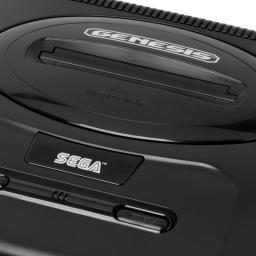
A gentleman in Moultrie, Georgia pawned his Sega Genesis console but was arrested later after the pawn shop employees found a stash of crystal meth in the console's cartridge slot.According to WALB, "There was no word on whether the Sega Genesis console was in working condition."
|
 |
by Cory Doctorow on (#PDZF)
The use of the term "accident" gives cops and courts the cover to excuse murder. In a brutal editorial, Hsi-Pei Liao talks about his daughter, who was killed by a driver when she was three. The driver got a ticket for failure to yeild and failure to use due care, and those tickets were eventually thrown out by a DMV judge who considered the case for 47 seconds. (more…)
|
 |
by Boing Boing's Store on (#PBGP)
Power up your gadgets in the most unexpected places with the extremely compact SolarJuice battery pack. SolarJuice charges up at home like your average battery pack, but also lets you add extra juice on-the-go using its built-in solar panel—so you’ll never be left unplugged from the digital world.4.5 Stars on Amazon!Simultaneously charges 2 devices at onceRain-resistant, shockproof & environmentally friendlyAnti-explosion, lightweight, compact & reliableIncludes a top grade-A cell, built-in 10000mAh lithium polymer batteryComprised of 2 total outputs: 2A fast-charging for mobile devices + 1A charging for smartphonesAllows casual solar charging via a powerful 1.2W monocrystalline solar panelBoasts an ultra-long battery life; recharge the SolarJuice 1000+ times Use in the dark w/ built-in LED flashlightGet The ZeroLemon SolarJuice 10000mAh Battery Pack From The Boing Boing Store
|
 |
by Jason Weisberger on (#PABD)
If ever there was a 'Missed Connection' that should be a Bogart and Bacall film, this one is it. (more…)
|
 |
by Cory Doctorow on (#P9HQ)
Normally, choosing to dress up for Hallowe'en as a sassy pop-culture meme means you're not going as a terrifying monstrosity from our cultural nightmares -- but with the Deep Dreaming costume, you can be both, with dogs! (more…)
|
 |
by Jason Weisberger on (#P9HS)
Two medical marijuana product companies are offering free weed to folks impacted by the catastrophic Valley fire. Recipients must present a valid medical marijuana prescription at one of 5 dispensaries in San Francisco, Santa Rosa, Sebastopol or Lake County. SFist shares:The giveaway has been going on since Thursday and runs through October 7, and the two companies, Care By Design and AbsoluteXtracts, will be giving out the products via five dispensaries in San Francisco, Santa Rosa, Sebastopol, and Lake County, according to a joint statement.
|
 |
by Cory Doctorow on (#P9FR)
In the 2015 Sense About Science lecture (MP3), Tracey Brown discusses the worst casualty of politicization of science, from fluoride to climate change -- the truth. (more…)
|
 |
by Cory Doctorow on (#P9EJ)
The Kindle Fire comes with a SDXC card slot that outclasses every other tablet in its price range, accommodating storage cards that can hold as much as 128GB of media -- but it won't read ebooks from the slot. (more…)
|
 |
by Cory Doctorow on (#P9DN)
IBM division Lexmark (which, a decade ago, lost a key copyright case that tried to ban ink-toner refilling) is headed to court in a patent case called Lexmark v. Impression, where it argues that patent law gives it the right to restrict your use of your property after you buy it. (more…)
|
 |
by Xeni Jardin on (#P96Q)
A booming biotech business in South Korea has new customers in America, because everyone wants to clone their dog. (more…)
|
 |
by Mark Frauenfelder on (#P90J)
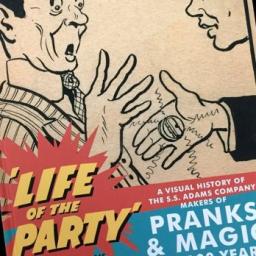
For over 100 years, the S.S. Adams Company of Neptune, New Jersey has been selling joy buzzers, sneezing powder, exploding cigars, fake vomit, extra salty salt water taffy, toy smoking monkeys, magic tricks, and hundreds of other inexpensive novelties loved by children and adults who act like children.The S.S. Adams company gave Life of the Party author Kirk Demarais unprecedented access to its archives of tricks, gags, and ephemera dating back to the company’s humble beginnings as a manufacturer of Cachoo sneezing powder. Samuel Sorenson Adams sold 150,000 bottles of the stuff at ten cents each. The FDA eventually banned the powder, which contained a toxic ingredient called dianisidine. Undaunted, Adams went on to invent over 700 other practical jokes (many of which were awarded patents). The photos of the many different magic tricks in Demarais’s book are the most appealing to me. Many of them are made from metal or wood and are beautiful and mysterious. I’m not a collector of anything, but I could become a collector of old magic tricks like this if I didn’t check myself. For now, I will content myself with this lavishly illustrated homage to a company that could only have thrived in an earlier century, when pleasures were simpler, and humor was broader.The foreword is written by Acme Novelty Library cartoonist Chris Ware.Life of the Party: A Visual History of the S.S. Adams Company, Makers of Pranks and Magic for 100 YearsBy Kirk Demarais S.S. Adams2006, 200 pages, 12.4 x 9.7 x 0.9 inches$30 Buy one on Amazon
|
 |
by Rob Beschizza on (#P8Z9)
Wired's Angela Watts reports on something that's been rather widely noted with respect to the forthcoming Matt Damon film "The Martian." It, contra to the usual outcome, is markedly better than the novel it's based on. (more…)
|
 |
by Cory Doctorow on (#P8XQ)
Kim Davis, the bigot who won't issue marriage licenses to same-sex couples, said she had a 15-minute audience with the Pope, who told her to stay strong. (more…)
|
 |
by Laura Hudson on (#P8D8)
The first time I finished The Beginner's Guide, the newest game by The Stanley Parable creator Davey Wreden, I felt furious and sick and sad. I shut my laptop and walked around the block at three in the morning, half in tears, trying to figure out what I could possibly say about this game. When I came home, I wrote over 2000 words about why the game never should have been made, and went to bed.When I woke up, I threw the whole thing out and wrote a totally new review, one that said the game was brilliant, that I loved it, that everyone should play it. That's the review you're reading now. It feels fitting. The Beginner's Guide is a game likes to make you question not just what it means, but whether you've been looking for meaning in games in the wrong way altogether.On its face, this is an autobiographical story about Wreden's relationship with a game developer identified only as "Coda," and the events that unfolded in their lives between 2008 and 2011. If you've never heard of Coda, don't feel bad: no one has. Wreden describes him as a very private, even reclusive developer he met at a game jam in Sacramento, a prolific creator who never posted his games online and shared them only cautiously—perhaps even exclusively—with Wreden.Although The Beginner's Guide revolves centrally around their friendship, you'll never see either of the men on screen. Instead, you learn about Coda the same way Wreden did: by playing his games. Each time you're dropped into one of Coda's small, strange world, Wreden takes you on a guided tour, narrating his interpretations of what the games mean and what they can tell us about the inner struggles of this enigmatic figure. https://youtu.be/RBK5Jheu0ToWreden is openly obsessed with Coda's work, which he explains by saying that they were a huge influence on his games, though that doesn't feel like the whole story. He suggests that there is a grand, unified theory behind all of them, and that only by looking at them as a whole can we really understand this vision—or the man behind it.This is a story about a game developer told by a game developer through games, so the mechanics of Coda's works matter a great deal. Indeed, at least some of what Wreden does is straight up game criticism, deconstructing the puzzles and labyrinths and long, lonely hallways—why they're designed the way they are, why they feel the way they do.In one game, you ascend a long, white staircase towards a door, but the nearer you get, the more you slow down until you're practically standing still. In another, you find yourself suddenly trapped in a prison cell, and have to wait an entire hour for it to open again. Wreden mercifully intercedes in these moments to modify the game in real-time and make it easier to navigate, observing this is "something we used to argue about a lot: whether a game ought to actually be playable." There's an unpleasant sense of emotional colonialism that sometimes permeates Wreden's analysis, a sense that Coda's games are neither as accessible or transparent as he would prefer—as though something owed has not quite been delivered. Yes, Coda made these games for himself, and if they seem unwelcoming or unplayable, it's probably because they weren't meant to be played—that they aren't for us. But we're playing them anyway, and when you're contemplating the idea of sitting in a digital cell for an actual hour, it's hard not to feel a little grateful that Wreden is willing to compromise Coda's artistic vision.It's your choice, of course: if you want to honor the intentions of Coda's games, you can always refuse Wreden's help and attempt things the hard way. Do the games mean more if you do? Does it mean anything at all if you do?One of the games in Wreden's tour of Coda's oeuvre, titled "This game is connected to the internet," supposedly allows online players to leave tiny messages scattered across the level in little bubbles for other people to find read. But—surprise!—the game isn't connected to the internet at all, and all the messages supposedly left by dozens of people were actually only written by one person: Coda.To Wreden, these messages represent a false or imagined community, and one that surely conveys a profound sense of loneliness: he sees them as a personal invitation of sorts from Coda, a way to know him better, and maybe a way for both of them to connect and feel less lonely.His narration cuts back and forth through each game like a knife through a layer cake, revealing what's happening mechanically, what he thinks Coda's trying to express, and what he believes this means about Coda as a person (and of course, about their friendship). While many of his analyses are very incisive, others arc towards the personal in ways that sometimes feel awfully presumptive.Wreden says several times that he got to know Coda better through his games than he did by actually talking to him, and indeed, that he might even prefer it that way. "This idea is really seductive to me," he says, "that I could just play someone's game and see the voices in their head and get to know them better, and have to do less of the messy in-person socializing."But exactly how much can you really tell about a person exclusively from the games or art they make? When is a puzzle a window into someone's soul, and when is just a puzzle—or at least a means of expressing something besides personal pathos?I've met a lot of creators over the years, and sometimes it's true: there are moments when their fears and anxieties and desires end up mapped pretty closely to their fictional characters and fantastical worlds. Sometimes, if you know them well enough, you can see the shapes of their intimate agonies moving beneath the sheets of their creations, the less-than-subtle reasons why that love interest suddenly betrayed the hero, or why this particular city melted down in a fictional nuclear holocaust. But it rarely works well in reverse. If you don't truly actually know someone, trying to reverse engineer a deep inner knowledge of their psyche simply by consuming their art is more akin to reading tea leaves than reading their diary. But we love to do it anyway, because it's a profoundly seductive idea: that every creative work could be a secret map into the heart and mind of someone you admire, if only you know how to read it right.Wreden describes growing frustrated, sometimes, when Coda won't tell him exactly what the games "mean." Over and over, he inserts himself into the space between Coda and his games as an interpretive conduit, believing that if only he can discern the hidden meaning behind these abstruse worlds, then perhaps he will finally understand his friend. As though a person were a puzzle; as though a person could be solved.It's difficult to tell at first exactly what The Beginner's Guide is supposed to be: a tribute, a eulogy, a motivational speech. Wreden says several times that Coda stopped making games in 2011 and that he hopes one day his old friend will create again. It's an impulse we see a lot on the internet these days, particularly in fan culture: the desire to write a paean so beautiful that it can bring the things we've lost back from the dead. And make no mistake, Wreden is Coda's number one fan. There are parts of this game that feel uncomfortably grasping, that want very badly to be a resurrection spell of sorts, though it takes a while to figure out exactly what has died—or why.There's more to say about the game, but I can't say it without venturing into major spoilers, so if you haven't played it yet, stop now.About halfway into our journey through Coda's games, they start to take a darker and more disturbing turn. Wreden decides that his friend is "in trouble," and that he needs to step in and "fix" the problem, but ends up committing a breach of trust so profound that Coda ends the friendship and cuts all ties. And thus we learn the "real" reason Wreden is making this game at all: He wants to reach out to Coda and ask him for forgiveness, even though he knows he's betraying Coda's wishes even more deeply by doing so. The first time I played the game, I felt ill, even angry after this revelation. It seemed like the game had made me unknowingly complicit in a huge violation of someone's privacy, one that I had no way of undoing. At the time, I was assuming—wrongly, I think—that the game told a true story, rather than a "true" one, that it depicted people and events in the real world rather than inventing characters plausible enough to make us suspend our disbelief.The second time through, however, it felt a little different. Rather than a story about the relationship between two game developers, The Beginner's Guide started to read more plausibly as a relationship between a game developer and their audience, and the dangers of projecting too much onto art and the people that create it. Rather than an estranged friend of Wreden, Coda serves as an elaborate metaphor for every game developer who has to contend with overinvested fans, while "Wreden" represents the players and critics who insist that games conform to their ideas about accessibility, endlessly demand answers about a "deeper meaning" that may not exist, or worse, insist that they and they alone can peer through the window a game supposedly offers into the developer's soul and discover the truth.It's hard to look too deeply at The Beginner's Guide for too long without feeling a little self-conscious, because it is built on the sand of semiotic contradictions, and designed to shift beneath your feet. It insists upon being read as a personal story but resists that conclusion; it is intended to provoke analysis and emotional responses, while simultaneously rebuking players for analyzing games too intensely or too personally.Maybe we're supposed to conclude that it doesn't matter, that by digging for the "truth" about Wreden and Coda as either players or critics, we transform ourselves into the same sort of point-missing voyeur "Wreden" reveals himself to be by the end. Or maybe we're supposed to conclude that saying too much about a game is a way of pinning down the butterfly of art with the needle of analysis, and that something is inevitably violated, or diminished, or lost when we do it.I'm still haunted by that initial feeling of complicity the game made me feel when I learned what was "really" going on, the sickening sense that I had violated someone very deeply by participating in someone else's misinterpretation of a game. Projecting your own ideas onto an artist and a creative work—or seeking answers from them—is depicted as a selfish act, a stifling act, even a destructive one.But as wrongheaded as it might be to assume that every story an artist tells is secretly the story of themselves, it's equally wrongheaded to assume that the best or only way for art to be understood is inside an echo chamber of its own voice. While it may or may not be interested in my analysis, The Beginner's Guide is a beautiful, thought-provoking and sometimes elusive piece of work, and one that I'm happy to recommend that people play—even though I'm well aware that it's more than capable of speaking for itself.
|
 |
by Cory Doctorow on (#P6MR)
My favorite sex toy review/sex ed/reproductive health webcomic has just released its second collection, with 328 pages' worth of comics by Erica Moen and her guest-comics-creators. (more…)
|
 |
by Rob Beschizza on (#P62E)
At least 13 are reported dead at Umpqua Community College in southern Oregon after a gunman began shooting at about 10:30 a.m. Thursday. (more…)
|
 |
by Cory Doctorow on (#P610)
China's hereditary oligarchy is in its second generation, and the fuerdai -- rich kids born to rich kids -- are a national symbol for corruption and excess, splashing social media with evidence of their debauchery. (more…)
|
 |
by Cory Doctorow on (#P5X5)
Content-based App Store takedowns aren't just for drone killing anymore: Apple's also removed the Ifixit App, which offers you third-party manuals for fixing things you own, including your Apple products. (more…)
|
 |
by David Pescovitz on (#P5V9)
In 1986, the year before his death, Andy Warhol painted a portrait of Barbie in the style of his famous paintings of Elvis, Marilyn Monroe, and so many other celebrities. But in Warhol's mind, it wasn't a painting of the doll but rather his dear friend BillyBoy*, a 23-year-old jewelry designer who had a collection of tens of thousands of Barbies. For an art exhibit, BillyBoy*'s dolls were dressed by famous fashion designers and he also designed two dolls for Mattel, "Le Nouveau Theatre De La Mode" and "Feelin' Groovy Barbie." Warhol had asked to paint a portrait of BillyBoy*, who always declined, until one day he said, "Well if you really want to do my portrait, do a portrait of Barbie because Barbie, c'est moi." So Warhol did.Last year, BillyBoy* sold his Barbie portrait at Christie's for more than $1 million. He's also turned his back on Barbie."I think Barbie is no longer touching on the zeitgeist of the moment," he told the BBC News. "If I had a daughter I would not give her Barbie dolls. I wouldn't want my child to be constantly obsessed with getting something, and that immense preoccupation with high-heeled shoes and clothes."
|
 |
by Cory Doctorow on (#P5TS)
The annual "Sex, work and tech" show comes back to San Francisco, Oct 2-4, at the Center for Sex and Culture, featuring "talks, performances, games, workshops, machines and systems." (more…)
|
 |
by David Pescovitz on (#P5G9)
As part of California Sunday's "The Thread" series, I asked comedian/actress Margaret Cho and punk pioneer Bob Mould, who are old pals, to have an email conversation about whatever's on their mind. They talked about the changing face of San Francisco, marriage equality, and THC sex lube! From California Sunday:From: Margaret ChoTo: Bob MouldHi Bob! Spending every major holiday together at the end of last year made me think that we’d continue into 2015 — but I realize I haven’t seen you at all! Let’s see, we did Thanksgiving and Christmas at your beautiful home in San Francisco — both occasions where I ate far more than I ever intended — then a fabulous New Year’s Eve show together in Chicago. It’s said that whatever you do on New Year’s Eve is what you’ll do for the entire year, and so I just assumed my year would include you, but it hasn’t!I must say, I spent much more time with you in 2014, when our friend Jim Short made an animated film of Fred Armisen and me doing our best Bob Mould impressions and you giving your impressions of our impressions — and when we played “See a Little Light†in front of the Larkin Street Youth Center as part of my homeless outreach project #berobin, which celebrated Robin Williams, his philanthropy, and his love of street performance.I didn’t see you in 2015, but I did see your band, Jason Narducy and Jon Wurster, whom I brazenly stole to back me for my new Showtime special, psyCHO. I had such an electric time performing with them at your tribute show at the Disney Concert Hall. Wasn’t that a crazy night?!!! All of us doing your songbook — Dave Grohl, Ryan Adams, The Hold Steady, No Age, and Britt Daniel — and I don’t know if you knew, but Neil Hamburger was also there to offer me emotional counsel because I was far too excited to sing “Your Favorite Thing†with Jason, Jon, and Grant-Lee Phillips.It’s the right song because you are my favorite rock star!I hope everything is amazing, and I’d love to do Thanksgiving and Christmas again, but I’ll be on tour myself, all over the place — Honolulu to Warsaw! Perhaps New Year’s Eve?????From: Bob MouldTo: Margaret ChoMargaret! It’s been a while since we’ve been able to hang out! Yes, we certainly spent much more time together in 2014. I have the fondest memories of our holiday get-togethers. Christmas was a riot — many of my friends who were there still regale me with the stories you told. The most popular one was about a sensual lubricant that might have contained THC? I don’t think I was in the room when the story started, but I walked in for the end of it, which had something to do with analgesic qualities. I was also happy when you were reunited with an old friend (a new acquaintance of mine via my next-door neighbor). I guess that’s the way San Francisco used to be (and apparently still can be) — those random reunions that can’t be planned.You and I have waxed nostalgic about “old†San Francisco, especially the punk rock days of the ’80s. I remember my first trip there in July/August 1981. I was a wild punk rock kid from Minnesota, touring around North America in a pimped-out van my late father drove out to me from my childhood home in northern New York State. My bandmates in Hüsker Dü and I spent two weeks camped out at Jello Biafra’s spacious apartment near Dolores Park. We lived on Biafra’s generosity and on food stamps that bought us lots of generic items at the Safeway on Market.Fast-forward 34 years and things are so different in San Francisco. That van would look so out of place next to the gigantic, gleaming tech buses that pick up hordes of newly arrived tech workers in front of the Whole Foods that’s now across the street from that Safeway (which has actually been remodeled and feels a little suburban). All the clubs of that era (Mabuhay, Valencia Tool & Die, The Vats!!!) are long gone. You were there — what do you remember about those days? And what do you think of the incredible changes that are happening across the city?The Thread: Bob Mould and Margaret Cho
|
 |
by Rob Beschizza on (#P5EY)
A big-rig containing millions of bees overturned on the highway, and the swarm promptly attached itself to the first responders. The officers decided to remain in their vehicles for the time being, according to reports. [KTLA via Arbroath]
|
 |
by Mark Frauenfelder on (#P5F0)
The leader of this protest group walked into a restaurant somewhere in the US and asked the hapless restaurant hostess why "dog meat" wasn't on the menu. The flustered hostess didn't have an answer for her. The protestor then walked into the middle of the dining area and yelled to get the patrons' attention. (more…)
|
 |
by Cory Doctorow on (#P5A3)
Companies like GM have engineered their cars so that it's a felony to make independent diagnostic tools for them, or to investigate the official diagnostic tools rented to mechanics in exchange for a promise to only buy GM's hyper-inflated replacement parts. (more…)
|
 |
by Cory Doctorow on (#P58P)
djBC writes, "Atlanta nerdcore rapper Tribe One teams up with producer and mashup artist dj BC for this Ghostbusters-inspired rap joint. The video was shot at Bootie Dragon Con and on location at an abandoned farm on the outskirts of Atlanta, and stars members of the Atlanta Ghostbusters cosplay group. If you want to add the song to your Halloween playlist, it's free to download."
|
 |
by Cory Doctorow on (#P57J)
The Canadian-as-maple-pie band's Stealin' All My Dreams is a catalog of all the horrors of the Harper regime, from stifling scientists to strip-mining the CBC to doubling down on tar-sand oil. The October elections are upon us, Canadians: get out there and vote, for those of us who've had our votes stolen by the Tories. (Thanks, David!)
|
 |
by Rob Beschizza on (#P554)
I love reading about all the drugs Hitler was on and the implication that his insane medical treatments made him even crazier and nastier than he otherwise was. Andrea Maurer takes a deep dive into the "High Hitler" story and finds it to be even more disturbing than popularly understood. (more…)
|
 |
by Cory Doctorow on (#P53Q)
Since the crisis, the number of people renting in the UK has sharply increased, but the number of landlords has decreased, as a smaller and smaller number of richer and richer people control the destiny of more and more Britons. (more…)
|
 |
by Rob Beschizza on (#P53S)
"Is your father a terrorist? Because you are the bomb."Guys, just stop. Stop. [via Digg]
|
 |
by Cory Doctorow on (#P50K)
John Hodgman's old New York Times advice column -- which transmogrified into a brilliant podcast -- has been restored to its original home, where it provides much-needed color in the Grey Lady's pages. (more…)
|
 |
by Xeni Jardin on (#P2BN)
The Intercept just published an amazing article by Jim Bamford yesterday talking about how the NSA exploited a backdoor in Vodafone to spy on Greek politicians and journalists during the 2004 Olympics. Bamford is an American author and journalist best known for his writing about United States intelligence agencies, and in particular the National Security Agency.In a meticulous investigation, Bamford reports at the Intercept that the NSA was behind the notorious, legendary “Athens Affairâ€. After the 2004 Olympics, the Greek government discovered that an unknown attacker had hacked into Vodafone’s “lawful intercept†system, the phone company’s method of wiretapping voice calls. The attacker spied on phone calls of the president and other Greek politicians and journalists before the hack was found out.Freedom of the Press Foundation director Trevor Timm wrote for the Guardian about why this is exactly why encryption backdoors are so dangerous. What are encryption backdoors? For non-techie readers, basically these are ways the government can unencrypt your "locked" communications if they decide they want to see your private material for any secret reason. And in related news, rumor has it the White House is nearing a decision on whether to embrace the right to encryption for American citizens, or join the FBI in calling for backdoors. Dozens of civil liberties groups, including Freedom of the Press Foundation, launched this site and petition today that feeds into the White House petition system: savecrypto.org. If you care about this issue, right now is the time to take action.
|
 |
by David Pescovitz on (#P27S)
Depending on whether your sound is on or off, this fellow is either painfully enduring or tremendously enjoying high G-force training. (YouTube)
|
 |
by Jason Weisberger on (#P200)
There is a fantastic thread running on Genii about Boing Boing's enthusiasm for magic! Internet forums are the source of all truth! Genii is an awesome resource for magicians, new and old, and the participants in their forums are incredibly well versed. The conversation they've had, minus the obligatory mention of German National-Socialist leadership, is fantastic and we are paying attention!They also have a ton of amazing tricks and secrets revealed in the forums. I don't think you need to log in. I like my dancing cane post.
|
 |
by Richard Kaufman on (#P1ZG)
Yeah, you’ve heard of Disneyland (that’s the one in California) and you were probably dragged to Walt Disney World (that’s the one in Florida) when you were a kid. And, possibly, if you give a rat’s patootie about Disney theme parks, you might have heard they have them in other countries, but you’ve probably never heard of Tokyo DisneySea. “TDS,†as the Japanese call it, is what is known as a Disney resort’s “second gate.†If you’re a WDW person, then Epcot is the second gate; if you’re a DL person, then Disney California Adventure is the second gate.In 2001, when The Walt Disney Company built Disney California Adventure, it spent one billion bucks for the park, the Grand Californian Hotel, and Downtown Disney. The same year, when The Oriental Land Company (who owns the Tokyo Disney Resort—The Walt Disney Company receives a royalty and percentage) built Tokyo DineySea, it spent three billion dollars just for the park. The Imagineers who conceive all this amazing stuff for Disney, most of which rarely gets built, got the chance to see their best creations realized. I could write a book about Tokyo DisneySea, but here are just 15 really cool things.1. Drinking a Kirin Frozen Draft while standing beside the Nautilus. Yes, they serve Japanese beer with a frozen “head†right next to Captain Nemo’s killer sub. Nice when it’s 85 degrees and 90% humidity.2. A quiet street in a small Italian town … except it’s really in a theme park near Tokyo. 3. Toy? No: real, and called Mermaid Lagoon.While it seems pretty small above ground (with only two rides on the outside), it’s really an entire amusement park—King Triton’s Kingdom—built “under the sea,†so to speak.You descend and discover three more rides, an amazing playground, a splash fountain, a huge theater, a restaurant, and several shops.4. They have six different flavors of popcorn including milk chocolate, soda, and curry. The line to purchase is often 20 minutes long. The Japanese really love popcorn and the limited edition seasonal plastic buckets in which it’s sold.5. You can wear really stupid things and nobody cares.6. The belly-dancing robots in Sinbad’s Storybook Voyage.7. Jose Carioca is there. Saludos Amigos!8. Get into one of these iron thingies designed by Captain Nemo…Descend 20,000 Leagues Under the Sea and piss off a giant squid…Zap him with an electric charge…Lose energy and go where no non-themepark person has gone before…Meet a really strange deep-sea being whose buddies push you back up to the surface (8E)9. Amazingly, these futuristic boats were designed and built from scratch just to provide decoration and atmosphere—that’s all.10. People eat all sorts of weird shit. This is a Halloween-themed Cruella deVille giant gyoza dog. Ten points if you know what that means.11. At the foot of Mount Prometheus, which blows its top every hour and shoots huge balls of flame into the sky, is Fortress Exploration. Dedicated to the Society of Explorers and Adventurers (DisneySEA, for you fans of acronyms), this enormous area contains recreations of famous scientific experiments including a huge Foucault’s Pendulum, Camera Obscura, Anamorphic Painted Room, and a full-size recreation of Leonardo DaVinci’s famous Flying Machine. And they give out maps (in multiple languages) for free so you can find your way between the turrets.12. They sell pumpkin churros at Halloween. Double yum.13. The majestic Hightower Hotel, aka The Tower of Terror, known to cause adults to soil themselves. Built by the bastard robber baron Harrison Hightower, whose collecting of antiquities from around the world included stealing an idol from an African tribe.This is Shiriki Utundu, who killed Harrison Hightower 100 years ago by throwing him down an elevator shaft … and now he’s going to do the same thing to you.14. You want strange frozen confections, you’ve got your choice.15. There’s a goddam ocean liner moored in the park! The S.S. Columbia looks full size, but is scaled slightly down and is actually not a ship but a building. It contains a lounge, fancy restaurant, an attraction (with room for a second in the future), and a show with dancing desserts is performed dockside four times daily. You really need to visit Tokyo for many wonderful reasons: Tokyo DisneySea and Tokyo Disneyland are merely two. The official website, conveniently in English.
|
by Cory Doctorow on (#P1W5)
The Prime Minister of Iceland offered to take in 50 Syrian refugees; 10,000 of his countrymen responded to this announcement by offering their homes to house Syrians fleeing horrific violence and danger. (more…)