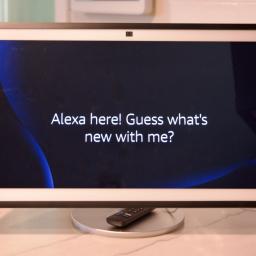
Image: Humane Humane, which makes the not-great AI Pin, wants other companies to build AI devices and gadgets that use its CosmOS operating system, and it has released a video that appears to show that the company already has it working in a car, TV, smart speaker, and phone.But note that the video, according to Humane's own fine print, is for illustrative purposes only" - it shows working prototypes" and some simulated experiences," and the print says that all designs, features, and specifications" are subject to change. So don't take it entirely at face value.In one example, the video shows a person talking to CosmOS in their car (with a blurred out logo on the steering wheel) to turn the heat up at their house and figure out what time people are coming over. They ask their (blurred out) smart speaker about a guacamole recipe, and their TV about how many goals a soccer player onscreen has scored. The video also shows CosmOS reading an email on the person's phone and responding to a question about whether the person can attend a meeting.If you've been following recent AI hype, especially around agents, none of these examples should feel particularly novel - Humane wants to demonstrate that CosmOS is capable of powerful agent-like capabilities, and for companies to consider it as a possible backbone for their devices. But the items in this video aren't Humane's own products, and Humane clearly isn't promising to make them. It's building an SDK for others to do so.That CosmOS SDK isn't available publicly yet - the company's website only says that it's coming soon," though you can click a button to sign up to build with us," which takes you to a form to fill out. Humane doesn't mention any partners building devices that rely on CosmOS - the blurred-out logos on the car and smart speaker suggest the company may have not gotten that far yet. We've asked Humane if it can share any examples.Humane may be looking for a new line of business after the AI Pin flopped; we reported in August that daily returns of the device were outpacing sales. The product initially launched in April, but the company dropped the price of the Pin just six months later. Earlier this year, Humane was reportedly looking for a buyer, with HP at one point being a contender.
Jeff Bezos. | Laura Normand / The Verge Jeff Bezos and President-elect Donald Trump famously didn't get along the last time Trump was in the White House. This time, Bezos says he's very optimistic" and even wants to help out.I'm actually very optimistic this time around," Bezos said of Trump during a rare public appearance at The New York Times DealBook Summit on Wednesday. He seems to have a lot of energy around reducing regulation. If I can help him do that, I'm going to help him."Trump railed against Bezos and his companies - Amazon, Blue Origin, and The Washington Post - during his 2016 term. Bezos defended himself but it did little to help his reputation with Trump. Now, his companies have a lot at stake in the coming administration, from the FTC's antitrust lawsuit against Amazon to Blue Origin's efforts to compete with SpaceX for government contracts.Onstage at the DealBook Summit on Wednesday, Bezos called Trump calmer this time" and more settled." He said he will try to talk him out of" the idea that the press, which includes The Washington Post, is an enemy of the people.You've probably grown in the last eight years," he said to DealBook's Andrew Ross Sorkin. He has, too."Bezos also echoed Sam... Read the full story at The Verge.
Image: Cath Virginia / The Verge; Getty Images US officials are urging Americans to make calls and send text messages over encrypted apps to minimize the risk of private information falling into the hands of foreign adversaries who might still be lurking in America's telecommunications networks, NBC News reports.Two officials from the Federal Bureau of Investigation (FBI) and the Cybersecurity and Infrastructure Security Agency (CISA) spoke with news outlets, including NBC News, Tuesday on the lasting effects of a recent attack on US telecommunications systems. The attack, which was tied to Chinese hacking group Salt Typhoon, impacted companies including AT&T, Verizon, T-Mobile and Lumen Technologies, The Wall Street Journal first reported in October. The Journal later reported that targets of the hack included phone numbers for people in the Donald Trump and Kamala Harris campaigns.Two months after the initial report of the hack, malicious actors may still be able to gain access to sensitive information about Americans' communications from the telecom networks.An FBI official on the call, who was not identified in press reports, reportedly said hackers accessed information including call records showing phone numbers called and the times of the call, and in some cases actual live phone calls of certain targets. The Journal reported last month that hackers could have gained access to unencrypted texts as well.Jeff Greene, executive assistant director for cybersecurity at CISA, told reporters on the call that the scale of the hack was so great that agencies could not possibly predict when there would be a full eviction" of malicious material, NBC News writes.Encryption is your friend, whether it's on text messaging or if you have the capacity to use encrypted voice communication," Greene said, according to NBC News. Even if the adversary is able to intercept the data, if it is encrypted, it will make it impossible." Services like Signal and WhatsApp offer end-to-end encrypted messaging that can obscure communications outside of the users involved in the call or text.Law enforcement's embrace of encrypted apps is particularly notable given that the FBI has previously railed against tech companies' protectiveness over the technology. Though the FBI publicly says it does not oppose encryption, it has strict parameters on its support. The agency's website states that it does not want encryption to be weakened or compromised so that it can be defeated by malicious actors," but wants companies that manage encrypted data to be able to decrypt that data and provide it to law enforcement only in response to U.S. legal process." That's something tech companies say could undermine the whole system.The bureau engaged in a long standoff with Apple following a shooting in San Bernadino, California in 2015, because the company refused to break the encryption on the shooter's iPhone to give investigators access, warning that to do so would endanger users' privacy across its products. The FBI eventually found a way to get into the phone without Apple.
Illustration: The Verge OpenAI, the AI model maker that used to describe its mission as saving the world, is partnering with Anduril, a military contractor, the two companies announced Wednesday.As part of the partnership, OpenAI will integrate its software into Anduril's counterdrone systems, which detect and take down drones. It's OpenAI's first partnership with a defense contractor - and a significant reversal of its earlier stance towards the military. OpenAI's terms of service once banned military and warfare" use of its technology, but it softened its position on military use earlier this year, changing its terms of service in January to remove the proscription.OpenAI builds AI to benefit as many people as possible, and supports U.S.-led efforts to ensure the technology upholds democratic values," OpenAI CEO Sam Altman said in a statement. Our partnership with Anduril will help ensure OpenAI technology protects U.S. military personnel, and will help the national security community understand and responsibly use this technology to keep our citizens safe and free."As the Wall Street Journal notes, Anduril - currently valued at $14 billion - has a $200 million counterdrone systems contract with the Marine Corps. But OpenAI won't just benefit financially from its Anduril partnership; it also stands to gain political clout. Anduril co-founder Palmer Luckey was an early supporter of president-elect Donald Trump, and also has ties to Elon Musk, one of the heads of the still-nebulous (and still nonexistent) Department of Government Efficiency. And the America First Policy Institute, a right-wing think-tank working closely with the Trump transition team, has proposed that Trump embrace AI to create a new Manhattan Project" for defense.
The fee creep is back. | Image: Cath Virginia / The Verge Verizon customers will soon see yet another fee increase on their next bill, a game that wireless carriers love to play. As spotted by Android Police, Verizon customers on reddit noticed the small fee bump - just 20 cents extra per line. But it comes only a couple of years after a bigger increase to the Administrative and Telco Recovery Charge" the company tacks onto monthly bills, and Verizon's claim that it's just the cost of doing business seems dubious at best.Verizon spokesperson George Koroneos confirmed the fee hike to The Verge, saying that Starting December 18, the monthly Verizon wireless Administrative and Telco Recovery Charge will increase by $0.20 per line for mobile voice (basic phones, Second Number, smartphones, etc.) and data-only (hotspots, tablets, etc.) products. Verizon Home Internet services are not affected." That takes the fee from $3.30 to $3.50 for each voice line on a plan and $1.40 up to $1.60 per data line.According to a Verizon support page, the fee helps defray and recover certain direct and indirect costs we or our agents incur," including network operating and maintenance costs. AT&T and T-Mobile have slightly different names for the same fee, and all make basically the same claim about offsetting the costs of running a wireless network.A more cynical perspective is that these wireless companies separate this fee from their monthly rate plan charges so they can raise rates without saying they're raising rates. That was the basis for a class-action lawsuit against AT&T in 2022, which that company agreed to settle.It may just be 20 cents now, but that small increase adds up to a lot when you multiply it across millions of users. After all, Verizon only made $3.4 billion in net income the third quarter this year, down from $4.9 billion in the same quarter last year. And while the fee creep is nothing new, it's yet another reminder of of the levers these companies can pull in order to pad out their bottom line.
The Strength Plus app isn't Peloton's first attempt at capitalizing on strength training. | Illustration by Alex Castro / The Verge Peloton announced the launch of Strength Plus, a new standalone, audio-based strength training app. The app was introduced in a limited beta program earlier in September, but is now officially available.The Strength Plus app allows users to generate custom workouts by choosing workout length, equipment, experience level, and which muscle groups they want to focus on. It also includes multi-week programs curated by Peloton's strength coaches, though workouts can be done at a user's own pace. Strength Plus includes audio cues and tips from instructors, as well as a library of instructional videos demonstrating exercises and equipment setup. It's more like a strength training playlist than Peloton's typical classes, which have you follow an instructor as they do the workout in real time. It works with the Apple Watch and users can log weights and reps within the app. And, instead of being stuck with instructor-curated workout music, users can listen to their own music, audio books, or podcasts.This move isn't surprising. Over the years, Peloton has repeatedly mentioned that strength training is its second most popular exercise type, though the company has had mixed success in capitalizing on it. In 2022, Peloton launched its own Guide strength training hardware, but it hasn't taken off like its treadmills or bikes. When it revamped the Peloton app, it also added Peloton Gym workouts that catered to gym-goers with written workouts and video demos, though that wasn't its own app, didn't let you log reps, and didn't include multi-week programming. Image: Peloton Peloton really wants to make strength training work. On paper, Strength Plus looks similar to other apps, most notably Ladder. (So much so, that Ladder has already clapped back with an entire Mac vs PC-style ad campaign.) The main difference is that Strength Plus leverages Peloton's more widely known instructors. More broadly, this could be seen as an attempt to expand Peloton's appeal outside the home - something the company has struggled to do after many people began returning to in-person gyms and classes once covid-19 lockdowns were lifted.Existing Peloton All Access, Guide, and App Plus members can access the Strength Plus app for free. For everyone else, Peloton is offering a limited $1 monthly promotional subscription for the first six months, and then $9.99 monthly after. For now, the app will also be iOS only. The Verge asked Peloton whether it plans to expand further to Android, but didn't immediately receive a response.
Illustration by Alex Castro / The Verge If you keep your passwords stored on Apple's iCloud, you can access those passwords on Firefox through an official iCloud Passwords extension, as spotted by MacRumors. However, the extension only supports macOS Sonoma or later, so you won't be able to use it with Windows.If you do need to access your iCloud passwords on Windows, you can access them by downloading iCloud for Windows and the iCloud Passwords extension for Chrome or Edge instead. We've asked Apple if it plans to add support for Windows to its Firefox extension.Another developer originally made the Firefox extension, but Apple has taken it over, according to a notice on the extension's GitHub page. Apple is now the sole owners in charge of maintaining their own official iCloud Passwords extension," the developer says. The extension's repository and source code aren't linked to it anymore except for historical reasons."
I'm sorry, I put that thing in what? | Image: Nissan Nissan put out a tutorial video for Ariya owners today that shows how to use a Tesla NACS adapter with the vehicle, and it includes a step completely out of left field: shove a small piece of plastic into your car's CCS port before you connect the adapter.The Ariya is Nissan's first EV with a CCS port, and the automaker just activated the vehicle's ability to connect to Tesla's vast Supercharger network in October. Other manufacturers have also adopted Tesla's NACS standard, with companies like Ford and Rivian already shipping adapters to current EV owners. But none of those EVs need you to take a confusing extra step to make the adapter work.As explained in the video, the NACS adapter available through Nissan includes a plug adapter" that must be installed into the hourglass-shaped cavity between the two DC pins at the bottom before charging at NACS-capable fast charging stations. Nissan assures the viewer that its simple" and requires no tools. However, you will need to use the adapter it provides or from a US dealership, which may mean other third-party options like the Lectron adapter might not work. (Probably for the best, considering the Lectron adapter was recently recalled.)What's odd about the Ariya's charge port is that despite being a standard that works at many CCS-capable fast charging stations, there is some negative hollow space between the two direct current pins at the bottom that isn't present on most other EVs. The plastic piece that Nissan wants you to stuff into the opening fills in the gap to look more like other CCS ports. We asked Nissan what the purpose of the opening is and why the insert is needed, but have not heard back at time of publication.Nissan's other EV model is the pioneering Leaf, which uses the all-but-obsolete CHAdeMO standard and probably won't get some magic adapter to connect to Tesla's Supercharger network (although there are some CHAdeMO to CCS adapters now).EV ownership is already rife with competing standards, janky software, and fragmented confusion. Somehow, Nissan managed to add another step that leaves customers juggling multiple pieces of plastic just to get their $40,000 electric SUV to operate properly.
Image: Laura Normand / The Verge President-elect Donald Trump made two nominations Wednesday that will shape significant parts of his administration's tech enforcement, if confirmed by the Senate.Former Republican Securities and Exchange Commissioner Paul Atkins is Trump's pick to lead the agency, replacing Biden-appointed chair and crypto foil Gary Gensler. The selection of Atkins, who co-chairs the Token Alliance at the Digital Chamber, a group dedicated to the use of digital assets, suggests a sharp divergence from Biden-era crypto policy. In his announcement, Trump says Atkins recognizes that digital assets & other innovations are crucial to Making America Greater than Ever Before."Trump also selected Gail Slater to lead the Department of Justice's Antitrust Division, which is currently litigating two anti-monopoly suits against Google, and a third against Apple, as well as reportedly probing AI-chipmaker Nvidia. Slater has previously worked at the Federal Trade Commission, in Trump's National Economic Counsel, and most recently as Vice President-elect JD Vance's economic policy advisor in his Senate office. She's also worked at Fox, Roku, and the now-defunct Internet Association, whose member included several Big Tech companies.Trump is borrowing a favorite term of Marc Andreessen's in with his reference to Little Tech"In his announcement on Truth Social, Trump writes that, Big Tech has run wild for years, stifling competition in our most innovative sector and, as we all know, using its market power to crack down on the rights of so many Americans, as well as those of Little Tech!" Trump is borrowing a favorite term of Marc Andreessen's in with his reference to Little Tech." Andreessen - a venture capitalist and crypto supporter who publicly backed Trump in the election - has pushed for the recognition of a contrast between policies that benefit startups versus the largest tech players.Slater has historically worked across the aisle, having served as an attorney advisor to former Democratic FTC Commissioner Julie Brill (who now works as Microsoft's chief privacy officer). Her history working for Vance - who has publicly praised Biden's FTC Chair Lina Khan for her aggressive approach toward tech - suggests Big Tech is likely to remain a key target of antitrust scrutiny in the years to come.
Image: Cath Virginia / The Verge; Getty Images Nearly two years ago, OpenAI said that artificial general intelligence, or AGI - the thing the company was created to build - could elevate humanity" and give everyone incredible new capabilities."Now, OpenAI CEO Sam Altman is trying to lower expectations.My guess is we will hit AGI sooner than most people in the world think and it will matter much less," he said during an interview with Andrew Ross Sorkin at The New York Times DealBook Summit on Wednesday. And a lot of the safety concerns that we and others expressed actually don't come at the AGI moment. AGI can get built, the world mostly goes on in mostly the same way, things grow faster, but then there is a long continuation from what we call AGI to what we call superintelligence."This isn't the first time Altman has downplayed the now seemingly imminent arrival of AGI, which OpenAI's charter once said will be able to automate the great majority of intellectual labor." He has recently teased that it could arrive as soon as 2025 and will be achievable on existing hardware. We at The Verge have heard that OpenAI intends to weave together its large language models and declare that to be AGI.At the DealBook Summit,... Read the full story at The Verge.
Illustration: The Verge You can now follow fediverse accounts on Threads, Meta CEO Mark Zuckerberg has announced. Threads rolled out fediverse users' likes and replies in a very limited way at first, and it's the same here - fediverse posts won't appear in your feeds, and you can only follow those accounts if they've interacted with a post on Threads.While fediverse posts won't show in feeds, Instagram head Adam Mosseri says their profile and posts do appear on Threads, and you have the option to get notifications when they publish. That's something, at least. Mosseri posted a video of what the process looks like:Zuckerberg says you can follow fediverse accounts when you see they've liked, followed, or replied" to a federated Threads profile, but there's one other way you might find them.On web and android today (and iOS soon), we'll start linkifying Fediverse usernames in posts," wrote Threads developer Peter Cottle among a series of posts about the new integration. Cottle added that your account will need to be federated and that the fediverse account must be eligible to be followed."Cottle also demonstrated that you can tag fediverse accounts, linking to Star Trek actor and activist George Takei's Mastodon account:Meta's Seine Kim tells The Verge in an email that the platform's goal remains to grow the fediverse responsibly, prioritizing the success of a safe, diverse, content-rich, and interoperable community." Kim added that the change is another step in Threads' plan to become fully interoperable with the fediverse in time.Notably though, new Threads features have picked up the pace in recent weeks. Maybe that's got something to do with all the attention Bluesky's been getting lately?
A new Nothing Community Widgets app has launched with a Snake game as its first offering. | Image: Nothing Nothing has released a new Android app called Nothing Community Widgets that will highlight home screen tools and games co-created by its users. The first widget it includes is a recreation of Snake which was the most memorable of the three games pre-installed on the Nokia 6110 when it launched 26 years ago.Although the original game was played by pressing buttons as cellphones lacked touchscreens, the snake in Nothing's version is steered using directional screen swipes, while a double tap pauses the action, according to Retro Dodo. But the gameplay is the same, with players scoring points by eating red dots while trying to avoid colliding with themselves as the snake grows longer and longer.
Photo by PATRICK T. FALLON/AFP via Getty Images President-Elect Donald Trump has nominated billionaire Jared Isaacman to head up NASA, he announced on Wednesday. Isaacman funded and partook in the Polaris Dawn mission, in which he and SpaceX engineer Sarah Gillis performed the first commercial spacewalk.Isaacman is set to replace former Florida Senator Bill Nelson as NASA Administrator, who President Joe Biden tapped to lead the agency when voted into office. Aside from Polaris Dawn, Isaacman also funded Inspiration 4, a mission that took him and three other non-professional astronauts to space atop SpaceX's Falcon 9 rocket in 2021.Most of Isaacman's fortune comes from Shift4, the payment-processing business he founded when he was 16. He still serves as CEO of the company, which recently acquired the Canadian gift card platform Givex and struck a payments deal with Elon Musk's Starlink in 2021.
Image: EA Dragon Age: The Veilguard has an incredible character creator, and starting today, you can mess around with it without having to buy the full game. EA will be releasing a free, standalone version of the character creator for all platforms the game is available on (PS5, Xbox Series X / S, and PC), and you'll be able to bring the character you make in the free creator over to the full game if you decide to buy it.If you have any interest at all in The Veilguard, I really recommend checking out the free character creator when it's available and seeing all of the options. (Hair looks particularly good.) And if you end up making a character, transfer them to the game, and want to make some tweaks, you'll be able to do so early on in your adventure, so don't sweat your decisions too much.EA is also releasing a fourth patch for the game, which adds a mission that will reward you with in-game items themed around the Dragon Age II protagonist, Hawke.
Illustration by Alex Castro / The Verge Amazon quietly carved out two Washington, DC zip codes from being serviced by its fastest Prime delivery service with its own branded trucks, outsourcing deliveries to slower services like UPS and the Postal Service, DC Attorney General Brian Schwalb alleges in a new lawsuit.The alleged decision led to about 48,000 Prime members living in two zip codes east of the Anacostia River receiving fewer benefits than they were actually paying for (at $14.99 a month or $139 a year), according to Schwalb. The neighborhoods that were allegedly affected include majority-Black and low-income areas. But even when customers noticed and complained about the slower delivery times, the AG alleges, Amazon misled the consumers to believe it was a coincidence."Amazon spokesperson Kelly Nantel tells The Verge in a statement that Amazon changed how it serviced the zip codes cited in the lawsuit due to specific and targeted acts against drivers delivering Amazon packages" in those areas. We made the deliberate choice to adjust our operations, including delivery routes and times, for the sole reason of protecting the safety of drivers." Nantel calls the AG's claims categorically false" and says Amazon is always transparent with customers during the shopping journey and checkout process about when, exactly, they can expect their orders to arrive."But while Amazon has the right to protect its workers through these changes, Schwalb says it can't deceive customers while doing so. Amazon is charging tens of thousands of hard-working Ward 7 and 8 residents for an expedited delivery service it promises but does not provide. While Amazon has every right to make operational changes, it cannot covertly decide that a dollar in one ZIP code is worth less than a dollar in another," he says in a statement.Schwalb is suing under DC's consumer protection law. He's seeking to stop Amazon from continuing its allegedly deceptive behavior and collect an unspecified amount of civil penalties, restitution, and damages.
Image: Cath Virginia / The Verge Meta is turning to nuclear energy to power its AI ambitions with the release a request for proposals to partner with nuclear energy developers.It's the latest announcement in a string of recent deals Big Tech companies have made to secure nuclear energy for their data centers. Developing new AI tools is an energy-intensive endeavor that risks derailing Silicon Valley's sustainability goals unless it can find less polluting sources of electricity. Meta now joins Amazon, Microsoft, and Google in efforts to get more nuclear reactors up and running.Meta now joins Amazon, Microsoft, and Google in efforts to get more nuclear reactors up and runningThat's much easier said than done. The first all-new nuclear reactor to be built in the US in decades started running in 2023 - seven years overdue and $17 billion over budget. Developers are now designing next-generation technology called small modular reactors (SMRs) that are supposed to make it easier to build and site a project, ostensibly cutting down costs. Those advanced reactors aren't expected to become commercially viable until the 2030s.Meta says it's interested in both SMRs and larger reactors, and is searching for partners... Read the full story at The Verge.
Sunrise/Khara There's a new Mobile Suit Gundam show right around the corner, and while Bandai hasn't revealed much about its story, its production studio and creative team bode very good things for the project.Sunrise has collaborated with Khara, the Hideaki Anno-founded studio behind the Rebuild of Evangelion films, to produce Mobile Suit Gundam GQuuuuuuX, a new series co-written by Anno and Yji Enokido, and directed by Kazyua Tsurumaki.Set in a reality where humanity has taken to living in massive space colonies, GQuuuuuuX follows as highschooler Yuzuriha Machu" Amate (Tomoyo Kurosaw) and courier Nyaan (Yui Ishikawa) are drawn into the world of underground mech fights called Clan Battles. A new trailer for the series teases how, after meeting Gundam pilot Shuji Ito (Shimba Tsuchiya), Machu learns to co-pilot the gMS- GQuuuuuuX. Designer Take's (best known for her work on the Pokemon franchise) distinctive style shines through in the trailer's shots of the show's human characters, and mechanical designer Ikuto Yamashita's take on the classic Gundam aesthetic feels fresh.Though Mobile Suit Gundam GQuuuuuuX is set to air on Nippon Television in the new year, the series does not yet have a concrete premiere date. But ahead of its TV debut, a theatrical cut of some of its episodes will screen in Japanese theaters on January 17th.
Image: The Verge ChatGPT now has over 300 million people using the AI chatbot each week. OpenAI CEO Sam Altman revealed the milestone during The New York Times' DealBook Summit on Wednesday, which comes just months after ChatGPT hit 200 million weekly users in August.Our product has scaled ... now we have more than 300 million weekly active users," Altman said. We have users sending more than 1 billion messages per day to ChatGPT."ChatGPT has grown rapidly since its launch in 2022 as OpenAI continues to add more capabilities, such as its AI search engine that surfaces and summarizes results from across the web (though they may not always be accurate), and a new Canvas" interface that lets users more easily adjust code written by the chatbot.Apple is also building ChatGPT directly into Siri as part of iOS 18.2, which is now available in beta and is poised to help the chatbot reach even more users.
Image: The Verge A misinformation expert accused of using AI to generate a legal document admitted he used ChatGPT to help him organize his citations, leading to hallucinations" that critics said called the entire filing into question. Jeff Hancock, the founder of the Stanford Social Media Lab who wrote the document, says the errors don't change the substantive points in the declaration."Hancock submitted the affidavit in support of Minnesota's Use of Deep Fake Technology to Influence an Election" law, which is being challenged in federal court by Christopher Khols - a conservative YouTuber who posts under the name Mr Reagan - and Minnesota state Rep. Mary Franson. After discovering that Hancock's filing seemed to contain citations that didn't exist, attorneys for Khols and Franson said it was unreliable" and asked that it be excluded from consideration.In a subsequent declaration filed late last week, Hancock acknowledged that he used ChatGPT to draft the declaration but denies he used it to write anything. I wrote and reviewed the substance of the declaration, and I stand firmly behind each of the claims made in it, all of which are supported by the most recent scholarly research in the field and reflect my opinion as an expert regarding the impact of AI technology on misinformation and its societal effects," Hancock wrote.As for the citation errors, Hancock explained that he used Google Scholar and GPT-4o to identify articles that were likely to be relevant to the declaration so that I could merge that which I knew already with new scholarship." Hancock says he used GPT-4o to create a citation list, not to write the document, and didn't realize the tool generated two citation errors, popularly referred to as hallucinations'" and added incorrect authors to another citation.I did not intend to mislead the Court or counsel," Hancock wrote in his most recent filing. I express my sincere regret for any confusion this may have caused. That said, I stand firmly behind all the substantive points in the declaration."
Image: Cath Virginia / The Verge, Getty Images In 2024, you couldn't escape hearing about AI. From smartphones to wearables to the smart home, it seemed every tech company wanted to pitch their next great AI innovation.The year was filled with impressive technological leaps and useful new tools, endless hype and frequent misfires, and implications for the future that range from truly exciting to unpredictable. This is the year we got a sense of what AI might actually do - and just how unprepared we still are to grapple with it.Here at The Verge, we thought a lot about AI's impacts on the industries and people we cover. From strikes across industries like gaming to its impact on our climate to the desire for policy protections for Hollywood and the AI Act, AI is already reshaping nearly every area of our lives.So let's take a look back at some of the biggest, boldest, weirdest AI stories from the last year - and look ahead to what could be in store for 2025. Read the full story at The Verge.
One of the co-branded GM Energy / EVgo fast chargers. | Image: General Motors General Motors and EV charging company EVgo announced that they've installed their 2,000th public EV charging stall, in Murrieta, California. With that, GM has met a deadline it set in September to have the bulk of its planned 2,850 DC fast-charging stalls set up by the end of this year.GM says the new station, which is near Interstate 215 in Riverside County, serves five 350kW fast chargers for as many as 10 EVs simultaneously. It doesn't mention whether these are strictly CCS chargers or if they include Tesla's NACS ports, which have emerged as the de facto standard over the last year and a half. We've asked GM for more information and will update if it responds.EVgo president Dennis Kish said that its relationship with GM has helped his company bring public charging to communities in more than 30 states across the US," and that the company is working toward deploying its first flagship destinations next year."GM said back in September that this network, which is distinct from another planned 2,000-strong network of DC fast chargers at Flying J and Pilot truck stops, will include 400 flagship" gas station-style charging locations. Those will be built out in major metropolitan areas of states like Florida, California, Texas, and Michigan, the company said today. That's all in addition to another EV charging network consortium called Ionna that GM is participating in along with car companies like Hyundai, Kia, BMW, and Stellantis.
The Xreal One. | Image: Xreal During a recent flight from Los Angeles to New York City, I put a headset on my face to watch a movie.I wasn't wearing the Vision Pro or a Meta Quest. I was trying the latest pair of AR glasses from Xreal, a Chinese startup taking an unusually focused approach to face computers.To call the Xreal One, which is available for preorder starting on Wednesday for $499, a pair of AR glasses feels like a stretch. While they do technically overlay graphics onto your field of vision, they really just function as a display mirror for your phone, laptop, or gaming console. But given the display advancements in the One over Xreal's last Air 2 glasses, that may be enough.The Xreal One uses a custom birdbath lens system to achieve what the company says is equivalent to a 1080p display with a 50-degree field of view. Practically, based on my experience watching Netflix's Rebel Ridge from my plane seat (a very good movie), that translates to a fairly immersive viewing experience.It's not like watching something in the Vision Pro. But the fact that I was wearing an 84-gram pair of glasses that didn't fully occlude my vision more than made up for the difference. The only time I felt the... Read the full story at The Verge.
Govee's Christmas Lights 2 adds some holiday cheer to your home with color-changing smart lights that sync to music. | Image: Govee Ornaments are nice and all, but few Christmas tree decorations are as magical as Govee's Christmas Lights 2. If you want your tree to truly dazzle this year, then you might want to check out Govee's 66-foot smart string lights while they're still available at their all-time low price of $63.99 ($36 off) from Govee and at Amazon when you clip the on-page coupon.Govee's string lights add a touch of color to your Christmas tree while making it come alive with 200 lamp beads that can dance to the beat of holiday tunes, and over 130 preset lighting effects to set the mood. What really make the lights shine, though, is their level of customizability. Govee lets you exercise your creative muscles, adding shape matching and AI features to design your own custom light displays.Aside from cool effects, Govee also added other features that make the lights a good investment. They're IP65 waterproof-rated, which means you can install them indoors or hang them up outside if you prefer. They're also compatible with Matter, allowing you control them via Amazon Alexa, Google Assistant, and any other major smart home platform.A few more deals worth checking out
Image: Alex Parkin / The Verge Happy holidays from OpenAI. The AI startup plans to kick off a shipmas" period of new features, products, and demos for 12 days, starting on December 5th. The announcements will include OpenAI's long-awaited text-to-video AI tool Sora and a new reasoning model, sources familiar with OpenAI's plans tell The Verge.OpenAI CEO Sam Altman confirmed the 12 days of announcements onstage at The New York Times' DealBook conference on Wednesday morning, though he didn't say exactly what was coming. OpenAI plans to launch or demo something every day for 12 days straight.
Image: Disney After bringing Hulu content to the Disney Plus app earlier this year, Disney is now doing the same for ESPN Plus programming.A new ESPN tile is being added to the app's homescreen. The tile just says ESPN," because for right now, it'll only include the live games and shows that are normally part of ESPN Plus. But next year will mark the long-awaited debut of a true ESPN streaming service - you know, the actual cable channel with shows that sports fans can't live without - and that'll eventually be accessible through this Disney Plus portal, too.Disney's reasoning for putting all this content under one umbrella is simple: it wants to get more people signed up for the Disney Plus / Hulu / ESPN Plus triple-package bundle. And the less friction there is, the more appealing that bundle becomes for customers who might only be paying for the core service right now. To help push the bundle even harder, Disney Plus subscribers can now access a curated selection of live sports events and shows from ESPN Plus and movies and series from Hulu." The tiles for both services will now appear in the main navigation even if you're not paying for Hulu or ESPN. Image: Disney If you're a bundle subscriber, you get all the stuff! If you're not, you get a small sampling of stuff... to help tempt you into the bundle. This gives our bundle subscribers one place to consume everything they love from all our brands." Alisa Bowen, president of Disney Plus, said in a press release. ESPN Plus offers access to over 30,000 live sports events each year" along with plenty of original content. But this is really just a half-step towards the end goal of bringing real, linear ESPN to the service. Disney says what we're seeing today is the groundwork for an expanded sports offering on Disney Plus in the US upon the launch of ESPN's flagship direct-to-consumer product, expected in fall of 2025."That ESPN streaming service is expected to launch as early as August and has been rumored to cost upwards of $30 per month. Yes, just for ESPN. You'll be able to view it through Disney Plus, but CEO Bob Iger has said the ESPN app will offer a more feature-packed sports experience with integrated betting and fantasy leagues. The Disney option is there for people who want the convenience of everything being crammed into a single app.Disney is determined to make its streaming business a reliable profit maker, and the real money is in bundles and ad-supported plans. On the ad front, advertisers will have the ability to purchase inventory by sport, league, team, within live events, and across all marketplaces" now that ESPN content is streaming within Disney Plus. The company has also taken steps to tackle password sharing and now charges customers between $6.99 and $9.99 for letting others sign into their Disney Plus account from a different location.The cost of subscribing to Disney Plus is inevitably going to keep climbing higher. And Disney will no doubt cite the app's value as an all-encompassing entertainment hub - now with sports - as the rationale for those hikes. For the end user, it can all feel reminiscent of cable, but that's the streaming era we find ourselves in.
Image: Disney Plus / Lucasfilm Ltd. Disney Plus' latest Star Wars series is trying to speak directly to a new generation of young fans. Read the full story at The Verge.
As far as tech goes, 2024 was a strong year for some innovative, interesting, and unforgettable moments.We kicked off the year with the Apple Vision Pro - Apple's long-awaited entry into the world of spatial computing." It was impressive, with The Verge's editor-in-chief, Nilay Patel, describing the device as magic, until it's not." But it still remains to be seen if Apple's first MR device can kick off this new age of computing.Meta also showed us what it developed after investing billions into its metaverse division. Deputy editor Alex Heath got a demo of Project Orion - a pair of AR glasses that won't make you look like a super dork (okay, maybe a little). More importantly, though, we got a sense of where AR is heading, which arguably puts Meta in pole position in this space.This was also the year of wearable AI assistants. At CES 2024, we were introduced to the cute Rabbit R1 that stole our hearts. And we got to see Humane's highly anticipated AI Pin. Even though the devices were big disappointments when they finally released, they do represent a turning point in the future of AI interactions.We can never go a year without the biggest smartphone upgrades. Samsung,... Read the full story at The Verge.
Broadcast channel replies allow participants to respond to messages as they can on Instagram posts. | Image: Meta Instagram is adding some new features to broadcast channels that give platform creators more ways to directly interact with their followers. Meta announced that creators can enable Replies" in their broadcast channel limited group chats, allowing participants to respond to messages and each other's comments - just like they already can on Instagram posts.Creators can also publish time-sensitive Prompts" to their channels, presented as questions like what are you having for dinner today?" to encourage audience engagement. Channel participants have 24 hours to respond with text or photos, and can like their favorite comments left by other users. Instagram is also rolling out new metrics for creators to track, including total number of interactions, story shares, and poll votes, alongside personalized, actionable guidance" that can help them grow and manage their audiences. Image: Meta Prompts work like open-response polls or sub-threads, allowing channel members to engage in a contained conversation. We've asked Meta to clarify when these new broadcast channel features will be available for Instagram creators. Instagram head Adam Mosseri initially teased the update by enabling it on his own IG Updates" channel earlier this week.While Facebook Messenger and WhatsApp also support broadcast channels, these new features have only been announced for Instagram. Meta hasn't mentioned if they'll eventually be rolled out to its other platforms, but given Instagram was the first to launch broadcast channels it may be being used as a testing ground.
Surf's contexts" are like folders, only AI-powered and more automated. | Image: Deta Let me just explain the demo that got me excited about Surf, a new browser coming from a startup called Deta. Max Eusterbrock, one of Deta's cofounders, shared his screen with me over Zoom and asked me to pick a YouTube video. I told him to search for Cleo Abram's latest, about digging through the center of the Earth. Do you have a question for the video?" Eusterbrock asked. I took a second to figure out what he meant, then remembered Abram had mentioned something about exactly how deep the Earth is. Eusterbrock opened the browser's built-in chat window and typed in my question. A moment later, it returned the answer, plus a timestamp and a link to the exact spot in the video that addressed it.What Surf did was both very cool and, in an AI-processing sense, actually pretty straightforward. It grabbed the automatically generated transcript from the YouTube page and quickly used an AI model - a combination of OpenAI tech and Deta's own - to run my question as a semantic search to see where the video answered it. It found the right spot, generated the answer and the link, and was done.Surf is still in its early stages. Deta is calling it version 0.1, with a full public release planned for next year. It's only a desktop browser for now, and Eusterbrock says he expects most people won't use it as their only browser anytime soon. Other than all the AI stuff, it's pretty basic - it's based on Chromium, shows a bunch of horizontal tabs at the top, you already know the drill. It's a browser.But inside that demo is the big idea behind this browser, and a peek at why everyone's so interested in connecting AI to the open web. Surf's main character is the chatbot, which lives in the sidebar and has total access to everything you see and do in your browser. (Terrifying security nightmare? Maybe! Deta's planning to do as much processing as possible locally, which should help.) You tell the chatbot what to look for, and you tell it which things to care about. Because it's a browser and not a ChatGPT clone, it can also see your private docs, your email, and everything else you see online. Image: Deta By adding sites and files to your stuff, you give Surf's AI more to work with. Surf's core construct is the context." A context is like a folder - in early versions of the app, it's actually called a folder - and you can fill each one with notes, links, and even screenshots and files, all of which live natively in your browser. Surf's chat can then query anywhere from a single file to an entire context all at once. It's a bit like Google's NotebookLM - another way to find things and ask questions across links and documents - but it's built right into the browser. When you save something to your stuff," the app's space for unsorted things, Surf can automatically suggest you add it to a related context.There are lots of other AI-powered features inside of Surf, too. When you select text in a PDF, rather than copy and paste the gobbledygook that sometimes comes out, the browser will use OCR to take a screenshot, read the text, and paste it out more cleanly. You can use the chatbot to tweak webpages, too; Eusterbrock navigated to Hacker News, told the bot to hide everything other than Show HN" posts, and it automatically did so. Surf can't actively use web apps on your behalf, but it can see everything currently on the page and make use of it however you'd like.Deta has been working on future-of-computing stuff for a while, starting with a whole cloud-based operating system called Space that could run in a browser tab. But Eusterbrock and his colleagues discovered that building a new OS also required building countless new apps and services. We had all these apps - like a Notion clone, but a lot worse than Notion," he said. And the big limitation of being a browser tab is you can't support Notion inside a browser tab."Instead of building the whole OS from scratch, Deta decided that the most powerful thing to be was actually the browser itself, able to operate across tabs and apps and websites. (This is roughly the same theory that animates The Browser Company's work on Arc and Dia, it's why OpenAI is looking into building a browser, and you could even say the same about Google and Chrome. If you control the browser, you can control the web.) There is some Space DNA in Surf, though, like the desktop-style homescreen where you can pin stuff for easy access and a universal search system.Deta's plan is ultimately to charge for the AI features, Eusterbrock says. He compares it to apps like Obsidian, which have a basic app for free but charge for extra and connected services like sync and publishing. Once we have costs on the cloud side," he says, that's where we think we can make a business out of this." Deta has a lot of feature ideas, a lot of new ways to organize your life through AI. And if it can build a browser you're willing to use, it can do almost anything.
Photo by Amelia Holowaty Krales / The Verge Apple's rumored smart display, sometimes reported as a HomePod with a screen," could come as late as next year's third quarter, according to Apple supply chain analyst Ming-Chi Kuo. It's previously been pegged for a March 2025 release.The display, which Kuo notes is expected to have a 6 or 7-inch screen and A18 chip like the current iPhone 16 line, has been rumored to be a square, magnetically mountable iPad-like device. It may run some Apple apps and Apple Intelligence, unlike the current lineup of HomePods and Apple TVs.Kuo writes that Apple could ship between 500,000 and a million of the displays in the second half of next year. The display could be part of a new push into the smart home world by Apple. Beyond the affordable tablet-style screen, Apple's plans may also include a pricier tabletop device with a screen on the end of a robotic arm, cameras, and potentially a TV.
Curb Your Enthusiasm is just one of the HBO shows that will play on the 24/7 channels. | Image: John Johnson / HBO Max is joining the growing list of streaming services that offer 24/7 cable-like channels. On Wednesday, Warner Bros. Discovery announced that it's testing a set of always-on channels with collections of HBO shows, movies, and documentaries and it's rolling them out to a small group of ad-free subscribers in the US.Max is launching five channels to start, including one called HBO Comedy for original series like Curb Your Enthusiasm, documentaries about comedians, and comedy films. There's also an HBO Signature channel for dramas, HBO Zone for classic series and movies, and HBO and HBO 2 channels dedicated to premieres and current content. Image: Warner Bros. Discovery The live channels will appear on the Max homepage. Just like the free ad-supported streaming services like Pluto, along with the curated channels on Disney Plus, Amazon Prime Video (RIP Freevee), Paramount Plus, and Peacock, the new HBO channels on Max are supposed to make it easier to jump into content when you're not sure what exactly you want to watch (or maybe just want to listen to something in the background). Max has already launched a similar always-on channel feature in Europe.The test allows Max to experiment with more kinds of curated channels, including live channels tailored to users' preferences. We're excited about even longer term, about personalizing more of that experience and potentially bringing channels oriented to the specific interests of a specific user," Tyler Whitworth, Warner Bros. Discovery's chief product manager, said during an interview with The Verge. He added that this would roll out in the later phases" of the channels experience.If you're included in the test, you'll see a row called Channels" on your Max homepage. When you select a channel, you'll jump into the show or movie that's playing and have controls to restart, rewind, and fast-forward the content.
Image: Spotify This year, Spotify teamed up with Google to let you generate a podcast with two AI hosts' based on what you've listened to. This year's Spotify Wrapped has arrived. As you look at your stats for 2024, you'll find a few new features you can use to interact with your data, including one that lets you listen to and share an AI-generated podcast summarizing your listening habits.Spotify built this feature using Google's AI note-taking tech, NotebookLM, which can generate a podcast with two AI hosts" based on your research. On Spotify, the AI hosts will tailor their conversation to your top songs, artists, and genres of the year. This feature is available to free and Premium users in English across the US, the UK, Australia, New Zealand, Canada, Ireland, and Sweden. Image: Spotify The NotebookLM-powered AI podcast will recap your yearly stats. At Spotify, of course, we love audio, we love podcasts, and we're always looking to be where our users are listening," Molly Holder, Spotify's senior director of product for personalization, said during a press briefing. This partnership with Google seemed like a very exciting integration and a way for us to do just that."Spotify Wrapped will also attempt to track how your taste evolved throughout the year with a new feature that will assign you up to three musical phrases for each month, like heatwave," beach," and reggaeton." The app will come up with a personalized music evolution" playlist as well, containing your favorite songs throughout the year and new music tailored to your taste. Image: Spotify Spotify will show how your tastes changed throughout the year. Spotify's AI DJ will again have a role in this year's Wrapped, as Premium subscribers can use it to create playlists based on the year's data with prompts like Make me a playlist of songs that represent my music journey over the year."Some other changes include the ability to see your longest listening streak for your top five artists and an update to the share" button that will show you whether the audio you're sharing is in your top 100 songs, top 20 artists, or top five podcasts.Apple Music, YouTube Music, and even Amazon Music all got the jump on Wrapped this year, releasing personalized recaps before Spotify. Still, there's no doubt which entry in recap season is the most discussed one.
The Growl trainer has a screen you can punch without regretting it later. | Image: Growl Growl is a startup launching a wall-mounted fitness device that uses a combination of projectors and sensors to give you a life-size boxing coach to train with. Unlike similar interactive trainers such as the Lululemon Mirror or Tonal, the Growl encourages physical interactivity with its screen that doubles as a punching bag you can actually hit. However, just like those smart home workout machines, it's pretty expensive, even with the hardware costs spread across a monthly subscription.Pricing for unlimited family access is anticipated" to start at $150 per month on a 48-month plan or $190 per month for 36 months when preorders open in April 2025. That puts the price tag at $7,200 for four years or $6,840 for three. That's not far off from the $7,407 cost of a Peloton Tread Plus over four years, including monthly subscription fees, and as with Peloton's hardware, you'll own the Growl at the end of the subscription period. Image: Growl Growl uses projectors instead of LCD or OLED screens to create larger, more immersive displays. By using projectors instead of LCD or OLED screens, its makers say that the Growl creates a more immersive experience without adding extra size. (Although it stays mostly out of the way, its design is described as compact as a wall shelf.") Your progress and other useful metrics are projected on the walls around the Growl. At the same time, its main screen, which is essentially half a punching bag that the company says offers similar resistance to the real thing, displays a life-size virtual trainer that's more engaging.The Growl detects when and where you've punched it using a series of infrared time-of-flight sensors, turning its flexible surface into a large touchscreen, while multiple cameras track your movements in 3D and provide real-time feedback using AI analysis.You can spar with the virtual trainer as they show you where to throw punches, or you can play interactive fitness games including a title that looks like the boxing equivalent of Beat Saber that has you punching a series of targets flying toward you.It's not just designed to track how long you've worked out or how many calories you've burned. It can suggest how to improve your form and technique without ever having to step into a ring and risk getting punched back.
Image: Google Veo, Google's latest generative AI video model, is now available for businesses to start incorporating into their content creation pipelines. After first being unveiled in May - three months after OpenAI demoed its competing Sora product - Veo has beaten it to market by launching in a private preview via Google's Vertex AI platform.Veo is capable of generating high-quality" 1080p resolution videos in a range of different visual and cinematic styles from text or image-based prompts. When the model was first announced these generated clips could be vaguely beyond a minute" in length, but Google doesn't specify length restrictions for the preview release. Some new example clips in Google's announcement are on par with what we've already seen from Veo - without a keen eye, it's extremely difficult to tell that the videos are AI-generated. Gif: Google The dog example in these Veo clips is especially impressive - note how its fur pattern and collar remain consistent through its movement. The latest version of Google's Imagen 3 text-to-image generator will also be available to all Google Cloud customers via Vertex starting next week," expanding its initial US release on Google's AI Test Kitchen back in August. Users on Google's allow list can also access new features like prompt-based photo editing, and the ability to infuse your own brand, style, logo, subject or product features" into generated images. Image: Google Veo isn't perfect though - see how light is shining through someone's hand at the top-left of the ai-generated concert video. Google says Veo and Imagen 3 carry built-in safeguards to prevent them from generating harmful content or violating copyright protections - though we've found the latter wasn't difficult to bypass. Everything produced by Veo and Imagen 3 is also embedded with DeepMind's SynthID technology - a kind of invisible digital watermark that Google says can decrease misinformation and misattribution concerns." It's a similar concept to Adobe's Content Credentials system, which can be embedded into content produced by the creative software giant's own image and video generative AI models.With Google's video model now in the wild, OpenAI is notably behind its competitors and running out of time to make good on its promise to release Sora by the end of 2024. We're already seeing AI-generated content appearing in ads like Coca-Cola's recent holiday campaign, and companies have an incentive not to wait around for Sora - according to Google, 86 percent of organizations already using generative AI are seeing an increase in revenue.
Image: Square Enix Fantasian was an easy game to recommend when it launched in 2021. Developed by Final Fantasy creator Hironobu Sakaguchi's Mistwalker studio, Fantasian was an approachable old-school roleplaying game that had a lot of clever ideas, along with an adorable aesthetic thanks to its world made out of hand-crafted dioramas. There was just one problem: it was exclusive to Apple Arcade, so anyone who wasn't a subscriber missed out. Now, that has finally changed as the game launches this week on PC, PlayStation, Xbox, and the Switch.The new port is called Fantasian Neo Dimension, but it's mostly identical to the Apple Arcade version, aside from the very welcome addition of voice acting. (In a nice bit of circular storytelling, Neo Dimension is being published by Final Fantasy maker Square Enix.) In many ways, Fantasian is classic Final Fantasy in all but name. It stars a hero named Leo, who - with the help of a tough princess, a mysterious magic wielder, and a grizzled ship captain - gets pulled into a quest that spans multiple realms, as they attempt to thwart a mechanical infestation led by a tall, dark, and dangerous villain.There's plenty that Final Fantasy fans will recognize: the amnesiac lead character, the playful love triangle, a world that blends fantasy and sci-fi, similar spells and items, and a beautiful soundtrack from famed composer Nobuo Uematsu. Hell, there's even a character named Sid. The basis of Fantasian is Sakaguchi and his team working with the framework they know but building on top of it in interesting ways. So you're left with a rock-solid RPG that makes some nice tweaks to the formula.The most obvious difference is the visual style, which is like a hand-crafted take on the old prerendered backgrounds from PlayStation-era Final Fantasy. It lends the game a very tactile aesthetic, and it's surprisingly flexible; there are warm and cozy forests and cabins but also cold mechanical areas made of metal and old circuit boards. And while the game has its origins on mobile, it still looks sharp and clear on console. I've been replaying it on the Switch, and the only issue has been the occasionally long load time before a battle.Fantasian also makes some tweaks to the turn-based RPG formula that make it both more approachable and less frustrating. The first is a fun twist on combat that lets you aim many of your attacks, which can be incredibly satisfying when you line things up just right and hit a whole bunch of enemies in one shot.Even more useful is the awkwardly named feature Dimengeon - a portmanteau of dungeon and dimension - which takes the sting out of random battles. When you have it switched on, those pesky monsters are zapped to another dimension, where you can battle them at your leisure. The twist is that they accumulate. So when the device fills up and you have to finally fight them, you can get into a battle against a whole bunch of bad guys at once. These fights have a strategic, almost puzzle-like feel.Those seemingly subtle tweaks are more than enough to make Fantasian an easy recommendation if you're looking for a classic RPG. Much like the recent remake of Dragon Quest III, a large part of the appeal of Fantasian is how traditional it is, while smoothing out the rough edges that can make the genre feel clunky and tedious. And as Final Fantasy itself continues to expand in different ways, Fantasian is a comforting look back at how things used to be.Fantasian Neo Dimension launches on December 5th on PC, PlayStation, Xbox, and the Switch.
Image: Microsoft Microsoft has poured cold water on any hopes of lower hardware requirements for Windows 11. With Windows 10 end of support approaching in October 2025, the software giant now says that its Trusted Platform Module (TPM) 2.0 requirement for Windows 11 is non-negotiable."In a blog post entitled TPM 2.0 - a necessity for a secure and future-proof Windows 11," Microsoft makes it very clear that it won't lower Windows 11's strict hardware requirements to encourage people to upgrade from Windows 10.TPM was a surprise requirement for Windows 11 when it was first announced in 2021, and now practically every modern PC ships with support for TPM 2.0. It's a hardware-level chip or firmware capability that helps encrypt or decrypt data, confirm digital signatures, and assist with any other cryptographic operations.TPM 2.0 plays a crucial role in enhancing identity and data protection on Windows devices, as well as maintaining the integrity of your system," says Steven Hosking, a senior product manager at Microsoft. TPM 2.0 also helps future-proof Windows 11. One way it does so is by helping to protect sensitive information as more AI capabilities come to physical, cloud, and server architecture."Microsoft details how TPM integrates with new security features in Windows 11 like Credential Guard and Windows Hello for Business, as well as BitLocker disk encryption. TPM 2.0 also helps support Secure Boot, a key technology that secures the boot process from any unauthorized changes.Hosking says Microsoft has implemented TPM 2.0 as a non-negotiable standard for the future of Windows," so there's no going back on the hardware requirements here. Microsoft also requires that Windows 11 devices are capable of virtualization-based security and hypervisor-protected code integrity (HVCI), which means Windows 11 is only supported on CPUs released from 2018 onward.Despite the requirements, there have been several workarounds over the years to allow Windows 11 to run on unsupported hardware. Microsoft didn't apply a hardware-compliance check initially for virtualized versions of Windows 11, but the company has been gradually locking down the upgrade and setup process in recent years - especially with the 24H2 update.The improved compatibility checks with 24H2 have forced tools like Flyby11 to leverage a feature of the Windows 11 setup that uses a Windows Server variant of the installation to bypass the hardware compatibility checks. Businesses can also use Microsoft's official Windows 11 LTSC 2024 release, which makes TPM an optional requirement but still enforces a list of compatible CPUs.Microsoft is now trying to convince Windows 10 users to buy a new PC with full-screen prompts. The latest prompts follow warnings about the Windows 10 end of support date earlier this year. Microsoft has used similar prompts like this in the past, with the company pushing Windows 10 upgrades for Windows 7 and Windows 8.1 users.
A shocking coup attempt sent South Korea into political upheaval. But on the ground, at the protests that would prevent the President from seizing power, people were organized, angry, and a little drunk. Read the full story at The Verge.
Image: Ubisoft Despite only officially launching the game in spring of this year, Ubisoft has already announced that it's ending development and sunsetting its free-to-play team-based shooter XDefiant. Like Hyper Scape before it, XDefiant had high expectations, with Ubisoft touting more than 1 million players in its closed beta last year. Now, it will disappear quickly, as it's no longer accepting new players as of today and is scheduled to shut off the servers entirely next June.Despite a delayed launch, Ubisoft said that XDefiant had reached more than 10 million players in its first two weeks and outperformed expectations thanks to acquisition and strong average revenue per session day." However, it couldn't maintain that momentum, and by this fall, rumors of trouble surfaced, with Insider Gaming reporting that concurrent player numbers across all platforms had fallen below 20,000.Ubisoft states, The game will remain available to all players who joined XDefiant before December 3rd, 2024. All functionalities, including progression, events, rewards, and achievements, will continue to be available until June 3rd, 2025." The planned Season 3 content will still launch, and the company is refunding anyone who bought the Ultimate Founders Pack, as well as players who bought VC and DLC in the last month.Like with Concord developer Firewalk Studios, this shutdown comes with job losses. According to Ubisoft, difficult consequences" are leading to the closing of our San Francisco and Osaka production studios and to the ramp down of our Sydney production site, with 143 people departing in San Francisco and 134 people likely to depart in Osaka and Sydney."
Image: Vizio After announcing plans to acquire Vizio in February, Walmart officially owns the company after the $2.3 billion transaction closed on Tuesday. The retail giant says the acquisition will help bolster its advertising business, as Platform Plus - the TV-maker's advertising and data division - accounts for all the company's [Vizio's] gross profit."All that data will be a boon for Walmart's growing advertising business, which has already started leveraging shopper information to target ads on Disney Plus and Hulu. The move will likely open up more opportunities for Walmart to sell more ads on Vizio TVs in stores, something it talked about expanding earlier this year, and maybe even stick ads on the Vizio TVs in people's living rooms.The deal has raised concerns among privacy advocates, as Vizio has gotten in trouble over advertising and data tracking in the past. In 2017, it paid a $2.2 million fine to settle a Federal Trade Commission lawsuit that accused it of tracking viewers without their consent.An acquisition by Walmart could help Vizio compete with other budget-friendly TV brands that rely on advertising as a significant source of revenue. Roku, which started selling its own TVs last year, made $908.2 million in advertising sales and subscriptions in the third quarter of 2024, with an average revenue per user of $41.10, while Vizio's last earnings report showed it was making about $37.17 per user.There's also Amazon's ad-friendly Fire TVs, Telly - the company that promises free TVs in exchange for showing persistent advertisements, and an incoming platform from advertising firm The Trade Desk that Sonos will use.Despite the acquisition, Walmart and Vizio will continue operating independently for the foreseeable future." Vizio CEO William Wang will also remain in his position.VIZIO has also expertly changed their business over time, like building and quickly scaling a profitable advertising business," Seth Dallaire, the executive vice president and chief growth officer of Walmart US, said in the announcement. Pairing it with Walmart Connect will be impactful and allow us to invest in our business even further on behalf of our customers."
Image: Cath Virginia / The Verge, Getty Images The Federal Trade Commission (FTC) is banning data brokers Gravy Analytics and Mobilewalla from collecting, using, and selling sensitive" location data of Americans, the agency announced on Tuesday. The FTC targeted Gravy Analytics, its subsidiary Venntel, and Mobilewalla for allegedly violating the FTC Act by collecting and selling information that could be used to track people to healthcare facilities, military bases, religious sites, labor union gatherings, and other sensitive locations.The FTC says (PDF) Mobilewalla relied primarily on consumer information that Mobilewalla collected from real-time bidding exchanges" by bidding to show people personalized ads on their mobile devices and then retaining tracking info identifying them.It also bought info from other sources and used additional data to build out the profiles attached to each advertising ID. Combining that data, according to the complaint, allowed Mobilewalla to create audience segments targeting pregnant women, as well as provide analysis of people who attended protests over the death of George Floyd.Meanwhile, Venntel's scheme is explained (PDF) as collecting location data from otherwise ordinary mobile apps, and then selling access to the data to other businesses or government agencies. 404 Media reports that the IRS, DEA, FBI, CBP, and ICE have all purchased Venntel data.Now, the companies must comply by never selling, disclosing, or using sensitive location data in any product or service, and must establish a sensitive data location program."Mobilewalla's proposed settlement order will prohibit the company from:
Illustration: The Verge Microsoft is asking the inspector general at the Federal Trade Commission to investigate whether agency management improperly leaked news of its antitrust investigation into the company, and make their findings public.Bloomberg first reported that the probe was underway last week, which The Verge later confirmed. The investigation covers Microsoft's cloud and software licensing businesses, AI, and cybersecurity offerings.Now, Microsoft's corporate vice president and deputy general counsel Rima Alaily is accusing FTC management of leaking details of the probe, in violation of the agency's own ethics guidelines. The agency instructs new employees that the existence of an FTC investigation is nonpublic information," though it may be disclosed after the Office of Public Affairs determines the target of a probe already made it public in a press release or government filing. Still, the guidelines add that the Commission has authority to make appropriate disclosures" when it determines that doing so would be in the public interest."Alaily writes that the information and sourcing in the Bloomberg story strongly suggests" the details came from within the FTC." She says that the story appears to be consistent with an unfortunate trend over the last two years of the FTC strategically leaking nonpublic information," citing a September report from the FTC IG that found a steadily increasing" volume of unauthorized disclosures" of nonpublic information to the press. The FTC declined to comment on the Microsoft letter.Microsoft claims it learned about the FTC's information demand like the rest of the world, through the Bloomberg story." Even when it inquired with FTC staff about the validity of the story, Alaily says, they wouldn't confirm the information demand existed, and she adds that Microsoft still hasn't seen the information demand reported by the press.The letter is the latest example of a more aggressive approach Microsoft has taken in recent months when it comes to antitrust scrutiny of its business. In October, Alaily accused Google in a blog post of launching an astroturf group to discredit Microsoft with competition authorities, and policymakers and mislead the public."Microsoft has mostly flown under the radar in past years as a target of antitrust lawsuits while its Big Tech peers were hit with complaints from US regulators. But it's increasingly faced scrutiny in both the US and in Europe amid major cybersecurity issues, its acquisition of game studio Activision Blizzard, and its partnership with OpenAI. Still, the fate of any existing investigation will ultimately depend on how officials in the incoming Trump administration view the matter.
Intel CEO Pat Gelsinger holds up an early Intel 18A wafer in late 2023. | Image: Intel On Monday, Intel CEO Pat Gelsinger abruptly decided to retire after less than four years on the job. That was the official story, anyhow. Within hours, Reuters, Bloomberg, and The New York Times had a different one: the board of directors pushed him out.Three and a half years ago, Gelsinger announced an ambitious plan to turn around the troubled chipmaker within four years - now, he's reportedly been kicked out of the company before he could see it through. It happened so abruptly that Intel doesn't have a planned successor in mind, and so completely that Gelsinger won't even stick around as an adviser. He's gone.Intel has been in a tailspin for years. It missed the smartphone revolution, has been plagued by quality control issues with its chips, lost customers like Apple to alternative processors, and now is at risk of missing out on AI, too.This isn't just about stock price and golden parachutesIf Intel is falling apart, this isn't just a business story. The United States government has called it a national security story, too. Intel isn't just the world's former leading maker of computer chips; it's one of the last companies to both design and manufacture them itself... Read the full story at The Verge.
Illustration by Alex Castro / The Verge Amazon has announced a series of new AI foundation models under a new Nova" branding that will be available as part of the Amazon Bedrock model library in AWS.There are three understanding" models available now, Amazon says in a blog post:
Eve's Android app has finally arrived, but it only supports the Eve Thermo at launch. | Image: Eve Systems Eve Systems has finally launched its first Android app - over two years after announcing it was working on one. This week, the once Apple-only smart home device maker launched the Eve for Matter app on the Google Play Store. The app will allow Android users to access the custom features of Eve's devices that Matter doesn't support, something previously only accessible to iOS users.However, at launch, the new app will only work with Google Home and only with one Eve device, the new Eve Thermo (79.99 Euros) - a Matter-over-Thread smart radiator valve designed for European homes. While the earlier version of the Eve Thermo can be upgraded to support Matter and Thread, the new version has them pre-installed. Image: Eve Systems The newest version of Eve's smart radiator valve - the Eve Thermo - comes with Matter-over-Thread on board. The plan is to continuously expand support for other Eve devices and platforms and turn the app into a comprehensive tool," Lars Felber, director of PR at Eve Systems, told The Verge. Nevertheless, we wanted to make the app available to our Eve Thermo customers with Android and Google Home as early as possible in the heating season, hence the initial exclusive release for this hardware," he said.There hasn't been an Android app for Eve products before because the company's commitment to privacy, along with eschewing cloud-to-cloud connections or requiring users to sign up for an account, meant it focused all its development efforts on Apple Home. However, the advent of the Matter smart home standard and its option for local control has allowed the company to branch out and work with the other platforms while maintaining its core values.The new Eve app lets you add the Eve Thermo to Google Home through Matter and control it on that platform, as well as share it with any other Matter-compatible platform. But it also simultaneously adds it to the Eve app, where you can access additional features, such as creating and managing autonomous on-device schedules. Without the Eve app, you only get basic controls.Currently, Android users can add any of Eve's other Matter devices - such as the Eve Energy smart plug and Eve Motion blinds - to compatible platforms, including Amazon Alexa, Google Home, and Samsung SmartThings.But, until Eve adds support for more devices, Android users will be limited to those devices' capabilities in Matter. In contrast, Apple Home users can access all of Eve's innovative features, including in-depth energy data for smart plugs and adaptive shading for smart shades, through the Eve for Matter & HomeKit iOS app.The Android app only works with Google Home as it was built on the Google Home APIs released earlier this year. Eve CEO Jerome Gackel said that these enabled the company to turbo-charge the development of Eve for Android." Felber said support for additional platforms, including Amazon Alexa and Samsung SmartThings, is coming in future versions.
Kent Nishimura / Los Angeles Times via Getty Images The Department of Energy preliminarily approved another loan to help fund the construction of electric vehicle battery factories in the US. This time, a joint venture between Stellantis and Samsung SDI will receive $7.54 billion to build two EV battery plants in Kokomo, Indiana.The project is expected to create 3,200 jobs, as well as 2,800 operations jobs at the plants and hundreds more at a nearby supplier park. The conditional loan commitment will provide $7.54 billion - $6.85 billion in principal and $688 million in capitalized interest - to StarPlus Energy LLC, which is jointly owned by Stellantis and Samsung SDI.The loan will come from the DOE's Advanced Technology Vehicles Manufacturing (ATVM) program, which was resurrected by President Joe Biden in 2022 to help fund the developing EV manufacturing industry in the US.The project is expected to create 3,200 jobs, as well as 2,800 operations jobsMuch like the $6.6 billion loan conditionally approved for Rivian last month, the new loan to StarPlus Energy will need to beat the clock if it's going to finalize its approval before Donald Trump takes over the White House.Trump has promised to reverse or cancel much of the spending by Biden on EVs once he assumes office. He has said he will kill the $7,500 tax credit for new EV purchases, as well as wipe out the rest of the spending from the Inflation Reduction Act (IRA). Assumedly, that will include the ATVM loan program as well - even though it predates the IRA.The loan program attained almost mythical status in the EV startup world thanks to its timely $465 million loan to Tesla in 2009, which is credited with helping save the company from an early death. But the program went fallow during the first Trump administration with a number of cash-strapped EV startups getting no response to requests for funding.Biden brought the program back in 2022 with a $2.5 billion loan to a joint venture of General Motors and LG Energy Solution to help fund the construction of a new lithium-ion battery manufacturing facility. Since then, the program has made other commitments, including $9.2 billion to a joint venture between Ford and SK Innovation and $2 billion to Redwood Materials.The Stellantis-Samsung plants are the latest beneficiaries of the program. According to DOE, the StarPlus project will produce about 67 GWh of batteries, enough to supply approximately 670,000 vehicles annually when it's operating at full capacity.Stellantis, which owns brands like Jeep, Dodge, Chrysler, and Ram, and international brands like Peugeot and Fiat, is going through some corporate upheaval that could determine its ability to meet the program's demands. The company's CEO, Carlos Tavares, recently announced that he would step down amid a sharp decline in sales in the US and abroad. And Stellantis is struggling to keep pace with its competitors in the shift to electric- and software-defined vehicles.
Illustration: The Verge Based on testing done by Columbia's Tow Center for Digital Journalism researchers, OpenAI's ChatGPT search tool has some issues when it comes to responding with the truth.OpenAI launched the tool for subscribers in October, saying it could give fast, timely answers with links to relevant web sources." Instead, Futurism points out that the researchers said ChatGPT search struggled to correctly identify quotes from articles, even when they came from publishers with arrangements to share data with OpenAI.The authors asked ChatGPT to identify the source of two hundred quotes from twenty publications." Forty of those quotes were taken from publishers who'd disallowed OpenAI's search crawler from accessing their site. Yet, the chatbot confidently replied with false information anyway, rarely admitting it was unsure about the details it gave:
Image: Nintendo Though it started out pretty chill, over the years, Animal Crossing: Pocket Camp steadily became bloated with monetization. There were all kinds of things to spend real money on, including loot boxes for unlocking rare items. When I logged in to the game last week after months away, my screen was dominated by notifications vying for my attention, most of them involving spending some kind of cash.That's what makes the new paid version of the app so intriguing. The original Pocket Camp has technically shut down, replaced by Pocket Camp Complete, which gets rid of all the in-app purchases in exchange for a one-time fee. (It's $9.99 at launch on both iOS and Android, which will jump to $19.99 in January.) And without the looming specter of having to spend real money, this version of Pocket Camp is a whole lot more relaxing.Fundamentally, the game is the same. You're tasked with running a campground for a bunch of friendly animals, which involves designing various spots for them to hang out, while also doing traditional Animal Crossing activities like fishing and catching bugs. The game allows existing Pocket Camp players to transfer their saves - all you need to do is link a... Read the full story at The Verge.
Image: Ford Ford continues to exhibit a dedication to diversifying its EV lineup in Europe - a dedication that, frankly, I wish could also be applied here at home - with the reveal of the new all-electric Puma Gen-E.The Puma is a familiar nameplate in Europe, as the automaker's bestselling vehicle there since it surpassed the Fiesta in sales in 2021. Now, it's getting a fully electric powertrain to complement the hybrid EcoBoost options that were added four years ago.The small, sporty Mustang Mach-E-looking subcompact crossover will get 376km (233 miles) on a full charge, can charge from 10 to 80 percent in 23 minutes when hooked up to a 100kW DC fast charger, and will accelerate from zero to 100km/h in a not-totally-disappointing eight seconds.Storage is a key selling point for the Puma Gen-E, with Ford promising extra space in the extremely compact trunk thanks to something the company is calling the GigaBox." It's basically an extra storage space underneath the floor of the trunk for additional items, a feature found in most EVs today but of added relevance to the Puma thanks to its small stature.Ford says the GigaBox can hold 145 liters (five cubic feet) of storage, which is a bit more than what most vehicles offer and certainly bigger than the 2.8 cubic feet of space offered by the gas-powered Puma's understorage.How small are we talking for this subcompact? The Puma Gen-E is 4,214 millimeters (165.9 inches) long, 1,930mm (75.9 inches) wide, and 1,555mm (61.2 inches) tall. That's smaller than the 2023 Chevy Bolt EV and by far the smallest vehicle in Ford's lineup.Storage is a key selling point for the Puma Gen-ETo compensate, Ford is giving its electric Puma a facelift in a variety of ways, including a very literal facelift with a new Mustang Mach-E-inspired shield design replacing the traditional grille. It's also getting unique alloy" wheels for an added electric vibe" that come in two sizes: 17 inches for the standard trim or 18 inches for the Premium version. Image: Ford Inside, a 12.8-inch center display will run on Ford's Sync 4 operating system (no Android-based Digital Experience in Europe yet) and supports wireless Apple CarPlay and Android Auto.Ford is clearly hoping that the small, sporty Bumblebee yellow Puma Gen-E can lift its sagging fortunes in Europe after the company was forced to idle the plant in Cologne where it makes the electric Explorer and Capri. The company also recently laid off 14 percent of its workers in Europe, with most of the cuts affecting operations in Germany and the UK.Ford says the Puma Gen-E will go into production at its assembly plant in Craiova, Romania, using electric drive units built in Halewood, England. The new EV is available to order today and will begin to make deliveries in spring 2025. Pricing has not been announced yet.
Illustration: The Verge Google officials had concerns about potential human rights violations that might be linked to its $1.2 billion contract with the Israeli government before ever even signing the deal, according to documents first reported on by The New York Times today.Google Cloud services could be used for, or linked to, the facilitation of human rights violations, including Israeli activity in the West Bank," Google lawyers, members of the company's policy team, and outside consultants wrote in the documents prepared for executives and reviewed by the Times. The documents date to several months before Google announced the deal in May 2021 and show that the company was worried about whether the contract might be bad for its reputation.Google Cloud services could be used for, or linked to, the facilitation of human rights violations"The company has staunchly defended the deal since inking it in 2021, going so far as to fire dozens of employees who protested the contract they believed might involve them in violence against Palestinians. Now, it seems Google was weighing those risks, too - but ultimately decided to move forward with the deal anyway.Dubbed Project Nimbus, the contract gives the Israeli government access to cloud services from Google and Amazon. Project Nimbus enabled the use of AI tools to analyze and identify objects in images and videos, according to the Times. It also included videoconferencing and services to store and analyze large amounts of data."The most profitable part of the deal was $525 million from Israel's Ministry of Defense expected between 2021 and 2028, the Times reports. That's not a huge sum for Google, which reportedly made $258 billion in sales in 2021. But it was enough to give the company some clout with other potential military and intelligence customers.Google didn't immediately respond to a request for comment from The Verge. But in April, it said in an emailed statement that the Nimbus contract is for workloads running on our commercial cloud by Israeli government ministries, who agree to comply with our Terms of Service and Acceptable Use Policy. This work is not directed at highly sensitive, classified, or military workloads relevant to weapons or intelligence services." A Google spokesperson provided a similar statement to the Times.However, separate Israeli government contract documents recently reported on by The Intercept suggest that Project Nimbus is subject to adjusted" terms of service rather than Google's general terms of service.In the months leading up to the contract in 2021, Google reportedly sought input from consultants including the firm Business for Social Responsibility (BSR). Consultants apparently recommended that the contract bar the sale and use of its AI tools to the Israeli military and other sensitive customers," the report says. BSR reportedly recommended due diligence" on Google's part to make sure its services weren't being misused and that Google add its AI principles that prohibit surveillance or weapons to the contract.Ultimately, the contract reportedly didn't reflect those recommendations. The contract did, however, include a right to suspend customers for breaching Google's terms of service and acceptable use policy.Before signing the deal, the Times says, Google had additional concerns about the company itself potentially running into legal quandaries because of the contract: