Bodycam: Cop Was Not in Danger When He Fired Shots That Killed 1-Year-Old Kohen Wiley
After the Mississippi attorney general cleared a white cop for firing into a car and killing a Black toddler in a Walmart parking lot, video footage released by the Mississippi Department of Public Safety has revealed the fullest picture to date of what happened.
The videos, provided to The Intercept in response to a public records request, come on the heels of leaked footage that exposed how a needlessly aggressive and reckless police confrontation of two suspected shoplifters led to 1-year-old Kohen Wiley's violent death in his mother's arms.
While the newly released videos include redacted versions of the previously leaked footage - including body camera footage for some of the officers, as well as Walmart surveillance video - the new footage reveals for the first time the body camera video belonging to the Senatobia police officer who fired the shots that killed Kohen Wiley: Sgt. Hunter Foster.
While the state concluded that the shooting was justified" based on a probe by the Mississippi Bureau of Investigation, the videos show how police escalated a non-life-threatening situation - one that could have ended with a mere shoplifting charge - by pursuing Kohen's mother, Vel'lesiya Wiley, and the driver, Latoya Ferrell, after they ran from the store and tried to drive away.
Foster's body camera footage makes clear that he positioned himself in front of the vehicle, aimed his gun at the car, and fired the fatal shot into the passenger side window after the car was moving past him and posed no threat.
This is consistent with the conclusions of Dr. Roger Mitchell, a forensic pathologist hired by Kohen Wiley's family, who determined in June that the fatal bullet was most likely fired into the side window, entering his small body on his right side and exiting his left.
The release also includes a 10-page, heavily redacted investigative report by the Mississippi Bureau of Investigation, which the state attorney general relied upon in concluding that the shooting was justified.
The report's narrative is misleading: Its only description of the shooting is that one officer discharged his firearm" after the car sped toward the officers." The report does not discuss the fact that the firing officer was beside the car when he first fired, which is clear in Foster's body camera footage. The report also redacts Kohen Wiley's cause of death.
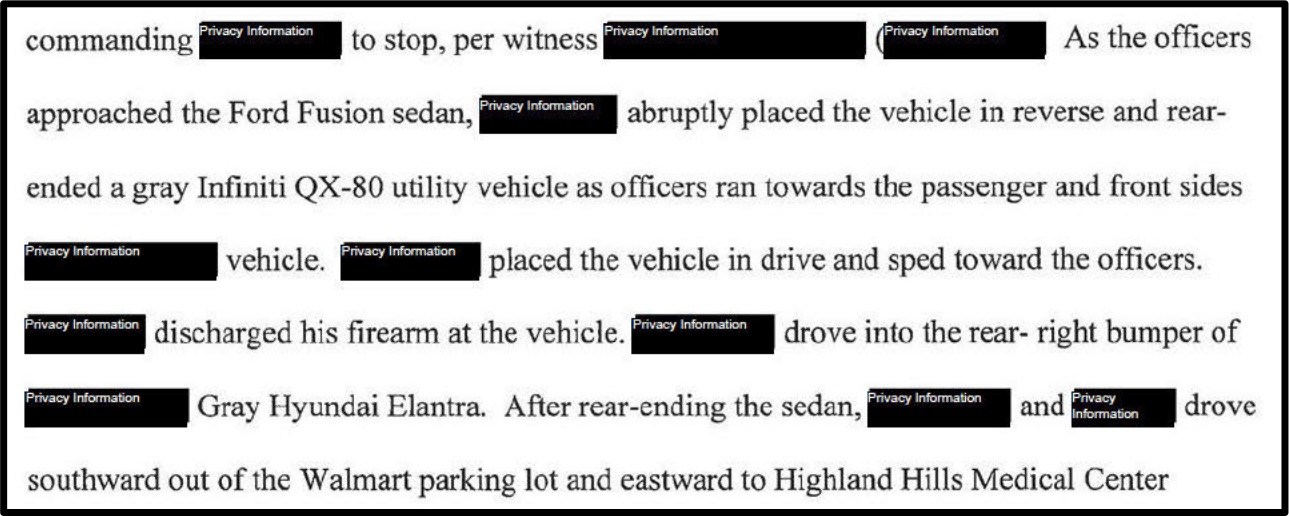 An excerpt of the report on the police shooting of Kohen Wiley from the Mississippi Bureau of Investigation released on Oct. 22, 2026, through a public records request.Screenshot: The Intercept
 Foster resigned from the Senatobia police department on Wednesday. Afterward, Foster's lawyer told CNN, The driver of the vehicle was attempting to kill those 5 officers, and Hunter Foster had no choice but to discharge his weapon." (Neither Foster nor his lawyer responded to The Intercept's requests for comment.)
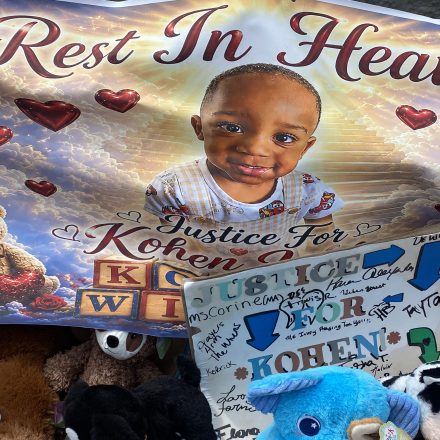 Related Kohen Wiley's Family Says Investigators Didn't Contact Them Before Concluding Cops Did No Wrong
 Residents of Senatobia had called for months for the body camera footage and Walmart surveillance videos to be released. After the state attorney general announced that the police had been cleared, a spokesperson for the Mississippi Department of Public Safety, which houses the state's Bureau of Investigations, told The Intercept that the videos would be released after the family had a chance to watch them.
Instead, as with the attorney general's announcement, the family first saw the leaked videos on social media. By the time Kohen Wiley's parents and grandparents met with state officials to view the videos on Thursday morning, most of the footage had been circulated online. At a press conference on Thursday afternoon, Kohen's maternal grandmother, Veronica Roberson, called it a slap in the face."
Roberson said she'd been haunted by the word justified" all week, slamming the idea that Foster fired the lethal shots because he feared for his life.
You shot my grandbaby from the side of the car," she said. How are you in danger?"
Get the Car!"The incident began with what appeared to be a routine occurrence in retail outlets all over the country: a shoplifting allegation.
The earliest footage is from a Walmart security camera. An apparent Walmart employee dressed in a black hoodie is stationed by the store entrance when Wiley and Ferrell approach, carrying a child and a box of diapers. They pause at the door and appear to have a brief exchange with the Walmart employee before breaking into a run toward the parking lot.
In body camera footage, which begins moments later, the staffer in the hoodie appears in the doorway of a small security room, where other Walmart employees, three Senatobia police officers, and two Tate County sheriff's deputies are gathered around a pair of computer monitors. According to the MBI report, the officers had been called to the store in response to a complaint that a man was sexually harassing customers.
The employee in the hoodie tells the cops and Walmart staffers that two people are running and gestures toward the store entrance.
Moments later, the five officers dash from the room and out into the parking lot, running toward a gray sedan. A sheriff's deputy reaches the driver's side door and puts his hand on the hood of the car while someone yells stop." The car backs up and starts to turn, but hits a parked SUV. Someone yells, Stop the car!"
As the officers continue to run toward the car, it begins to move forward. At one point, two officers are directly in front of the vehicle, including Foster, the police sergeant identified as the shooter, who aims his gun at the front windshield.
The car starts to turn left, away from the three officers on the vehicle's right side, and either narrowly misses or grazes Foster, who stumbles to the passenger side and aims his gun at the window. He then appears to fire three shots in rapid succession.
As the car pulls away, the officers continue their pursuit.
Get the car! Get the car! Get the car!" one of them yells.
The gray sedan pauses briefly before taking off again.
The records released by state officials do not include any footage of what happened after the officers return to their vehicles. But the leaked footage, which was compiled into a nearly 7-minute long video, shows Foster pacing next to a police vehicle outside the nearby Highland Hills Medical Center an hour and 20 minutes after the shooting.
I didn't even see a fucking baby in her lap," Foster says.
His colleague responds that nobody else did either: All I saw was two females in the car."
Reckless and AggressiveAs the leaked video began to circulate on social media on Tuesday, much of the attention focused on the moment the car moved toward Foster.
The Senatobia Police Department claimed from the start that the car drove toward officers and nearly hit one, suggesting the shots were fired in self-defense. Darkhorse Press, the independent Mississippi outlet that first published the leaked footage, even stated in a headline that the car actually hit at least two officers."
Among those who have repeated a version of this story is Republican Gov. Tate Reeves, who said the driver tried to run over the policeman," despite admitting that he had not actually watched the footage.
 Related In the Aftermath of a Police Killing, the Justifications Begin Immediately
 What the videos show is that the police officers themselves needlessly escalated a shoplifting incident into the scenario that they claim put them at risk. Almost immediately after being informed that two people were running," the five armed officers sprinted out to the parking lot, surrounded the car, and, at various points in the confrontation, drew their guns. They also positioned themselves in a way that cut off any escape route for the driver.
These are reckless, aggressive tactics in response to a minor shoplifting charge. They also violate best practices in policing.
Most departments today prohibit officers from standing in front of the possible escape route of a car when someone inside is suspected of only minor offenses. Many also require officers to get out of the way of a vehicle if it drives toward them. While most departments authorize a police officer to use deadly force if they reasonably" believe it's necessary to protect their or others' lives, this generally does not excuse using lethal force if the reasonable" fear arose from a cop's own violation of department policy.
The police officers themselves needlessly escalated a shoplifting incident into the scenario that they claim put them at risk.
Policies and best practices, however, don't establish the bounds of legal liability; they are related but separate. Under the landmark Supreme Court case Tennessee v. Garner, a police officer can use deadly force if he has a good-faith belief that the suspect poses a significant threat of death or serious physical injury to the officer or others." The law is less clear about criminal liability when an officer's own illegal or ill-advised actions caused the circumstances that led him to fear for his safety.
Other examples of self-defense law hold people criminally liable if their own actions put them in harm's way. In general, those cases indicate that a person can't argue self-defense after killing someone if they instigated the altercation that led to the killing - even if it was reasonable to deploy lethal force when they did.
 Related Cops Are Already Unleashed. Trump Is Telling Them to Run Wild.
 By that standard, if an officer puts themselves in the path of a moving vehicle, they shouldn't be able to justify lethal force by claiming to fear for their life because the vehicle was about to hit them. The law, however, isn't crystal clear on this, and there's at least some indication that the current Supreme Court may adopt a more lenient standard for police officers.
Moving VehicleMost police departments prohibit officers from shooting into moving vehicles unless someone inside poses a direct threat to the safety of others unrelated to use of the vehicle itself - for instance, if the person is armed and shooting at people. The reason is simple: Killing the driver of a moving car does not stop the car and can therefore exacerbate threats to public safety.
Like many other departments, the Senatobia police department's policy contains vague language warning officers that firing into moving vehicles is dangerous to bystanders and unlikely to stop a car; it reads more like guidance than prohibition. One portion of the policy, however, is much clearer: Officers will not" discharge firearms into a fleeing vehicle - with will not" underlined for emphasis.
It seems clear from the leaked footage that Ferrell, the driver, maneuvered the car in what appeared to be an attempt to flee rather than to kill or injure officers. The video shows her at first trying to reverse away from police. After striking the SUV, however, she then appears to try to drive around and then between the officers. She then strikes another car while trying to drive away.
The videos depict a driver showing far more awareness for the officers' safety from behind the wheel than Foster showed for the occupants of the car - or the surrounding bystanders.
Foster's actions aren't consistent with any reasonable concept of self-defense. Footage shows that he fired at least three shots into the passenger side of the car. This was already apparent in the leaked body camera footage. It's even clearer in the newly released video from Foster's camera. By the time he fires the first of the three shots, he is clearly beside - not in front of - the car. By the time he fires the last shot, the car has passed him.
Even if Foster wanted to claim that he fired to disable the driver - and, again, his own department firmly prohibits shooting at a fleeing car - he fired through the passenger side window. He did so despite being told that there were two people inside, which means that whatever the driver was doing, he was also putting the other person at risk.
 Related Trust What You Can See With Your Own Eyes
 Ultimately, the videos depict a driver showing far more awareness for the officers' safety from behind the wheel than Foster showed for the occupants of the car - or the surrounding bystanders.
Police policies should reflect how people behave in the real world, and people accused of stealing tend to flee. For armed officers to quickly escalate a shoplifting allegation puts everyone nearby at risk. Amid the frenzied response from the cops, Ferrell struck two other cars while attempting to escape. Anyone in or near those cars could have been injured or killed. Foster also fired his gun in a crowded parking lot. That, too, could have resulted in additional death or injury.
The police had other options. They could easily have written down the car's license plate or obtained the plate number from the numerous surveillance tools at their disposal: their body camera footage, Walmart security footage, or one of the many Flock cameras nearby.
If they had to arrest the women, they could have done so later, at home and under less duress. They may not have caught Wiley or Ferrell red-handed with the alleged stolen goods, theoretically making a shoplifting prosecution more difficult. Creating an obstacle to prosecuting a shoplifting case, however, should be an easy tradeoff for not putting lives at risk.
Walmart's RoleFinally, the leaked video footage raises important questions about Walmart's role in Kohen Wiley's death. The company has yet to publicly comment about the incident - and has not responded to repeated inquiries from The Intercept.
When the Walmart employee in the hoodie entered the room where officers were viewing security monitors, he told them that two people were fleeing the store. He did not say that one of them had a baby in her arms, even though surveillance footage showed Wiley carrying Kohen as she passed him. This would prove consequential, as Foster said in video footage that he had no idea there was a baby in the car.
Does Walmart policy require staff to tell police when a suspected shoplifter is accompanied by children? And how often does Walmart call on police for such minor crimes?
 Related Congress Might Give ICE the Power to Go After Shoplifters
 This isn't the first time aggressive policing of shoplifting at a Walmart has resulted in the death of an unarmed person. Earlier this year, deputies shot suspected shoplifters in two separate incidents at Walmarts in Florida. When police tackled a fleeing shoplifter in Anchorage, Alaska, recently, he pulled a gun and shot two officers before they returned fire, killing him.
Over the last 10 years, police have also shot suspected shoplifters at Walmarts in Miami; Decatur and San Antonio, Texas; Tempe, Arizona; Colorado Springs, Colorado; Chester, South Carolina; and Lake Forest, California. Most of the suspects were armed, but gunfire erupted only after police confronted them for shoplifting.
Even the best policing policies are useless if they aren't enforced when officers violate them.
Walmart seems to have wavered over the years between aggressive crackdowns on suspected shoplifters and more lenient policies that factor in whether the suspect has been accused before, the necessity of the items they're accused of stealing, and the value of the stolen goods.
Like many national retailers, the company's policy when it comes to its own employees is to avoid confrontations with suspected shoplifters. A previous lawsuit revealed that the company's stated policy as of 2010 was PUT PEOPLE FIRST" (all caps in original) and prioritized the physical well-being of suspects, customers and Walmart associates."
That policy means little if the store simply outsources enforcement to police who take a far more aggressive approach. Walmart itself has also been criticized by police groups, who claim that cost-saving reductions in staff have made the store a more attractive target for shoplifting, which then leads to more calls to police.
And in Senatobia, the last high-profile incident of police violence before Kohen Wiley was killed took place in 2025 - at the same Walmart parking lot.
Even the best policing policies are useless if they aren't enforced. And officers are rarely prosecuted, period. Foster's resignation is at least some form of accountability, but the insistence from state officials that police did nothing wrong means there will be little to stop similar killings from happening again.
This week, residents of Senatobia returned to the Walmart for a vigil in honor of Kohen Wiley, in the same place where a makeshift shrine once stood. A community gathering has also been scheduled next weekend to mark what would have been his second birthday.
At the press conference Thursday, family and activists vowed to keep fighting for justice. As with so much police violence, however, the most pressing question isn't whether Foster himself is punished. It's whether we're willing to tolerate more deaths like that of Kohen Wiley - whether Senatobia, Walmart, and the state of Mississippi will do anything to make clear that a 1-year-old's life is more important than a pack of diapers.
The post Bodycam: Cop Was Not in Danger When He Fired Shots That Killed 1-Year-Old Kohen Wiley appeared first on The Intercept.