A circle in the hyperbolic plane
Let be the upper half plane, the set of complex real numbers with positive imaginary part. When we measure distances the way we've discussed in the last couple posts, the geometry of is hyperbolic.
What is a circle of radius r in ? The same as a circle in any geometry: it's the set of points a fixed distance r from a center. But when you draw a circle using one metric, it may look very different when viewed from the perspective of another metric.
Suppose we put on glasses that gave us a hyperbolic perspective on , draw a circle of radiusr centered ati, then take off the hyperbolic glasses and put on Euclidean glasses. What would our drawing look like?
In the previous post we gave several equivalent expressions for the hyperbolic metric. We'll use the first one here.
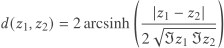
Here the Fraktur letter stands for imaginary part. So the set of points in a circle of radiusr centered at i is

Divide the expression ford(x +iy,i) by 2, apply sinh, and square. This gives us
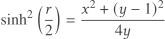
which is an equation for a Euclidean circle. If we multiply both sides by 4y and complete the square, we find that the center of the circle is (0, cosh(r)) and the radius is sinh(r).
Summary so farSo to recap, if we put on our hyperbolic glasses and draw a circle, then switch out these glasses for Euclidean glasses, the figure we drew again looks like a circle.
To put it another way, a hyperbolic viewer and a Euclidean viewer would agree that a circle has been draw. However, the two viewers would disagree where the center of the circle is located, and they would disagree on the radius.
Both would agree that the center is on the imaginary axis, but the hyperbolic viewer would say the imaginary part of the center is 1 and the Euclidean viewer would say it's cosh(r). The hyperbolic observer would say the circle has radiusr, but the Euclidean observer would say it has radius sinh(r).
Small circlesFor smallr, the hyperbolic and Euclidean viewpoints nearly agree because
cosh(r) = 1 + O(r^2)
and
sinh(r) = r + O(r^3)
Big circlesNote that if you asked a Euclidean observer to draw a circle of radius 100, centered at (0, 1), he would say that the circle will extend outside of the half plane. A hyperbolic observer would disagree. From his perspective, the real axis is infinitely far away and so he can draw a circle of any radius centered at any point and stay within the half plane.
Moving circlesNow what if we looked at circles centered somewhere else? The hyperbolic metric is invariant under Mobius transformations, and so in particular it is invariant under
z x0 + y0 z.
This takes a circle with hyperbolic center ito a circle centered at x0 +iy0 without changing the hyperbolic radius. The Euclidean center moves from cosh(r) to y0 cosh(r) and the radius changes from sinh(r) to y0 sinh(r).
The post A circle in the hyperbolic plane first appeared on John D. Cook.