The EPA Was Considering a Massive Lead Cleanup in Omaha. Then Trump Shifted Guidance.
The county health worker scanned the Omaha, Nebraska, home with an X-ray gun, searching for the poison.
It was 2022, and doctors had recently found high levels of lead in the blood of Crystalyn Prine's 2-year-old son, prompting the Health Department to investigate. The worker said it didn't seem to come from the walls, where any lead would be buried under layers of smooth paint. The lead assessor swabbed the floors for dust but didn't find answers as to how Prine's son had been exposed.
A danger did lurk outside, the worker told her. For more than a century, a smelter and other factories had spewed lead-laced smoke across the city's east side, leading the federal government to declare a huge swath of Omaha a Superfund site and to dig up and replace nearly 14,000 yards - including about a third of the east side's residential properties - since 1999.
Prine looked up the soil tests for her home online and discovered her yard contained potentially harmful levels of lead. But when she called the city, officials told her that her home didn't qualify for government-funded cleanup under the standard in place from the U.S. Environmental Protection Agency.
Prine didn't want to move out of the home that had been in her husband's family for generations. So she followed the county's advice to keep her five kids safe. They washed their hands frequently and took off their shoes when they came inside.
Then, Prine heard some news at the clinic where she worked as a nurse that gave her hope: In January 2024, the EPA under President Joe Biden lowered the lead levels that could trigger cleanup. Her home was above the new threshold.
That didn't automatically mean her yard would be cleaned up, local officials told her, but last year, the EPA began to study the possibility of cleaning up tens of thousands of more yards in Omaha, according to emails and other records obtained by Flatwater Free Press and ProPublica. The agency was also discussing with local officials whether to expand the cleanup area to other parts of Omaha and its surrounding suburbs.
Then, this October, the Trump administration rolled back the Biden administration's guidance. In doing so, it tripled the amount of lead that had to be in the soil to warrant a potential cleanup, meaning that Prine and other families might again be out of luck.
Prine's son Jack, now 5, struggles to speak. He talks less than his 2-year-old brother and stumbles over five-word sentences.
 On a recent Sunday morning, 5-year-old Jack Prine, left, plays with his 2-year-old brother at home. Tests showed lead in the blood of both children. Rebecca S. Gratz for ProPublica
You would think that if lead is this impactful on a small child, that you would definitely want to be fixing it," she said. What do you do as a parent? I don't want to keep my kid from playing outside. He loves playing outside, and I should be able to do that in my own yard."
Scientists have long agreed about the dangers of lead. The toxic metal can get into kids' brains and nervous systems, causing IQ loss and developmental delays. Experts say the Trump administration's guidance runs counter to decades of research: In the 26 years since the government began to clean up east Omaha - the largest residential lead Superfund site in the country - scientists have found harm at ever lower levels of exposure.
Yet what gets cleaned up is often not just a matter of science but also money and government priorities, according to experts who have studied the Superfund program.
Prine's block illustrates how widespread Omaha's lead problem is and how many people who might have benefited from the Biden guidance may no longer get relief. Of the 11 homes on her block, four were cleaned up by the EPA. Six others tested below the original cleanup standard but above the levels in the Biden guidance and were never remediated.
Every Home on This Block Tested High for Lead. Only Four Were Cleaned Up.Under current cleanup standards, homes in Omaha need 400 parts per million of lead in their soil to qualify for remediation. Four of the 11 homes on this block qualified. The remaining seven had levels from 100 to 400 parts per million.
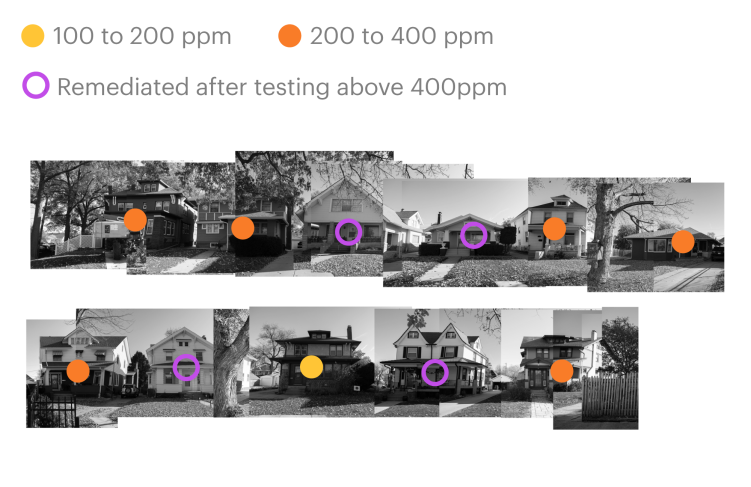 Note: An EPA risk model predicts that lead-soil levels below 100 ppm would generally protect kids from developing a blood-lead level the Centers for Disease Control and Prevention finds concerning. Photos by Rebecca S. Gratz for ProPublica
Flatwater Free Press and ProPublica are embarking on a yearlong project about Omaha's lead legacy, including testing soil to find out how effective the cleanup has been. If you live in or near the affected area, you can sign up for free lead testing of your soil.
Despite the changing guidance, Omaha still follows a cleanup standard set in 2009: Properties qualify for cleanup if parts of the yard have more than 400 parts per million of lead in the soil - the equivalent of a marble in a 10-pound bucket of dirt. The Biden administration lowered the guidance for so-called removal management levels to 200 parts per million.
The Trump administration has said its new guidance, which raised them to 600 parts per million, would speed cleanups by providing clearer direction and streamlining investigations of contaminated sites. But environmental advocates said it only accelerates project completion by cleaning up fewer properties.
The EPA disputed that. Protecting communities from lead exposure at contaminated sites is EPA's statutory responsibility and a top priority for the Trump EPA," the agency said in a statement. The criticism that our Residential Soil Lead Directive will result in EPA doing less is false."
The new guidance doesn't necessarily scrap the hopes of Omaha homeowners or the conversations that were happening around the Biden recommendations. That's because the Trump administration continues to allow EPA managers to study properties with lower levels of lead, depending on how widespread the contamination is and how likely people are to be harmed. What actually gets cleaned up is decided by local EPA officials, who can set remediation levels higher or lower based on the circumstances of specific sites.
 More than 25 years after the EPA declared Omaha's east side a Superfund site, the city is still working to clean up lead-contaminated properties, including this vacant lot. Rebecca S. Gratz for ProPublica
Regional EPA spokesperson Kellen Ashford said the agency is continuing to assess the Omaha site and will meet with local and state leaders to chart a path forward with how the updated residential lead directive may apply."
Gabriel Filippelli, executive director of Indiana University's Environmental Resilience Institute, has studied lead and Superfund sites for decades and said he is doubtful the EPA will spend the money to clean up more yards in Omaha. The EPA doesn't act if you don't have local people raising alarm bells," he said.
Yet in Omaha, many are unaware of the debate - or even the presence of lead in their yards. Most of the cleanup happened more than a decade ago. As years passed, new people moved in, and younger residents never learned about the site. Others who did know assumed the lead problem was solved. The dustup around lead has mostly settled even if much of the toxic metal in the city's dirt never left.
Mass Poison"When Prine moved into Omaha's Field Club neighborhood in 2018, she loved the Queen Anne and Victorian-style homes that lined shady boulevards and how her neighbors decorated heavily for Halloween and Christmas.
While she had visited the home previously to see her husband's family, Prine had no idea her neighborhood was in the middle of a massive environmental cleanup.
The first time I heard about it was when my son had an elevated blood-lead level," she said.
From 1870 to 1997, the American Smelting and Refining Company sat on the Missouri River in downtown Omaha, melting and refining so much lead to make batteries, cover cables and enrich gasoline that it was once the largest operation in the country, according to a 1949 newspaper article.
By the 1970s, researchers had proven lead was poisoning American children. Doctors in Omaha noticed kids with elevated blood-lead levels and published findings connecting the toxic metal in their bodies to the smoke pouring out of ASARCO and other polluters.
 The view of Omaha's riverfront in 1968. Omaha factories, primarily a lead smelter, deposited 400 million pounds of the toxic metal across the city over more than a century. Omaha World-Herald
In the late 1990s, when city leaders wanted to demolish ASARCO and redevelop the site into a riverfront park, they had to figure out how to clean up Omaha's lead legacy. They turned to the EPA, which declared a 27-square-mile swath of east Omaha a Superfund site, a federal designation that would allow the agency to clean up the contamination and try to hold the polluters responsible to pay for it.
The agency estimated the smelter, along with other polluters, had spewed about 400 million pounds of lead dust over an area, where 125,000 people, including 14,000 young children, lived.
The EPA won $246 million in settlements from ASARCO and others to fund the cleanup.
By 2015, most of the yards that tested above 400 parts per million had their soil replaced, and the EPA handed the remaining work to the city. The old smelter site was redeveloped into a science museum with a playground outside.
The project seemed like a success. The number of kids testing high for lead has dropped dramatically since the 1990s, though similar patterns exist nationwide and fewer than half the kids in the site are tested annually, according to data from the Health Department in Douglas County, where Omaha is located.
But evidence had already been emerging that the cleanup levels the EPA had set in Omaha may not protect children," which the agency acknowledged in 2019, during the first Trump administration. Managers wrote in a site review that increasing evidence supports a lower blood-lead level of concern" than the 1994 health guidance that informed the cleanup plan.
Lead, even in incredibly small amounts, can build up in the brains, bones or organs of children as well as adults, said Bruce Lanphear, a professor at Simon Fraser University in Canada who has studied lead for decades.
Lead represents the largest mass poison in human history," he said.
 The former American Smelting and Refining Company site is now home to a science museum and playground. Rebecca S. Gratz for ProPublica
After the Centers for Disease Control and Prevention lowered its blood-lead level standard, the EPA's Office of Superfund Remediation and Technology Innovation began working on new lead cleanup guidance for the EPA regions in 2012, said James Woolford, director of the office from 2006 to 2020. The EPA took a cautious, studied" approach to how much lead in dirt is acceptable.
Zero was obviously the preference. But what could you do given what's in the environment?" he asked. And so we were kind of stuck there."
Then, in 2024, Biden stepped in.
If regional EPA officials applied the administration's guidance to the Omaha site, over 13,000 more properties in Omaha could have qualified, a Flatwater Free Press and ProPublica analysis of EPA and city of Omaha soil tests found.
The number could have been even higher, records show. Nearly 27,000 properties, including those that never received cleanup and those that received partial cleanup, would have been eligible for further evaluation, EPA manager Preston Law wrote to a state environmental official in March 2024.
The EPA had also been discussing with city and state officials whether to expand the cleanup area: A map that an EPA contractor created with a computer model to simulate the smelter's plume shows that it likely stretched 23 miles north to south across five counties in Nebraska and Iowa.
 A computer-simulated map shows the smelter's plume stretching 23 miles north to south across five counties in Nebraska and Iowa. The model was created by an EPA contractor in 2024 as part of a new assessment of the site. Obtained by Flatwater Free Press and ProPublica
But cleaning up all the properties to the Biden levels could cost more than $800 million, the then-interim director of the Nebraska Department of Energy and Environment, Thaddeus Fineran, wrote to the EPA's administrator in May 2024.
If cleanup costs exceeded the funds set aside from Omaha's settlements, the EPA would have to dip into the federal Superfund trust fund, which generally requires a 10% match from the state, said Ashford, the EPA spokesperson.
That could mean a contribution of $80 million or more from Nebraska, which is already facing a $471 million budget deficit. In the letter, Fineran wrote that the state would reserve the right to challenge the Updated Lead Soil Guidance and any actions taken in furtherance thereof."
The Nebraska Department of Water, Energy, and Environment, as the agency is now called, declined an interview, referring questions to the EPA.
Researchers and decision-makers are likely taking a cautious approach toward what they agree to clean up in Omaha, Woolford said. Given its size, it could carry weight elsewhere.
It will set the baseline for sites across the country," he said.
Hollow" ClaimsThe Trump administration may upend any plans to expand the cleanup.
In March, the EPA announced what it called the biggest deregulatory action in U.S. history." By July, about 1 in 5 employees who worked for the EPA when Trump took office were gone. The administration proposed slashing the EPA's budget in half.
The administration promised to prioritize Superfund cleanups. But in October, it changed the lead guidance. As a result, more people will be at risk of absorbing damaging amounts of lead into their bodies, said Tom Neltner, national director for the advocacy organization Unleaded Kids.
It signals that the claims that lead is a priority for them are hollow," he said.
The Trump administration said Biden's approach had inconsistencies and inefficiencies" that led to analysis paralysis" and slowed projects down.
Children can't wait years for us to put a shovel in the dirt to clean up the areas where they live and play," EPA Administrator Lee Zeldin said in a statement.
 To avoid the lead-contaminated soil in their yard, the Prine children play only on the back patio and sidewalk. Rebecca S. Gratz for ProPublica
Under the guidance, the EPA could issue a lower standard for the Omaha site. But Robert Weinstock, director of Northwestern University's Environmental Advocacy Center, said that's unlikely unless the state sets a lower state standard than the EPA.
Trump's guidance has some advantages in being more clear, said Filippelli of Indiana University. The Biden guidance seemed overly ambitious: Filippelli and other researchers estimated 1 in 4 American homes could have qualified for cleanup with an estimated cost of $290 billion to $1.2 trillion.
 Steve Zivny, program manager of Omaha's Lead Information Office Rebecca S. Gratz for ProPublica
While Omaha could be the litmus test for how low the Trump EPA is willing to set cleanup standards, the new guidelines don't inspire confidence that the administration will do more to clean up old sites where work is nearly finished.
I imagine the inertia would be just to say, Oh, we're done with Omaha,'" he said.
The city has received no timeline from the EPA, said Steve Zivny, program manager of Omaha's Lead Information Office. He's guessing money will play a big part in the decision over whether to clean up at a lower lead level, though. About $90 million of the Omaha Superfund settlement remains.
If the data is there and the science is there and the money's there, I think we would expect it to be lowered," Zivny said. But there's just so many factors that are not really in our control."
If cleanup levels aren't lowered in Omaha, advocates will have more work to do, said Kiley Petersmith, an assistant professor at Nebraska Methodist College who until recently oversaw a statewide blood-lead testing program.
I think we're just gonna have to rally together to do more to prevent it from getting from our environment into our kids," she said.
A Buried IssueDespite the cleanup efforts, Omahans are still exposed at higher rates compared with the national average, said Dr. Egg Qin, an epidemiologist at the University of Nebraska Medical Center who has studied the Superfund site. Yet the city seems to be moving on, he said.
Somebody needs to take the responsibility," Qin said, to make sure the community knows lead poisoning still exists significantly in Omaha."
About 40% of the 398 people who have already signed up to have their soil tested by Flatwater Free Press and ProPublica said they did not feel knowledgeable about the history of lead contamination in Omaha.
 Like the Prines, Omaha resident Vanessa Ballard takes care to not wear shoes in her home to avoid high levels of lead-contaminated soil. Rebecca S. Gratz for ProPublica
That may in part be due to disclosure rules. When a person sells a home, state and federal law requires them to share any knowledge about lead hazards. The EPA's original cleanup plan from 2009 says that should include providing buyers with soil test results.
But in most cases, there can be very little disclosure, said Tim Reeder, a real estate agent who works in the Superfund site. Omaha's association of real estate agents provides a map of the Superfund site to give to buyers, along with some basic information, if the home is within the boundaries.
City and local health officials spread the word about lead through neighborhood meetings, local TV interviews and billboards. But most people don't take it seriously until someone they know tests high, Petersmith said.
Unfortunately, once it affects them personally, like if their child or grandchild or cousin has lead exposure, then it's too late," she said.
When Omaha pediatrician Katie MacKrell moved into a house in the Dundee neighborhood, she thought her kids were fine to play in the yard. Her son sucked his thumb. Her daughter dropped her pacifier and put it back in.
When their kids both tested high for lead, MacKrell and her husband went to work fixing lead paint issues in the house. When it came to the yard, her property tested for lead levels above the Biden guidance but didn't qualify under the original cleanup threshold. And without government help, it could cost the couple more than $10,000 to pay for the remediation themselves.
 Ballard sits with her 19-month-old son, DiVine Cronin, as he plays with a new toy at home. Rebecca S. Gratz for ProPublica
 Ballard covers the windows in her home with plastic to keep DiVine and her 5-year-old, MJ Collins, pictured, from touching the lead paint and to prevent lead-contaminated dust from blowing inside. Rebecca S. Gratz for ProPublica
The lead also caught Vanessa Ballard, a high school teacher and mom of two young boys, by surprise. She had imagined growing fruit trees in her backyard until she discovered lead levels high enough to potentially clean up under the Biden guidelines. Now, no one goes in the backyard. Her oldest son splashes in soapy water after making tracks for his Hot Wheels cars in the dirt, and she mixes droplets of iron with the kids' juice every night to help their bodies repel lead.
I have no hand in the cause of this, but I have all the responsibility in the prevention of it harming me and my family," she said.
Prine will never know whether lead stunted Jack's speech development, but she worries about it every day.
Starting kindergarten helped. But her son is still behind other kids. Prine said she tries to put on a brave face, to believe one day he'll catch up. If he doesn't, it's hard not to suspect the culprit could be in her soil.
It seemed the government, at least for a short while, agreed. Now she, and so many others in Omaha, don't know when, if ever, to expect a solution.
Why does it take so long, when they say it's not safe, to then come in and say, We're gonna take this seriously?'" Prine asked. That we're gonna help these kids and protect them?'"
 Crystalyn Prine holds hands with her 6-month-old daughter. Tests found lead in the blood of two of her other children. Rebecca S. Gratz for ProPublica
The post The EPA Was Considering a Massive Lead Cleanup in Omaha. Then Trump Shifted Guidance. appeared first on ProPublica.