Tritone substitution
Big moves in roots can correspond to small moves in chords.
Imagine the 12 notes of a chromatic scale arranged around the hours of a clock: C at 12:00, C at 1:00, D at 2:00, etc. The furthest apart two notes can be is 6 half steps, just as the furthest apart two times can be is 6 hours.
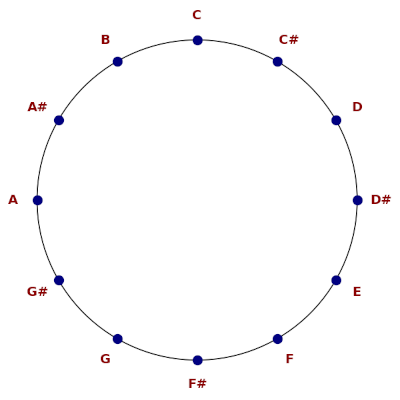
An interval of 6 half steps is called a tritone. That's a common term in jazz. In classical music you'd likely say augmented fourth or diminished fifth. Same thing.
The largest possible movement in roots corresponds to almost the smallest possible movement between chords. Specifically, to go from a dominant seventh chord to another dominant seventh chord whose roots are a tritone apart only requires moving two notes of the chord a half step each.
For example, C and F are a tritone apart, but a C7 chord and a F7 chord are very close together. To move from the former to the latter you only need to move two notes a half step.
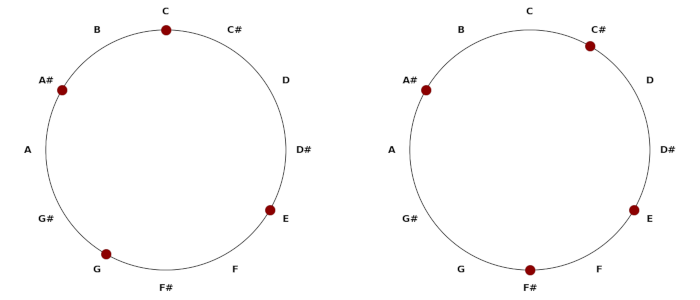
Replacing a dominant seventh chord with one a tritone away is called a tritone substitution, or just tritone sub. It's called this for two reasons. The root moves a tritone, but also the tritoneinside the chord doesnot move. In the example above, the third and the seventh of the C7 chord become the seventh and third of the F7 chord. On the diagram, the dots at 4:00 and 10:00 don't move.
Tritone substitutions are a common technique for making basic chord progressions more sophisticated. A common tritone sub is to replace the V of a ii-V-I chord progression, giving a nice chromatic progression in the bass line. For example, in the key of C, a D min - G7- C progression becomes D min - D7- C.
Related postsThe post Tritone substitution first appeared on John D. Cook.