More on Newton’s diameter theorem
A few days ago I wrote a post on Newton's diameter theorem. The theorem says to plot the curve formed by the solutions to f(x, y) = 0 where f is a polynomial in x and y of degree n. Next plot several parallel lines that cross the curve at n points and find the centroid of the intersections on each line. Then the centroids will fall on a line.
The previous post contained an illustration using a cubic polynomial and three evenly spaced parallel lines. This post uses a fifth degree polynomial, and shows that the parallel lines need not be evenly spaced.
In this post
f(x,y) = y^3 + y - x (x + 1) (x + 2) (x - 3) (x - 2).
Here's an example of three lines that each cross the curve five times.
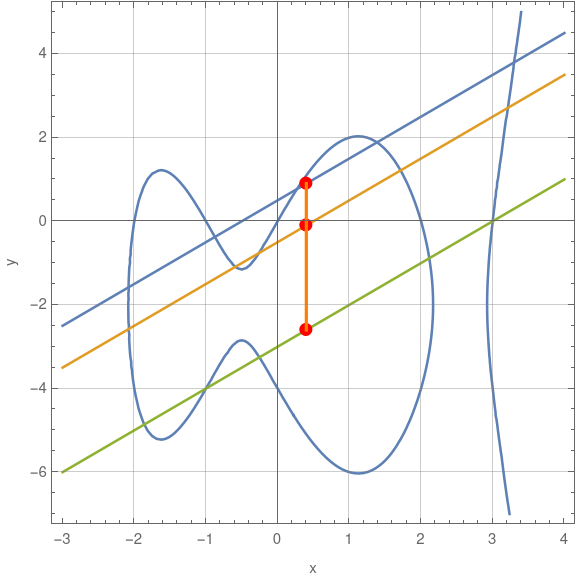
The lines arey =x +k wherek = 0.5, -0.5, and -3. The coordinates of the centroids are (0.4, 0.9), (0.4, -0.1), and (0.4, -2.6).
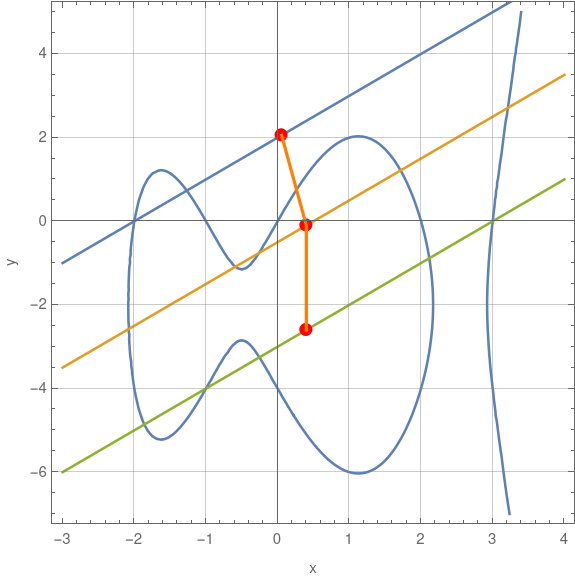
And to show that the requirement that the lines cross five times is necessary, here's a plot where one of the parallel lines only crosses three times. The top line is nowy =x + 2 and the centroid on the top line moved to (0.0550019, 2.055).