Approximation to solve an oblique triangle
The previous post gave a simple and accurate approximation for the smaller angle of a right triangle. Given aright triangle with sides a,b, andc, wherea is the shortest side andc is the hypotenuse, the angle opposite side a is approximately

in radians. The previous post worked in degrees, but here we'll use radians.
If the triangle is oblique rather than a right triangle, there an approximation for the angle A that doesn't require inverse trig functions, though it does require square roots. The approximation is derived in [1] using the same series that is the basis of the approximation in the earlier post, the power series for 2 csc(x) + cot(x).
For an oblique triangle, the approximation is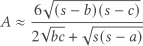
wheres is the semiperimeter.

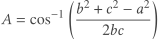
For comparison, we can find the exact value of A using the law of cosines.

and so
Here's a little Python script to see how accurate the approximation is.
from math import sqrt, acosdef approx(a, b, c): "approximate the angle opposite a" s = (a + b + c)/2 return 6*sqrt((s - b)*(s - c)) / (2*sqrt(b*c) + sqrt(s*(s - a)))def exact(a, b, c): "exact value of the angle opposite a" return acos((b**2 + c**2 - a**2)/(2*b*c))a, b, c = 6, 7, 12print( approx(a, b, c) )print( exact(a, b, c) )
This prints
0.363875384767762430.36387760856668505
showing that in our example the approximation is good to five decimal places.
[1] H. E. Stelson. Note on the approximate solution of an oblique triangle without tables. American Mathematical Monthly. Vol 56, No. 2 (February, 1949), pp. 84-95.
The post Approximation to solve an oblique triangle first appeared on John D. Cook.