The shape of a guitar pick
I saw a post on X that plotted the function
(logx)^2 + (logy)^2 = 1.
Of course the plot of
x^2 + y^2 = 1
is a circle, but I never thought what taking logs would do to the shape.
Here's what the contours look like setting the right hand side equal to 1, 2, 3, ..., 10.
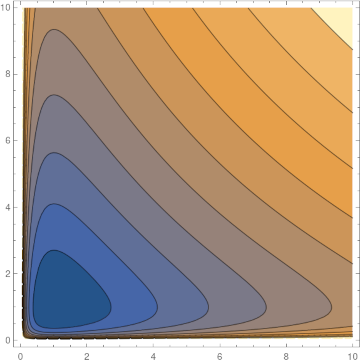
ContourPlot[Log[x]^2 + Log[y]^2, {x, 0, 10}, {y, 0, 10}, Contours -> Range[10]]The dark blue contour near the origin reminded me of a guitar pick, so I decided to take a stab at creating an equation for the shape of a guitar pick.
I wanted to rotate the image so the axis of symmetry for the pick is vertical, so I replaced x andy withx +y andx -y.
The aspect ratio was too wide, so I experimented with
log(y +kx)^2 + log(y -kx)^2 =r^2
where increasingk increases the height-to-width ratio. After a little experimentation I settled onk = 1.5 andr = 1.
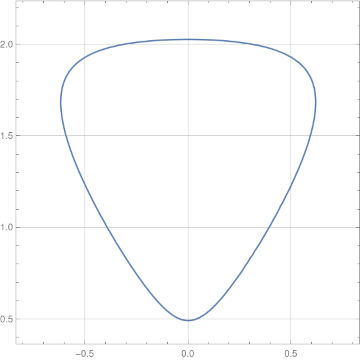
This has an aspect ratio of roughly 5:4, which is about what I measured from a photo of a guitar pick.
Updating: refining the fitAfter posting this article on X, Paul Graham replied with a photo of a Fender guitar pick with the image above overlaid. The fit was fairly good, but the aspect ratio wasn't quite right.
So then I did a little research. The shape referred to in this post is known as the 351," but even for the 351 shape the aspect ratio varies slightly between picks.
Settingk = 1.6 gives a better fit to Paul Graham's pick.
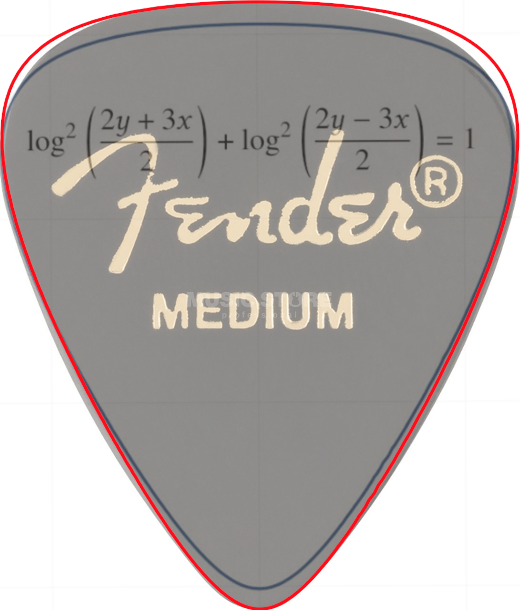
The blue line represents my fit using k = 1.5 and the red line represents my fit using k = 1.6.
The post The shape of a guitar pick first appeared on John D. Cook.