Calculating curvature
Curvature is conceptually simple but usually difficult to calculate. For a level set curve f(x,y) = c, such as in the previous couple posts, the equation for curvature is
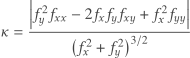
Even whenf has a fairly simple expression, the expression for can be complicated.
If we define

then the level set of f(x,y) = c is an equilateral triangle whenc = -4. The level sets are smoothed triangles for -4 <c < 0.
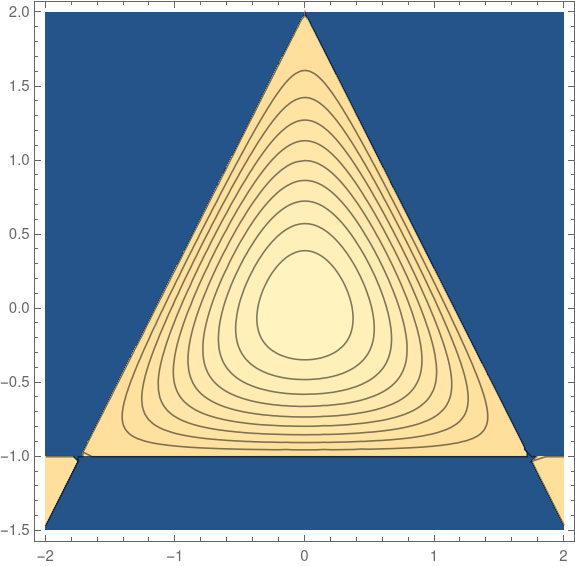
The curvature of these level sets at any point is given by

But there is one instance in which curvature is easy to calculate. For the graph of a functiong(x) =y, the curvature is approximately the absolute value of the second derivative ofg, provided the first derivative is small.
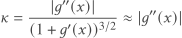
At a local maximum or local minimum ofg(x) the approximation is exact because the first derivative is zero.
Max and min curvature of smoothed trianglesThis means that in the example above, we can calculate the maximum and minimum curvature of the level sets. The maximum curvature occurs in the corners and the minimum occurs in the middle of the sides. By symmetry there are three maxima and three minima, but we can take the ones corresponding tox = 0 for convenience. There we find the curvature is simply

Whenx = 0, we have

and so the maximum and minimum curvature are the two roots of the cubic equation fory that lie in the interval [-1, 2]. (There's another root greater than 2.)
For example, when c = -3, the roots are 0.8794, 1.3473, and 2.5321. The first root corresponds to the minimum curvature, the second to the maximum, and the third is outside our region of interest. It follows that the minimum curvature is 0.7237 and the maximum is 14.0838.
When c = -1 the minimum and maximum curvature are 2.80747 and 9.91622 respectively,
Since c = -4 corresponds to the triangle, the minimum curvature is 0 and the maximum is infinite. As c increases, the minimum and maximum curvature come together because the level set is becoming more round.
The post Calculating curvature first appeared on John D. Cook.