Circular and hyperbolic functions differ by rotations
The difference between a circular function and a hyperbolic function is a rotation or two.
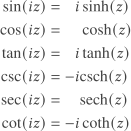
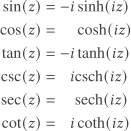
For example, cosh(z) = cos(iz). You can read that as saying that to find the hyperbolic cosine of z, first you rotatez a quarter turn to the left (i.e. multiply by i) and then take the cosine.
For another example, sinh(z) = -i sin(iz). This says that you can calculate the hyperbolic sine ofz by rotatingz to the left, taking the sine, and then rotating to the right.
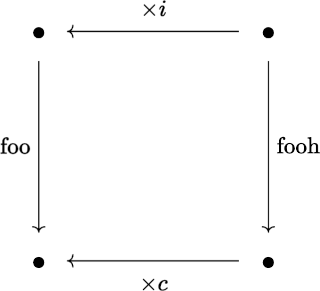
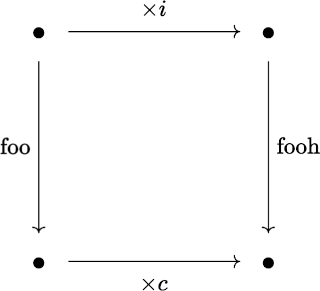
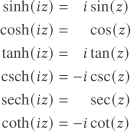
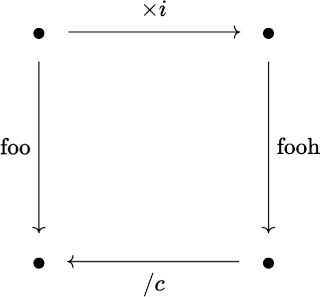
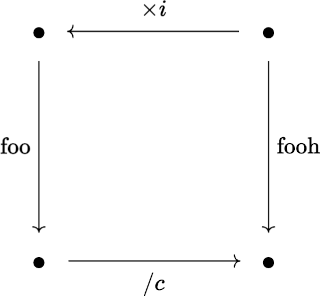
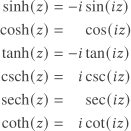
You can relate each trig function foo" with its hyperbolic counterpart fooh" by applying one of the functions toiz then multiplying by a constant c that depends on foo:c =i for sin and tan,c = 1 for cos and sec, andc = -i for csc and cot.
Note that if the constant for foo isc, the constant for 1/foo is 1/c. So, for example, the constant for tan isi and the constant for cot is 1/i = -i.
We have four groups of equations, depending on whether the left side of the equation is foo(iz), fooh(iz), foo(z), or fooh(z).
This post was written as a warm-up for the next post on couth and uncouth function pairs.
foo(iz)