Streets Alliance: 3 actions Seattle can take now to make streets safer
The Seattle Streets Alliance has published an action alert urging Seattle to take three actions to improve street safety, two specific interventions and one systemic change. Supporters can sign on to the ideas and send letters to city leaders.
Daylight every intersection SDOT touches SDOT image adapted from a graphic by Lancaster, PA.
 Image adapted from California's Streets for All.
The group is calling for SDOT to daylight every intersection they touch, which means installing physical barriers to prevent people from parking cars illegally close to a crosswalk. State law already prohibits parking within 20 feet of a crosswalk, and every corner is a crosswalk whether it is striped or not. If there is a traffic signal or sign, parking is prohibited within 30 feet. However, nobody follows this law, creating very dangerous situations where people driving cannot see other people approaching the intersection until it is too late. This problem is only getting worse as car keep getting bigger and hoods keep getting taller, blocking the view of shorter people, people in chairs, and children. Since we know people will not follow the parking restrictions voluntarily, physical barriers are necessary to keep sight lines clear. Hoboken, New Jersey, has noted that its widespread focus on intersection daylighting has been a major factor in its nine-year run without a traffic death. The last time a person was killed in Hoboken traffic, Obama was still had 2 days left as President.
The intervention policy here is fairly simple: Every time SDOT conducts any kind of work at an intersection on a street with parking, they should add intersection daylighting. It should be treated like a basic maintenance task. Intersection daylighting can be as simple and cheap as some parking stops and flex posts, though these spaces can also be used for on-street bike and scooter parking to help reduce bike and scooters on sidewalks. Crews can also install planters for added greenery. For more extensive projects with paving work, the city can install proper sidewalk extensions with curbs and planting areas or even rain-capture gardens in locations with stormwater retention needs.
Require truck side guards From a UMass study (PDF) on truck side guards.
Seattle's traffic safety goal needs to be eliminating collisions between large trucks and people walking and biking. However, truck side guards are a final fail-safe measure designed to push people away from the rear wheels. Too often, people are killed not from the initial collision but because they were knocked to the ground and then crushed by the rear wheels. Side guards can save lives and should be mandatory on all trucks nationwide or at least statewide. UW installed side guards on all its trucks in 2015. Seattle installed them on city-owned trucks in 2017, and they even found a local supplier. Seattle does not have the power to require side guards on all trucks, but they can require them as a contract condition for companies doing municipal work.
Mandatory Vision Zero review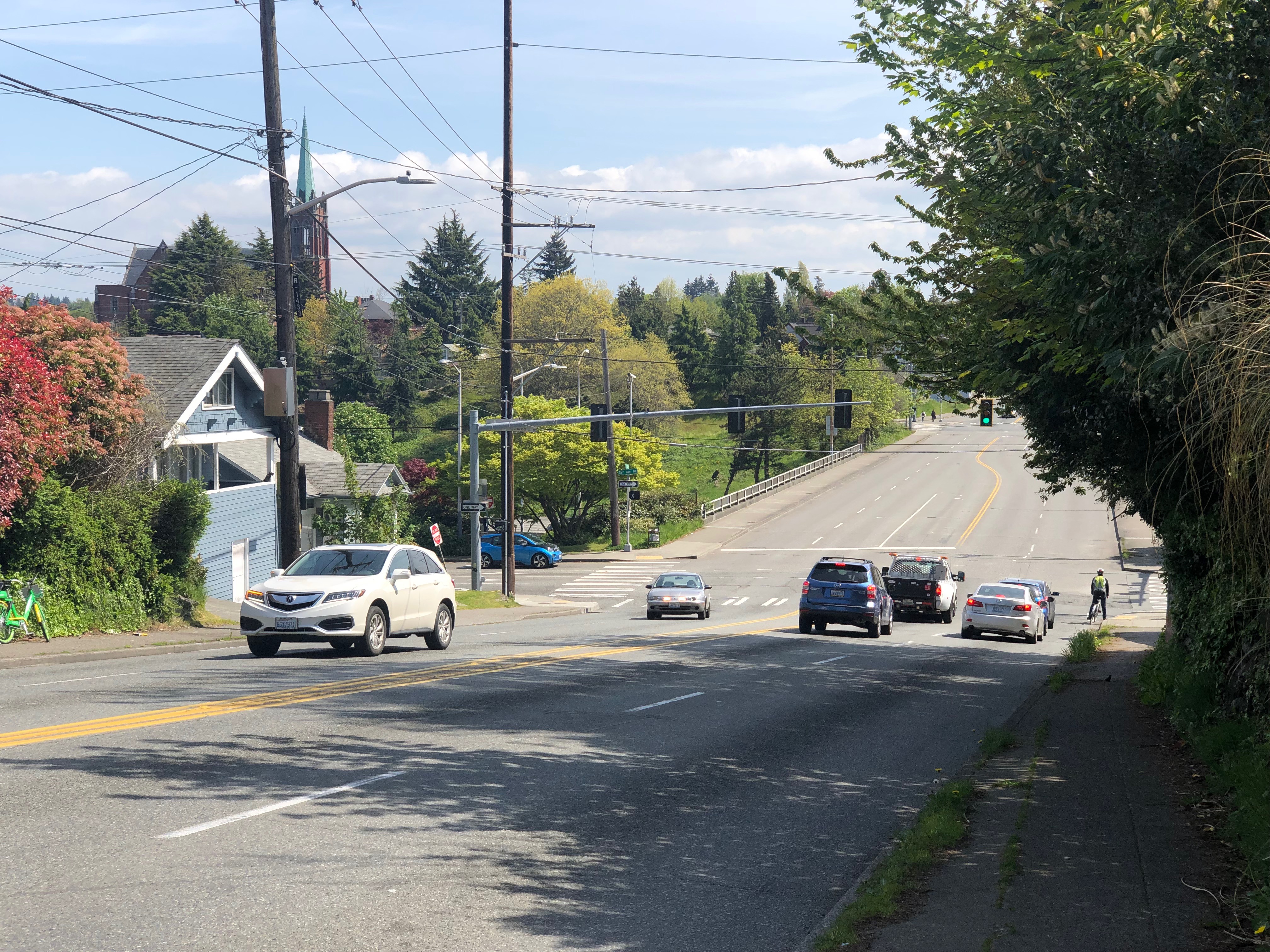 NE 50th Street was repaved in 2019 without any safety improvements.
All major SDOT projects should be required to pass a safety review by an independent Vision Zero team that has the power to send designs back for revision until they pass approval. SDOT has been saying over and over since the McGinn Administration (at least) that safety is the department's top priority. Yet the city still moves forward with projects that miss opportunities to improve safety. We have a backwards process in which a design change requires a full public outreach and review process, much of which can be skipped by simply rebuilding the existing design no matter how dangerous. In 2019, years into the city's Vision Zero program, SDOT repaved NE 50th Street and then put it back the same as it was before with multiple lanes in the same direction, awful skinny sidewalks (that were not improved) and no bike lanes despite significant numbers of people biking. The result is that NE 50th Street remains one of the city's most dangerous streets. This cannot ever happen again.
Existing designs must be treated with the same level of scrutiny as a design change. I would add to this point that there needs to be some kind of additional safety review for even smaller projects that do not trigger the city's complete streets ordinance. For example, when SDOT repaves a couple blocks of a street they should still be making intersection daylighting, crosswalk, and bike lane safety improvements along the way.