Alienware AW3426DW gaming monitor review: Premium gaming and OLED goodness in a value-priced package
Of the many sizes and shapes the best gaming monitors come in, the 34-inch ultra-wide 21:9 screen strikes a good balance between size and player immersion. It's wider than the 32-inch 16:9 format but not as large as extreme displays like the 52-inch LG I reviewed recently.
What makes them even better is QD-OLED technology, and there, Alienware is offering a nice update to last year's AW3425DW. It's the AW3426DW, and it brings a few new features, like a five-layer tandem OLED for higher light output, V-stripe RGB sub-pixels for sharper rendering, a bump from 240 to 280 Hz, and a new anti-reflective screen coating. It's still WQHD 3440x1440 pixels, and it still offers Adaptive-Sync, HDR10, and wide gamut color, and adds Dolby Vision to its list of supported content. Let's take a look.
Alienware AW3426DW SpecsPanel Type / Backlight | Quantum Dot Organic Light Emitting Diode (QD-OLED) |
Screen Size / Aspect Ratio | 34 inches / 21:9 |
Curve radius: 1800mm | |
Max Resolution and Refresh Rate | 3440x1440 @ 280 Hz |
FreeSync and G-Sync Compatible | |
Native Color Depth and Gamut | 10-bit / DCI-P3+ |
HDR10, Dolby Vision | |
DisplayHDR 500 True Black | |
Response Time (GTG) | 0.03ms |
Brightness (mfr) | 300 nits full field |
1,300 nits HDR 3% window | |
Contrast | Unmeasurable |
Speakers | None |
Video Inputs | 1x DisplayPort 1.4 |
2x HDMI 2.1 | |
USB 3.2 | 1x up, 1x type A, 1x type C |
Power Consumption | 29.5w, brightness @ 200 nits |
Panel Dimensions WxHxD w/base | 32.1 x 17.5-21.9 x 9.1 inches (815 x 445-556 x 231mm) |
Panel Thickness | 4.4 inches (112mm) |
Bezel Width | Top: 0.35 inch (9mm) |
Sides: 0.47 inch (12mm) | |
Bottom: 0.75 inch (19mm) | |
Weight | 17.4 pounds (7.9kg) |
Warranty | 3 years, including burn-in |
The AW3426DW's Tandem OLED is a new variant of the technology that takes the simple approach of stacking multiple OLED layers for greater light output with less energy consumption. It also taxes the layers less, so they last longer and are more resistant to burn-in. Alienware backs this with a three-year warranty that includes burn-in. The screen has a 34-inch diagonal, a 21:9 aspect ratio, a 1800mm curve radius, and WQHD (3440x1440) resolution.
V-Stripe RGB refers to the sub-pixel layout, which is finer and more precisely applied. This makes fine text and detail sharper by reducing color fringing. With its five OLED layers, the AW3426DW now boasts higher light output than last year's model. The VESA DisplayHDR rating is now 500 nits for a full white field and 1,300 nits for a 3% window. To cap off the imaging improvements, there's a new anti-glare coating applied to the screen that further deepens black levels and more effectively rejects ambient light.
With 280 Hz instead of last year's 240, the AW3426DW is a tad speedier, and my test results, which you'll see on the next page, show a nice drop in input lag. Panel response is typical OLED-quick, resulting in perfect motion resolution and smooth action free of motion blur. Adaptive-Sync is also supported on both Nvidia and AMD platforms.
It's no surprise that the AW3426DW supports HDR10, but now it adds Dolby Vision to the mix. The benefits of its dynamic tone mapping cannot be understated. HDR10's tone mapping is fixed to the content metadata, which usually has a peak of 1,000 nits. If a display can't hit 1,000 nits, or its output exceeds that, it must tone map to render all brightness steps. Dolby Vision controls this process within the content and always knows the display's actual output level. Bottom line: it's more accurate and consistent, and it looks better. It's a difference you can plainly see. Dolby Vision isn't common in games, but it is common from streaming services like Netflix, HBO Max, and Disney+.
All other features of the AW3425DW carry over to the AW3426DW, like AlienVision and its cool aiming point/sniper mode editor. You also get USB ports and a backlit Alienware logo on the back. There's no headphone jack or internal speaker, but the downstream USB-A and USB-C ports are on the bottom edge of the panel, where they are within easy reach. Video inputs include two HDMI and a DisplayPort.
Assembly and AccessoriesThe AW3426DW arrived in secure molded pulp packaging that is completely recyclable. The base, upright, and panel assemble easily with no tools needed. The power supply is internal, so you get IEC power plus HDMI, DisplayPort, and USB cables. A small microfiber cloth is provided to keep that beautiful screen free of dust and fingerprints.
Product 360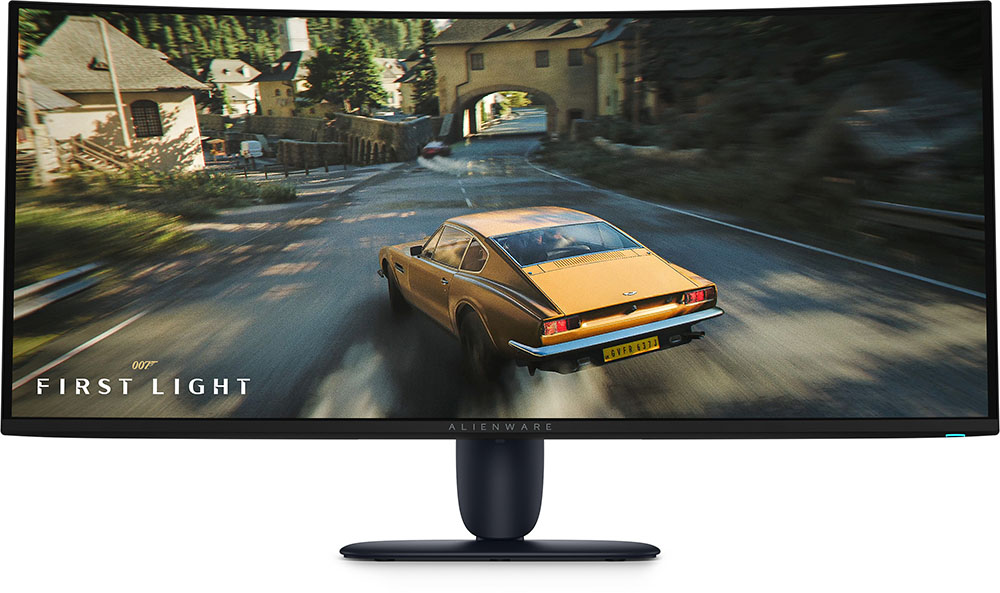 Dell
Dell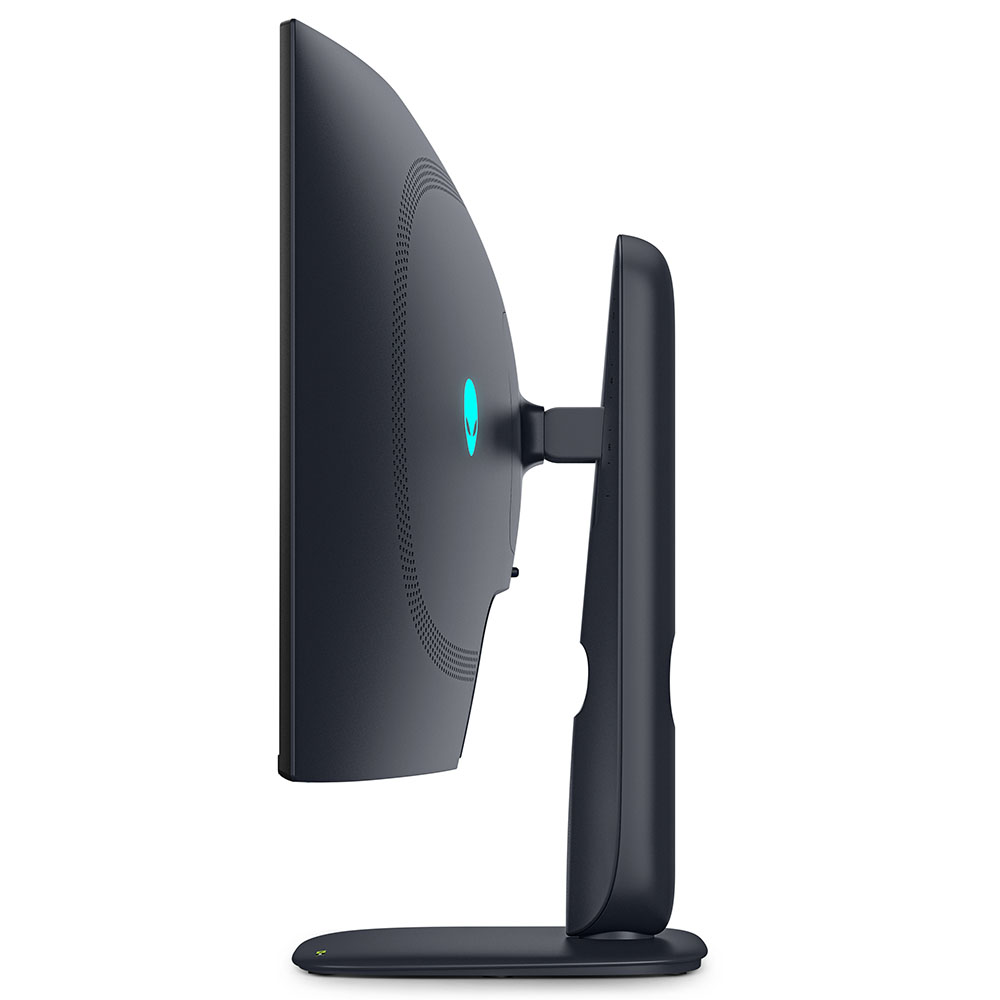 Dell
Dell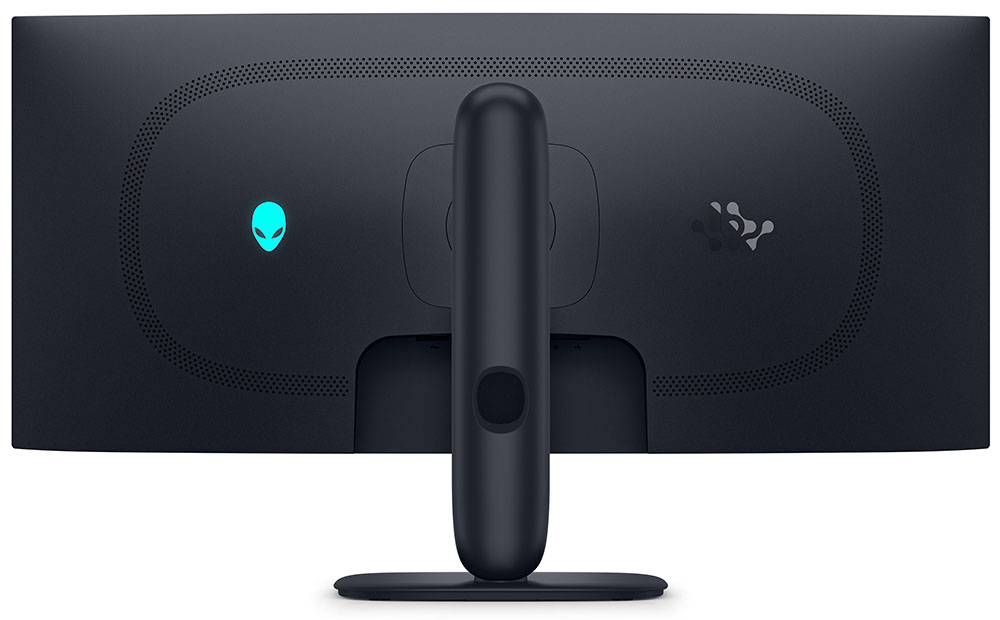 Dell
Dell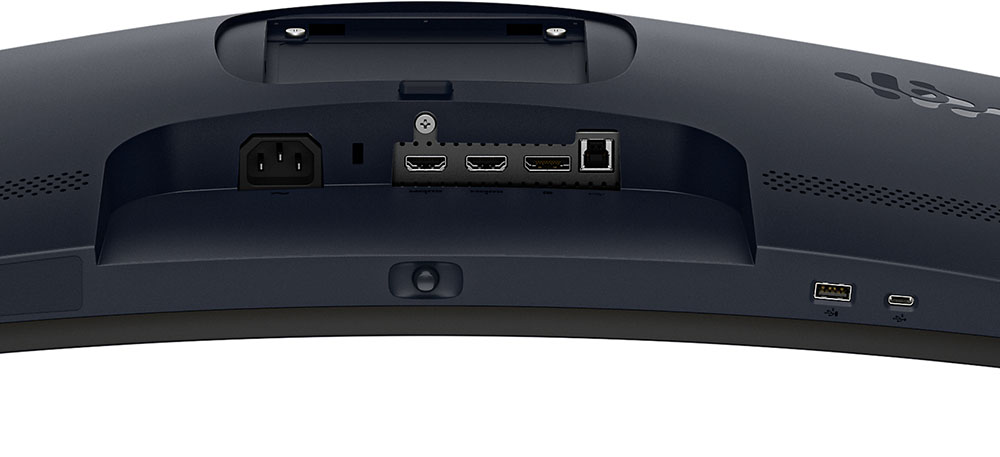 Dell
DellThe AW3426DW maintains the aesthetic Alienware introduced last year with softly rounded corners and smooth tapers. My favorite bit is where the upright and base meet; the joint appears to float with a slender swivel point that's barely visible. In the back is a backlit Alienware head and a polished symbol; Alienware 30" is the official term. The head can light up with different colors and effects. A subtle vent rings the fulcrum with small perforations that keep the internals cool. A graphite layer behind the OLEDs further cools the screen.
The side photo affords a good view of the rounded aesthetic. The stand has no angles or corners at all, just a small cable hole to keep wiring tidy. Ergonomics include a 5/21-degree tilt and a 20-degree swivel. The height range is 4.4 inches, and there is no portrait mode. Movements are firm and free of play. Build quality is premium in every respect. If you'd rather not use the stand, there is a 100mm VESA mount with fasteners included.
Underneath, you'll find a small I/O panel with two HDMI 2.1 ports and a DisplayPort 1.4 with Display Stream Compression (DSC). A USB upstream port supports the two downstream jacks on the panel's edge. You get a USB Type-A and Type-C. The Type-C port supports charging and peripherals, but not video. In the center, you can see the OSD joystick that controls all monitor functions.
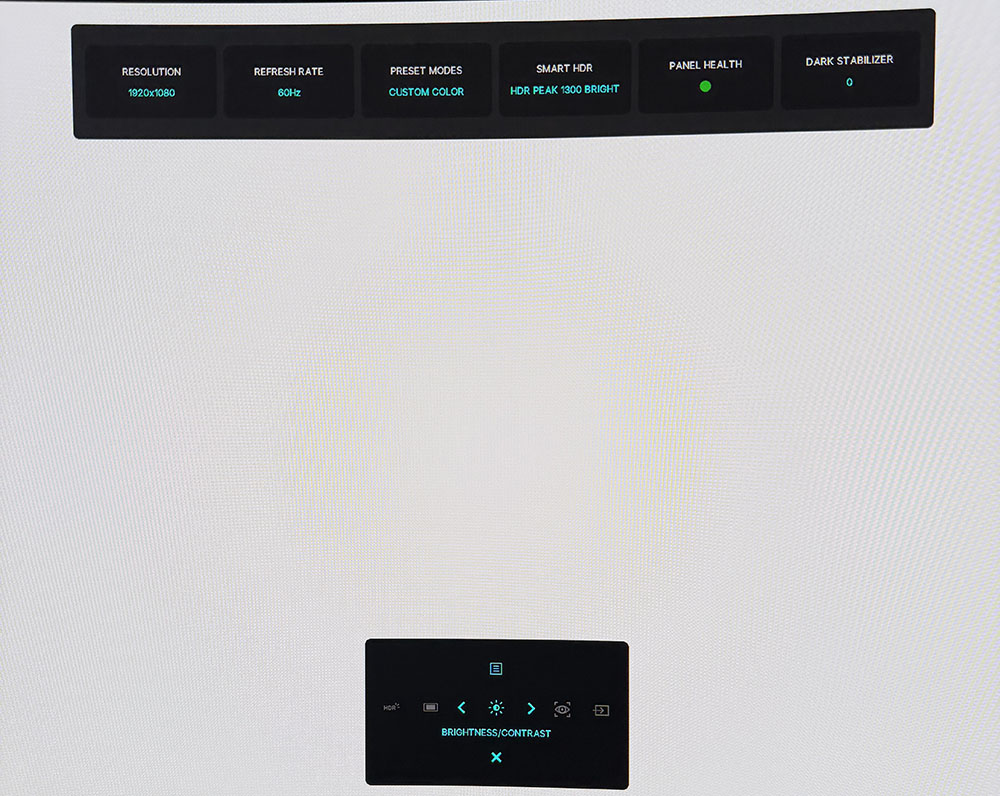
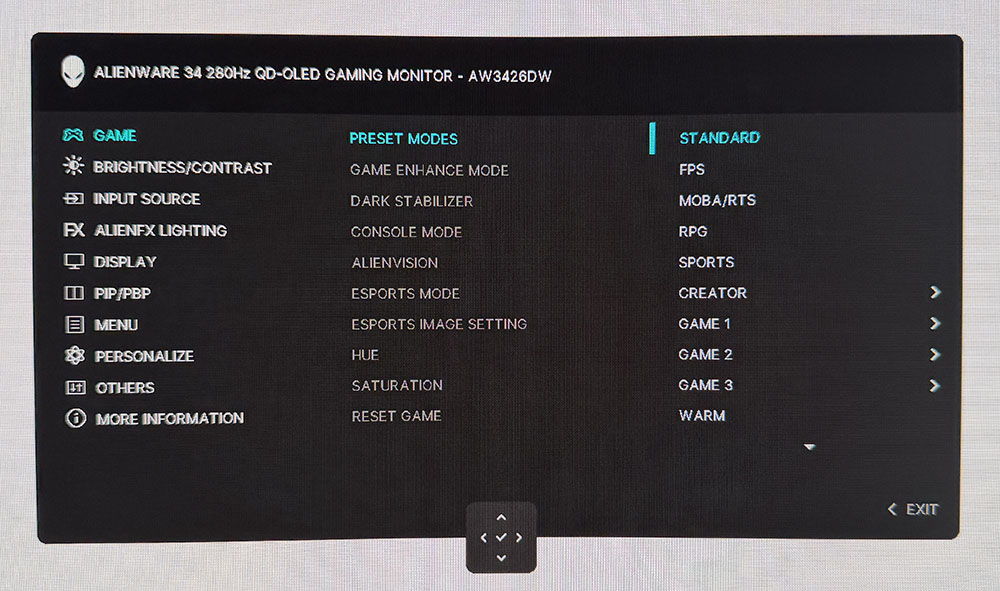
OSD FeaturesPressing the AW3426DW's joystick opens a quick menu at the bottom of the screen with a large status bar at the top. It shows input signal info along with the current picture mode, HDR status, panel health, and dark stabilizer setting. The quick menu has five icons that scroll left to right. They can be programmed for many different monitor functions, such as brightness/contrast, input, AlienVision, HDR, and others. Clicking the joystick up opens the full OSD.
 Tom's Hardware
 Tom's Hardware
 Tom's Hardware
 Tom's Hardware
 Tom's Hardware
 Tom's Hardware
 Tom's Hardware
 Tom's Hardware
 Tom's Hardware
 Tom's Hardware
In the Game menu, you can choose from 13 picture modes. Standard works well by default and does not require calibration if you're OK with using the full color gamut in SDR mode. It covers 105% of DCI-P3. If you want to make adjustments, select Custom Color, where you get RGB gain/bias and color management. To access sRGB, there's a Creator mode with a gamut selector and gamma presets.
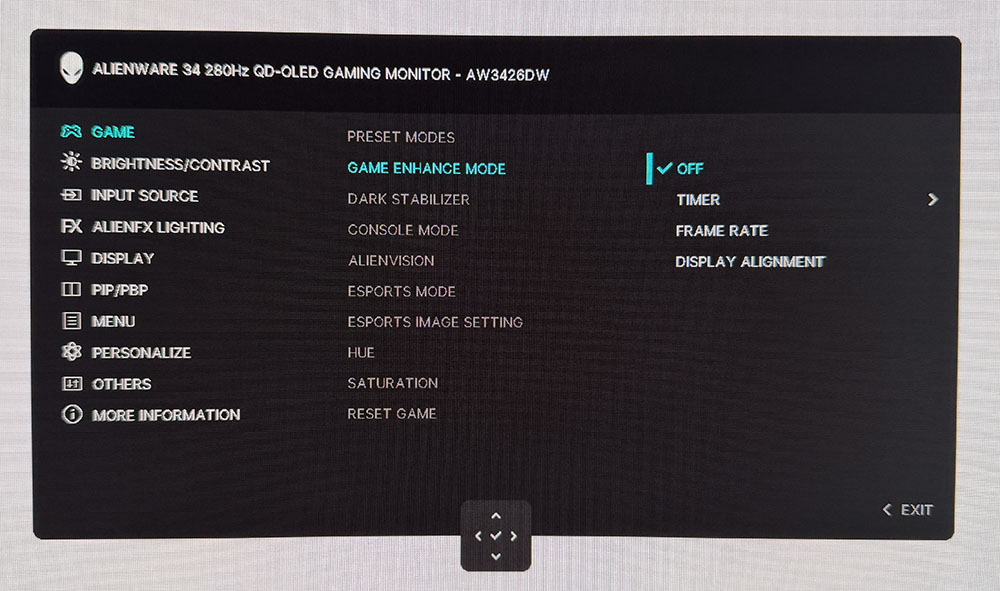
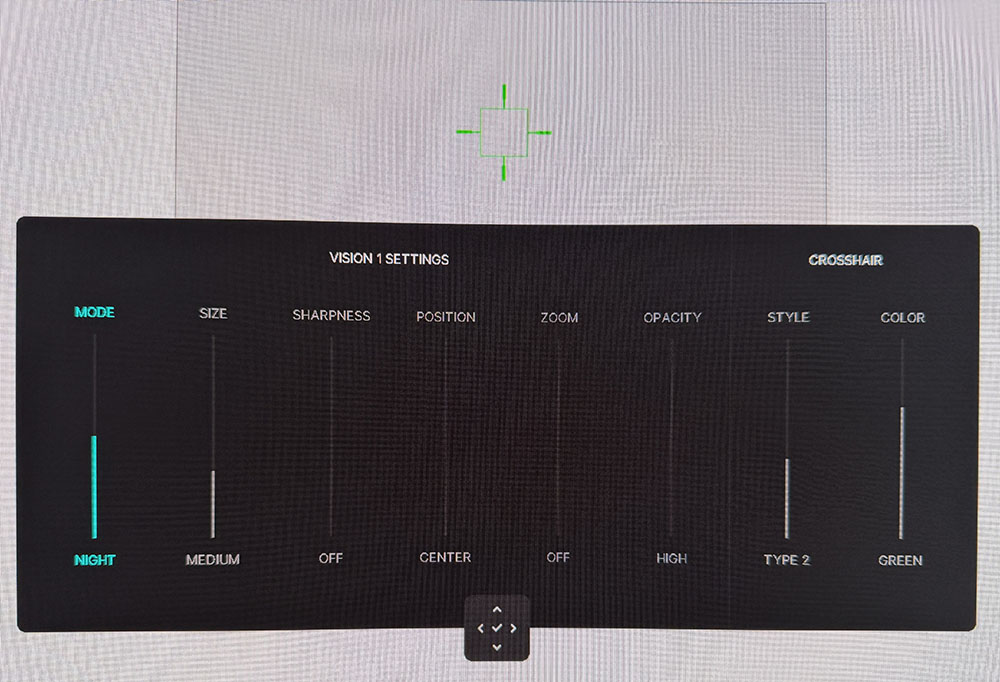
Game Enhance Mode contains a timer, frame counter, and alignment marks, but where are the aiming points? That's one of the coolest features of the AW3426DW, it's called AlienVision, and it is a completely customizable set of reticles and sniper modes, eight parameters in all, that can be edited and combined in hundreds of ways to create a custom view of the game environment. Once configured, there are three memories so you can have setups for different games.
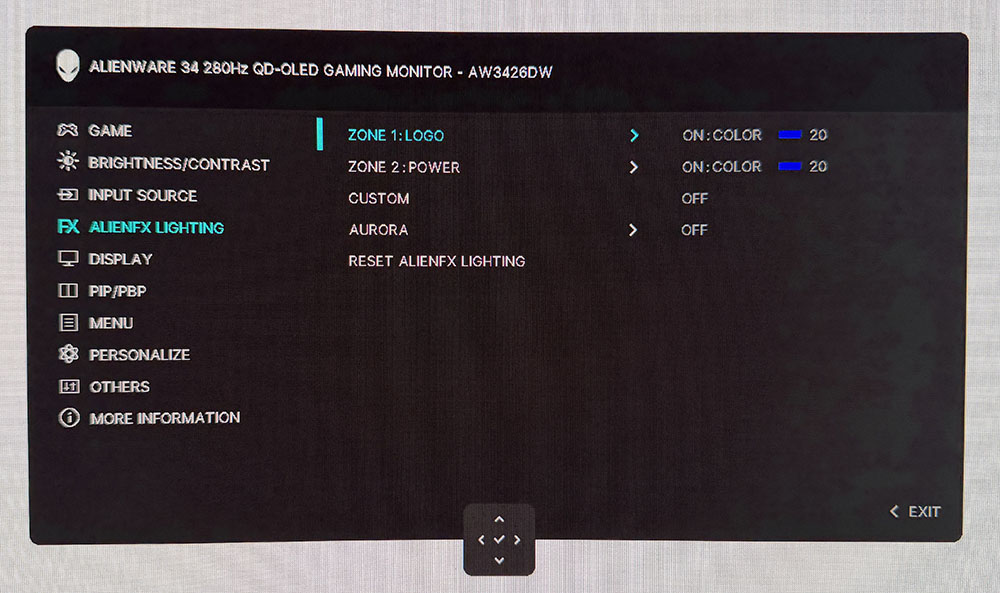
In the AlienFX Lighting menu, you can customize the behavior of the power button and the Alienware head on the back. There are lots of color and effect options, and you can turn on Aurora, which coordinates the lights with what's happening on screen. You'll need Alienware Command Center and a USB connection to make that happen.
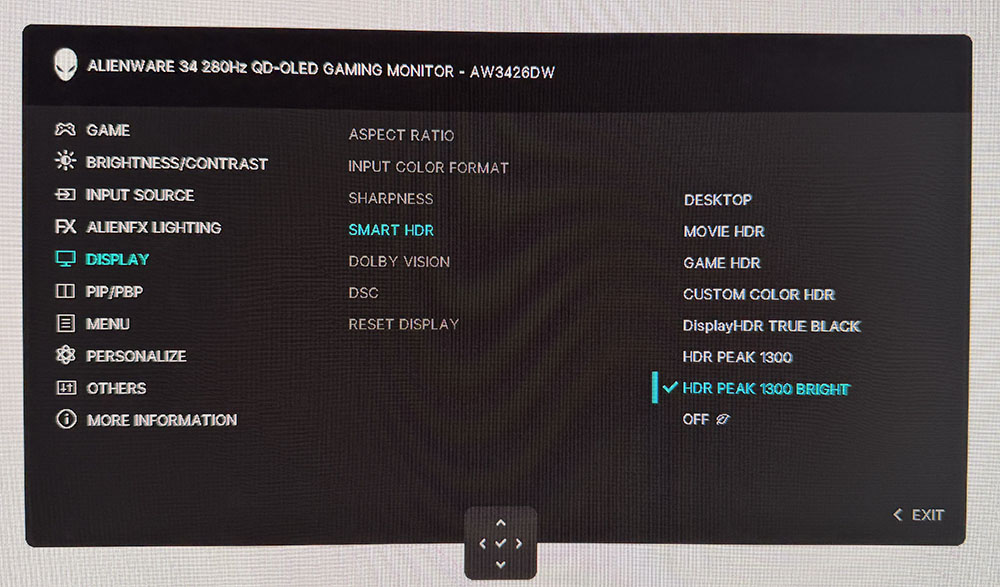
The Display menu has seven HDR modes for HDR10 content, including a tweakable Custom Color option. I found decent accuracy in both Desktop and HDR Peak 1300 Bright modes. I'll tell you more about that on page five. You can also toggle Dolby Vision on and off here.
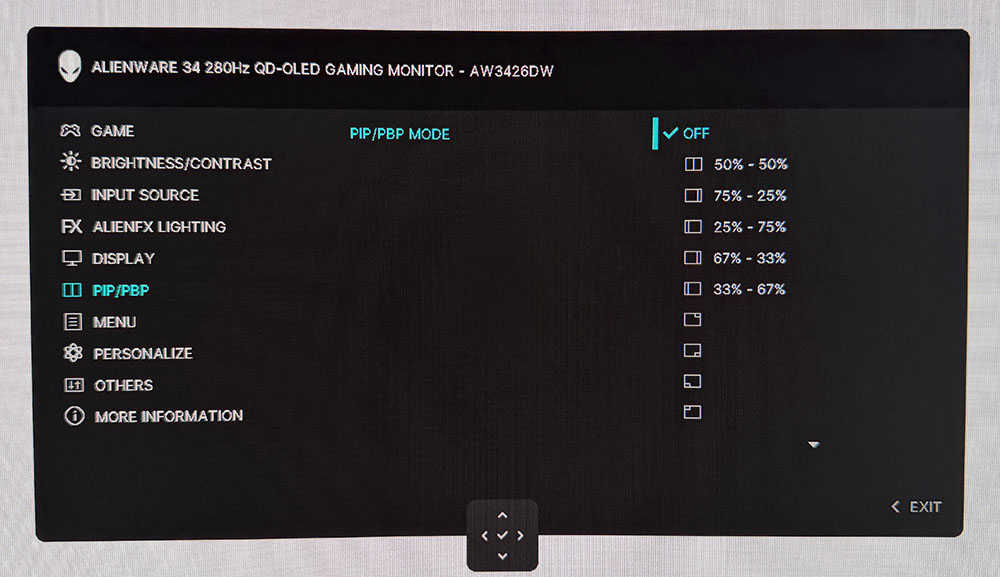
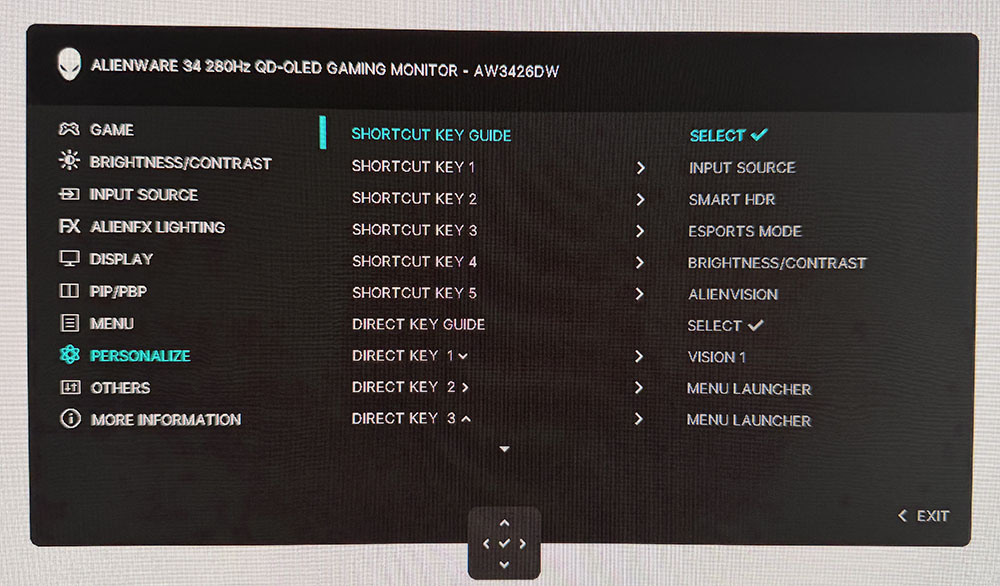
The AW3426DW includes PIP and PBP with options for window size and position. In Personalize, you can specify the functions of the five quick menu icons and the four joystick directions. This makes it easy to quickly change something like the input or the picture mode.
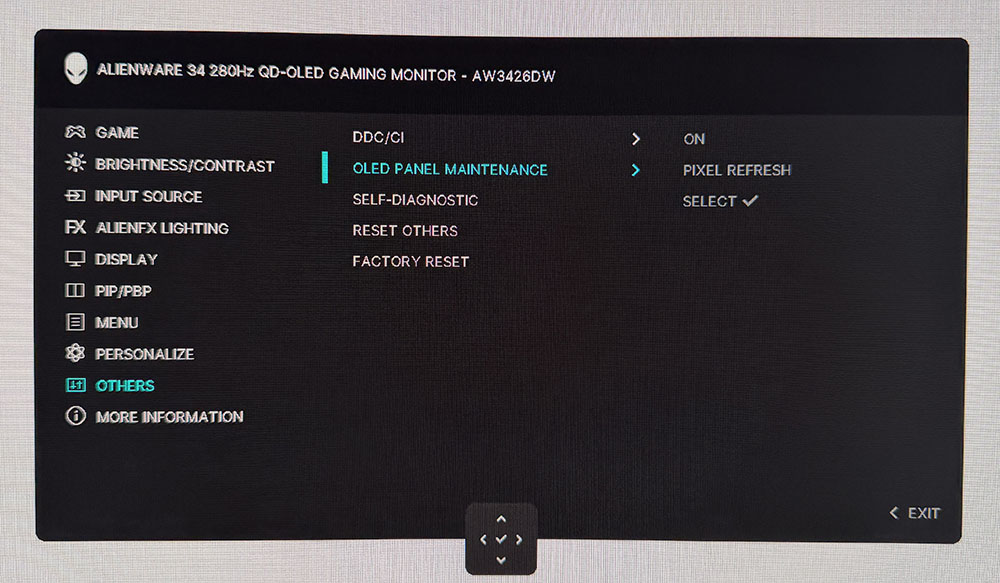
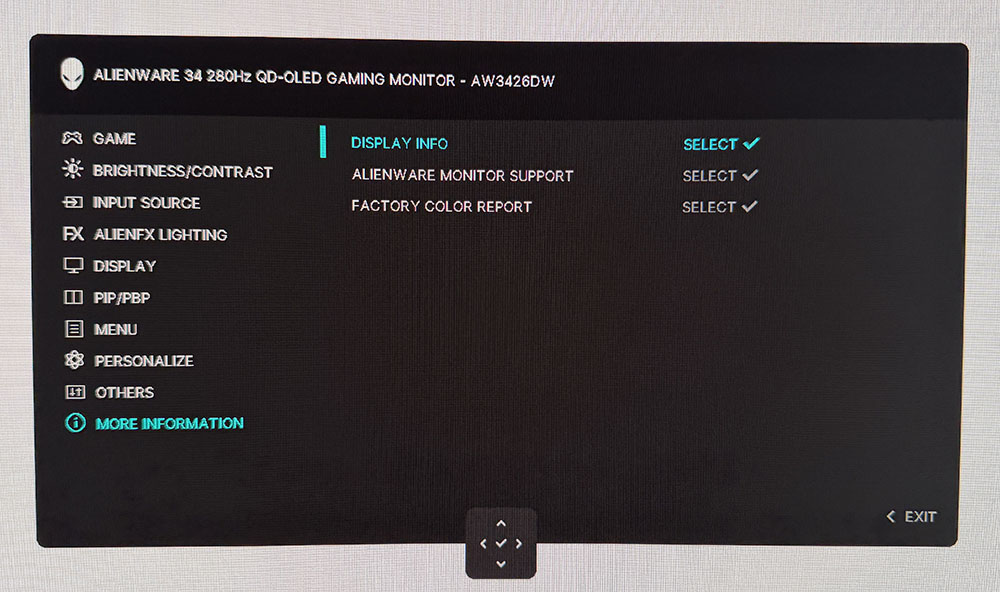
OLED care is much simpler now than in previous models. Functions like logo detection and pixel orbiting are handled automatically by the AW3426DW's firmware. The only thing you can do manually is pixel refresh. This menu also has a factory reset option. In the Information menu, you'll find an 11-page calibration report for each monitor, along with signal information and support resources.
Alienware AW3426DW Calibration SettingsCalibrating the AW3426DW is completely unnecessary. Just leave it in the default Standard mode and set brightness to taste. There is no variable brightness for SDR, so only one value is needed. If you want to calibrate, choose Custom Color. It has RGB gain and bias, plus hue and saturation sliders for each color. To change the gamut, use Creator mode. It lets you specify sRGB or P3 and includes five gamma presets. In the three Game modes, you can also adjust color and specify a custom value for the dark stabilizer. My SDR settings are included below.
For HDR content, there are seven more modes. Desktop is the default and is similar to HDR Peak 1300 Bright in its color and luminance tracking. The latter delivers the brightest highlights and the most vivid color.
Picture Mode | Custom Color |
Brightness 200 nits | 81 |
Brightness 120 nits | 53 |
Brightness 100 nits | 43 |
Brightness 80 nits | 32 |
Brightness 50 nits | 16 (min. 22 nits) |
Contrast | 75 |
Color Temp User | Red 99, Green 99, Blue 100 |
I suspect that some readers here will be wondering if the AW3426DW is a worthwhile upgrade over the AW3425DW. After several days of gaming and working, I will say that it is. HDR is brighter, and the new panel with its V-Strip RGB pixel structure is clearer than before. It's hard to quantify this since OLEDs are sharp by nature, but the AW3426DW does make an incremental improvement. Brighter HDR certainly makes an impact with highlights that pop and a dimensional quality that no premium Mini LED can match.
Color accuracy is superb both out of the box and after calibration, where I changed just two settings, one click each. The AW3426DW is truly factory-calibrated. It equals any professional monitor in terms of measured performance and image fidelity.
Gaming was an addictive experience, as it is with any fast OLED. The smooth motion that comes with panel response, measured in fractions of a millisecond, is something you can't get from an LCD. An OLED draws the screen about 10 times faster than an LCD with an equal refresh rate. The AW3426DW's bump to 280 Hz is also a reason to upgrade. It reduces my input lag by 4ms in my test. Could I spot that difference in gameplay? No, but I'm not a competition gamer either. Those looking for every advantage will want to give this monitor an audition.
The 34-inch curved panel proved useful for both work and entertainment. It's just large enough for me to display two documents side by side. It requires a bit more scrolling than my 16:9 32-inch screen, but the 1800R curve isn't too severe. There was no image distortion, but I got a nice wraparound effect when navigating first-person shooters and graphical adventures.
I appreciated the inclusion of USB ports, especially the two located on the bottom edge of the panel. It's easy to plug in peripherals or charge a phone from the USB-C port. But I missed the 3.5mm headphone jack. And there are no internal speakers, so to get audio, you'll need USB-capable headphones or a desktop amplifier if you want to drive cabinet speakers. And I enjoyed the AlienFX feature with its glowing Alien head. It played colors off the wall behind my desk.
Takeaway: The AW3426DW is a worthy upgrade from the AW3425DW. It's quicker and brighter, and the image is a tad sharper than before. Input lag is lower as well, which will appeal to skilled gamers looking for every possible advantage. Color is saturated and vivid with accuracy good enough to use right out of the box. The screen's curve strikes an ideal balance between immersion and a square image.
MORE: Best Gaming Monitors
MORE: How We Test PC Monitors
MORE: How to Buy a PC Monitor
To compare the AW3426DW's performance, I've included its predecessor, the AW3425DW, along with Asus' PG34WCDN, Acer's X34 OLED, AOC's AG346UCD, and Gigabyte's MO34WQC2. The response chart is a different group of OLEDs owing to my recent acquisition of the Nvidia LDAT tester. It includes Acer's X27 X1, ViewSonic's VX2738-2K, MSI's MPG 322UR X24, Asus PG34WCDN, and Alienware's AW2726DM.
Pixel Response and Input LagClick here to read up on our pixel response and input lag testing procedures.
 Tom's Hardware
 Tom's Hardware
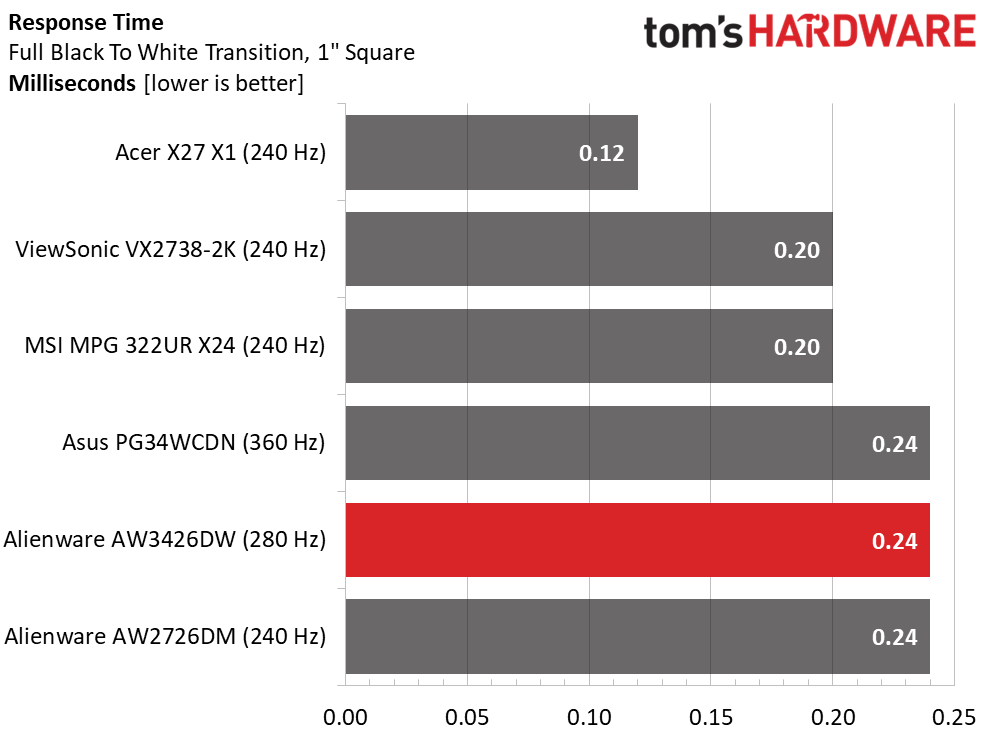
OLED panel response times are extremely tight, and in practice, you're unlikely to see a difference unless frame rates are low. A panel like the AW3426DW, with its 0.24ms draw time, will retain smooth motion resolution down to about 160 fps. A faster panel like the Acer can maintain blur-free operation up to around 140 fps. If your video card can keep the action above 200 Hz, all the panels will perform equally from a visual standpoint.
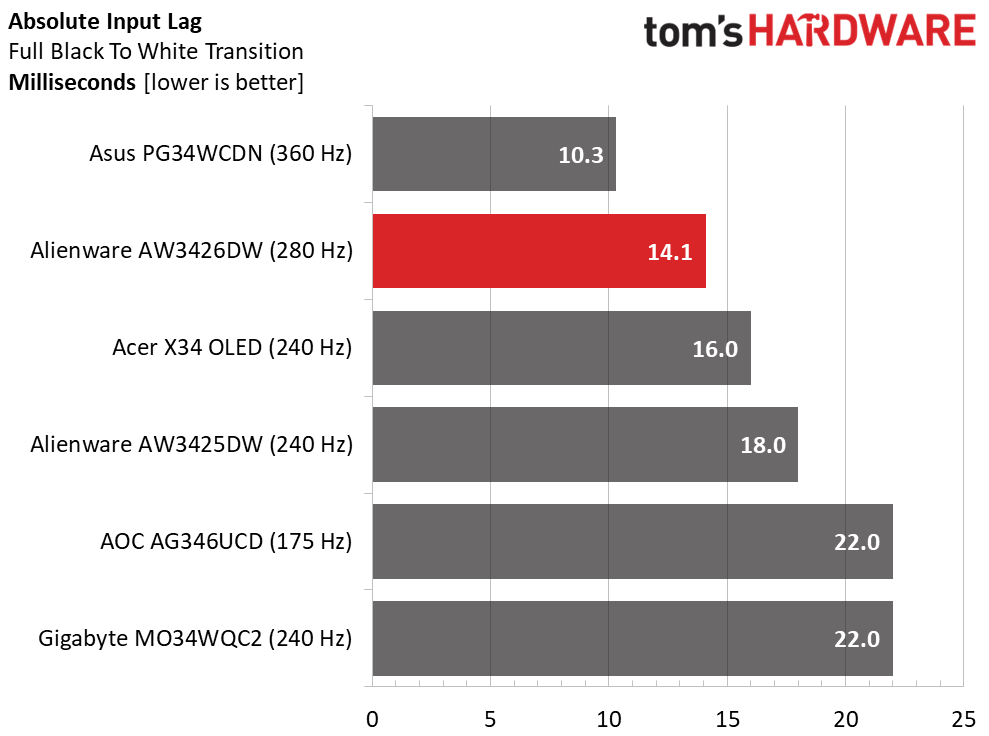
In the lag test, the AW3426DW is among the fastest panels I've tested. The Asus is an extreme overachiever. Only a couple of other monitors can approach 10ms in my test. 14.1ms is very fast, more than enough for pro-level competition. And it's a tad quicker than last year's AW3425DW. Most gamers will be satisfied with the AOC and Gigabyte screens at 22ms. Remember that the fastest human reaction time is typically around 100ms.
Test Takeaway: The AW3426DW improves slightly over its predecessor, with nearly 4ms less input lag. Its panel response is on par with the other fast OLEDs I've tested. Motion resolution is extremely high, with moving objects rendering blur-free. It is fast and smooth enough for pro-level competition.
Viewing Angles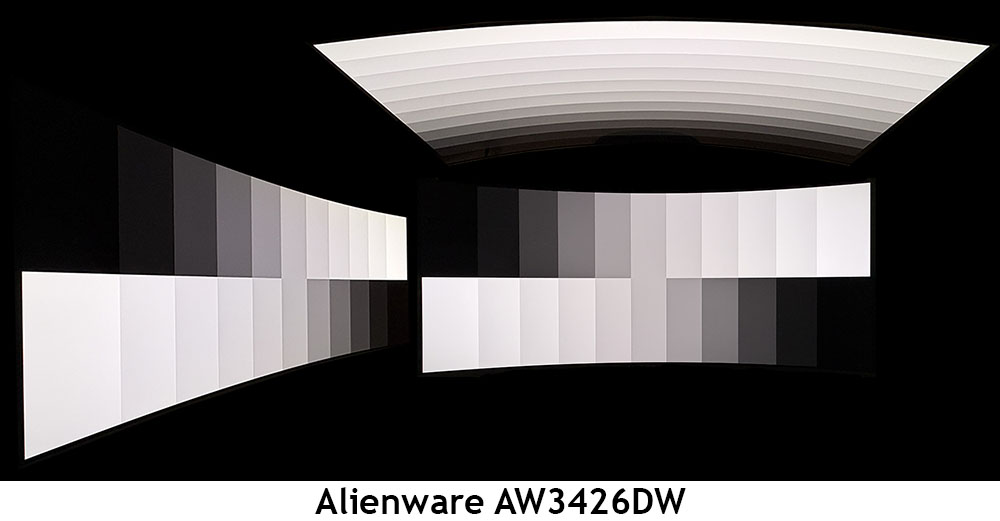
Most Quantum Dot OLEDs show a slight tint in 45-degree-angle photos, but the AW3426DW's tandem OLED tech seems to have eliminated that issue. There is no change to gamma or brightness either. This is about as good as it can possibly be. Viewing angles up to 45 degrees are visually perfect. The top view has a slight red shift with a 10% brightness drop and reduced gamma.
Screen UniformityTo learn how we measure screen uniformity, click here.
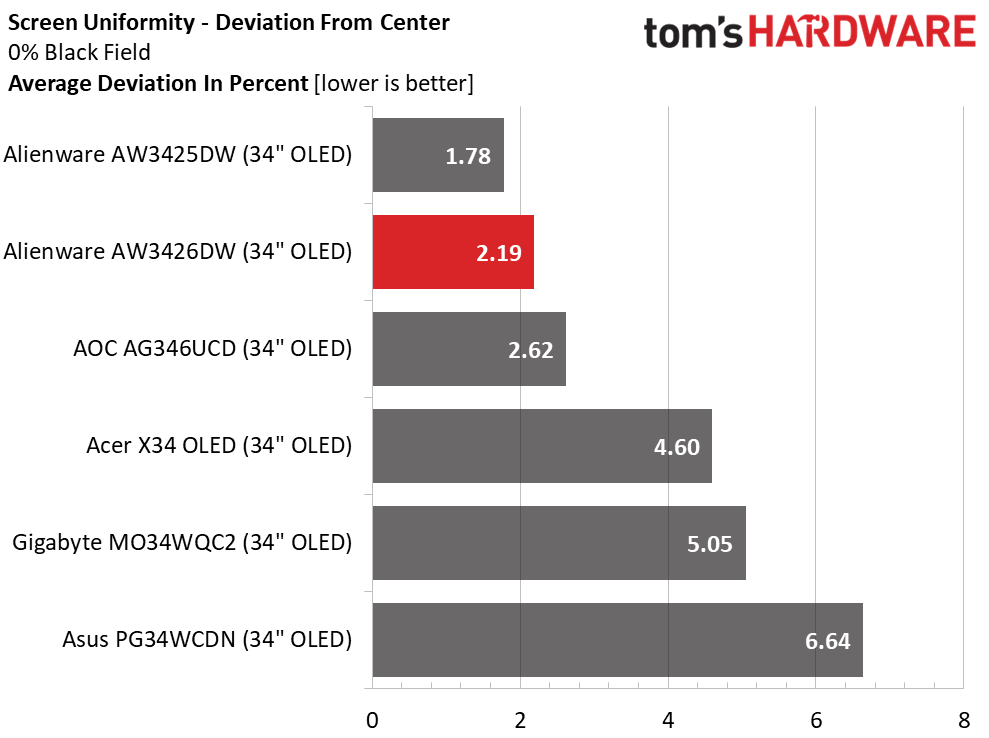
Fittingly, the AW3426DW aces my uniformity test and is bested only by its predecessor, the AW3425DW. Visually, there is no difference here. You won't see any variation among these screens, as they are all below the visible threshold of 10%. It doesn't get better than that.
MORE: Best Gaming Monitors
MORE: How We Test PC Monitors
MORE: How to Buy a PC Monitor
To read about our monitor tests in-depth, please check out Display Testing Explained: How We Test PC Monitors. We cover brightness and contrast testing on page two.
Uncalibrated - Maximum Backlight Level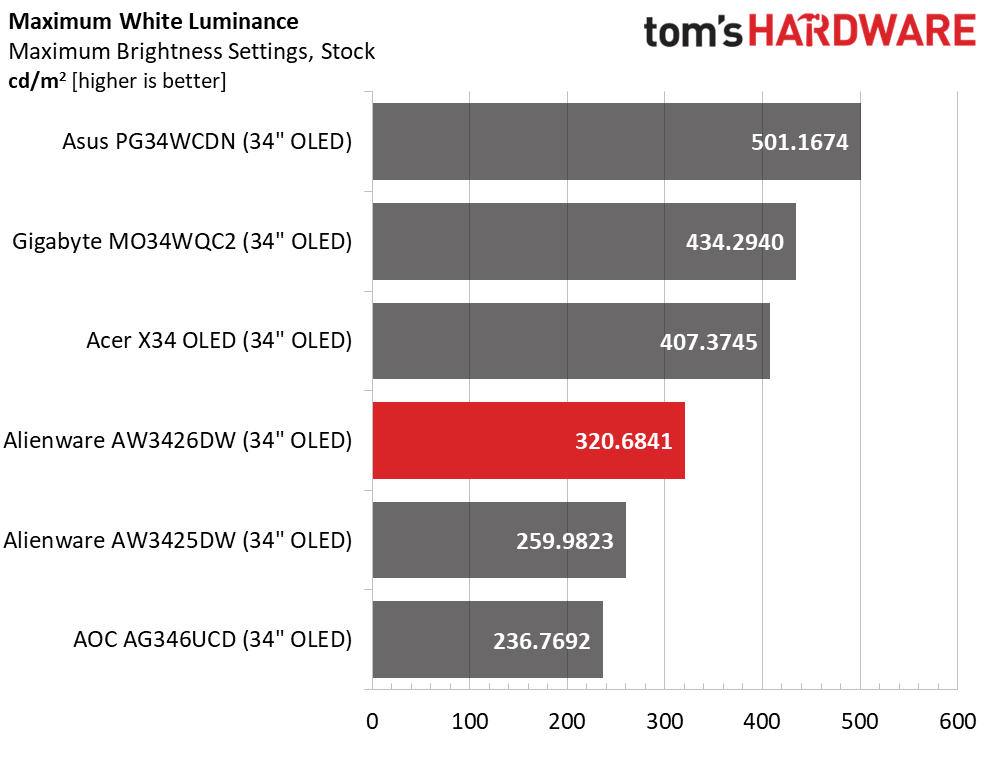 Tom's Hardware
 Tom's Hardware
 Tom's Hardware
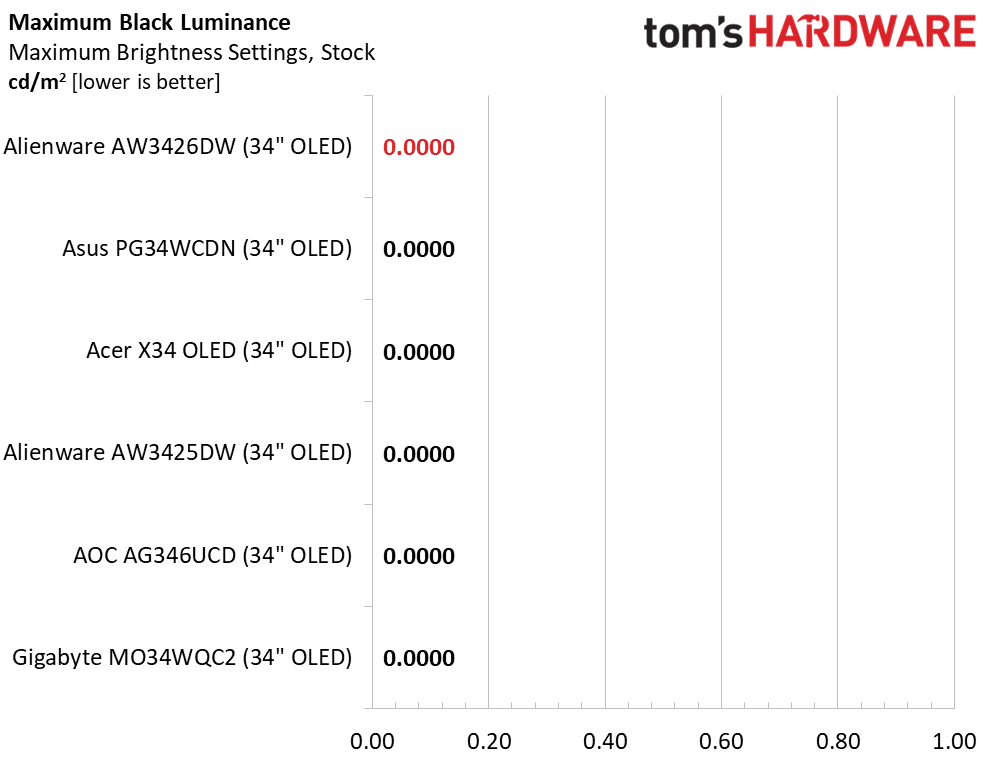
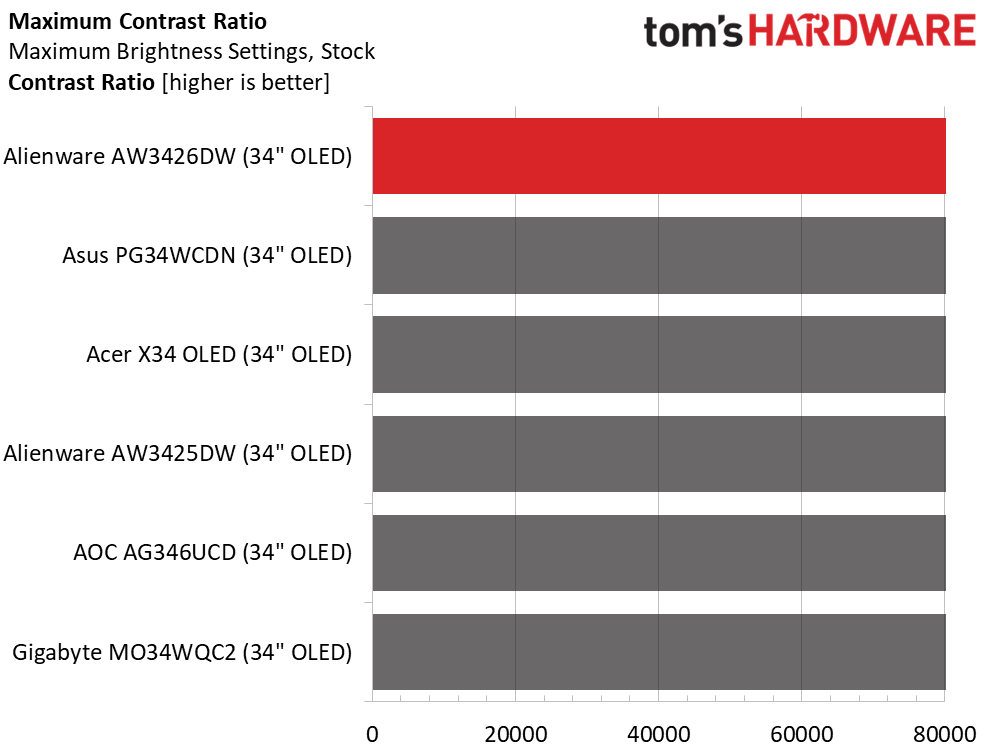
The AW3426DW is a bit brighter than last year, with over 320 nits peak for SDR. That's from a full field white pattern. There is no variable brightness option, so you'll see the same number from smaller windows and highlights in actual content. This does not reduce the impact of OLED's infinite contrast and its unmeasurable black levels. The new anti-glare layer and five-layer Tandem OLED are said to lower black levels, but to the naked eye, they were already as black as black gets.
After Calibration to 200 nits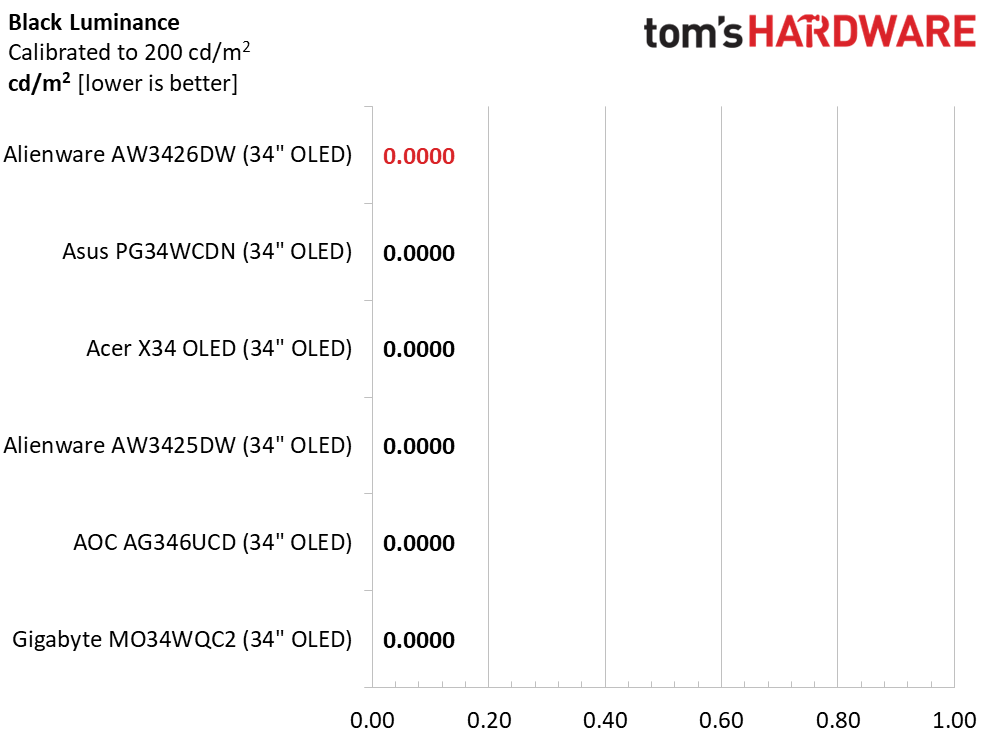 Tom's Hardware
 Tom's Hardware
 Tom's Hardware
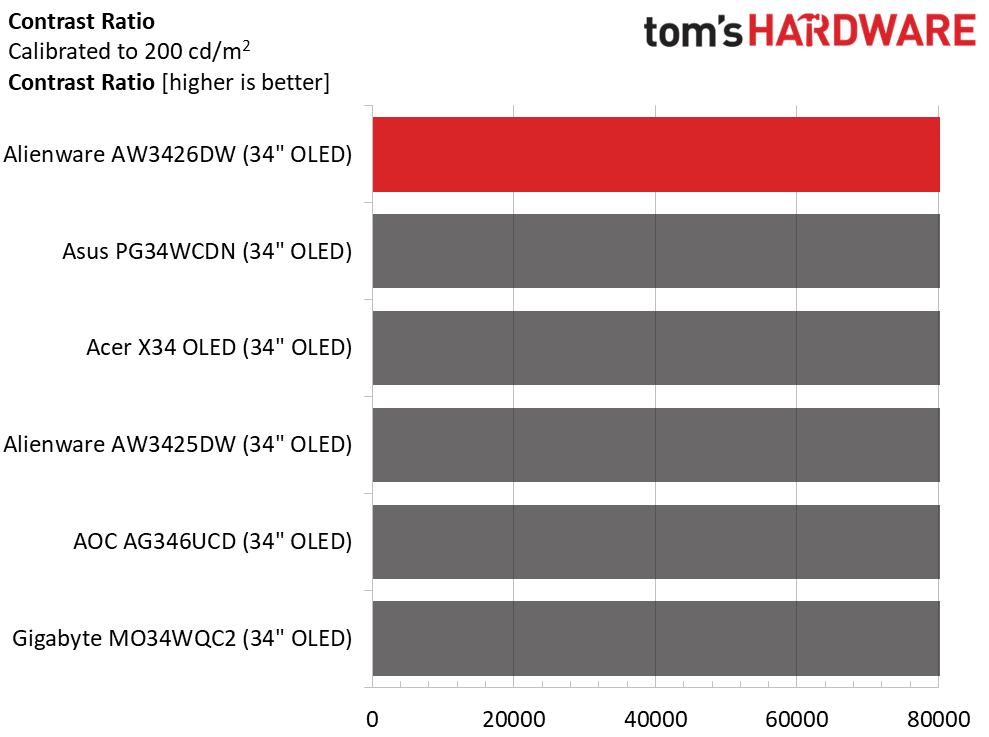
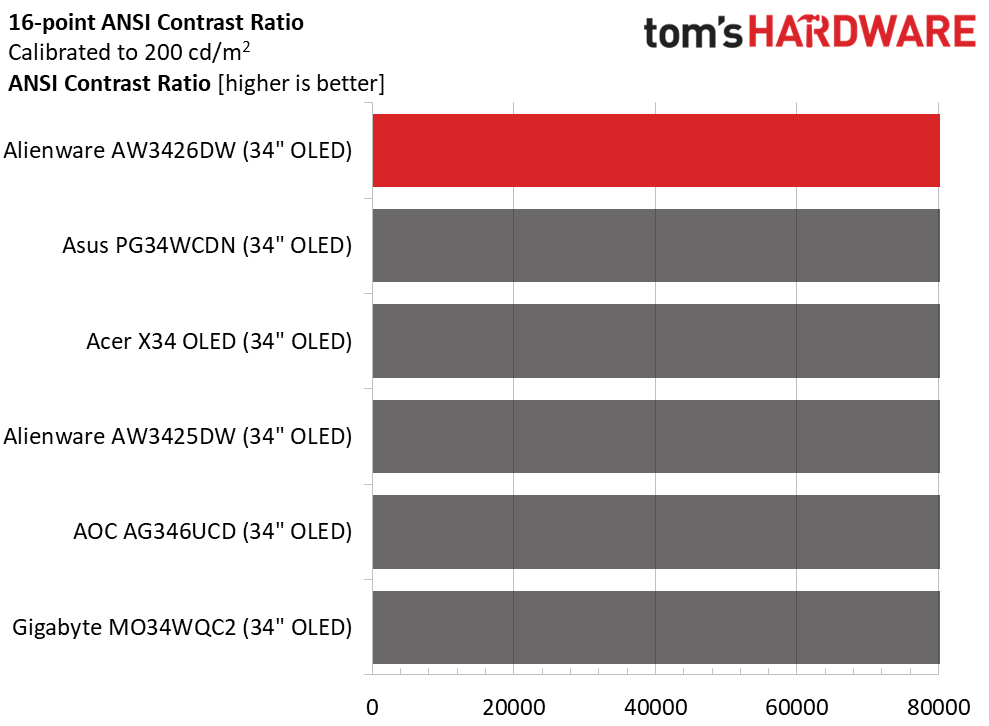
Calibration doesn't change the black level or contrast result. It still cannot be measured. You'll only need one brightness value since there's no variable option. That comes into play for HDR content, though. ANSI, or intra-image contrast, also cannot be measured.
Test Takeaway: The AW3426DW offers the same black level and contrast performance as any OLED. That said, its new anti-glare layer offers better light rejection, which improves the perception of blacks in environments with medium to high ambient light levels. That is a visual observation that I cannot measure with instruments. One point in favor of upgrading your AW3425DW to an AW3426DW is the extra 60 nits of peak brightness it offers.
MORE: Best Gaming Monitors
MORE: How We Test PC Monitors
MORE: How to Buy a PC Monitor
The AW3426DW came to me set to Standard picture mode, which, as you'll see, does not need calibration. There is an 11-page report stored in each sample's firmware that you can read from the OSD. My tests confirmed that it is indeed calibrated at the factory.
Grayscale and Gamma TrackingOur grayscale and gamma tests use Calman calibration software from Portrait Displays. We describe our grayscale and gamma tests in detail here.
 Portrait Displays Calman
 Portrait Displays Calman
 Portrait Displays Calman
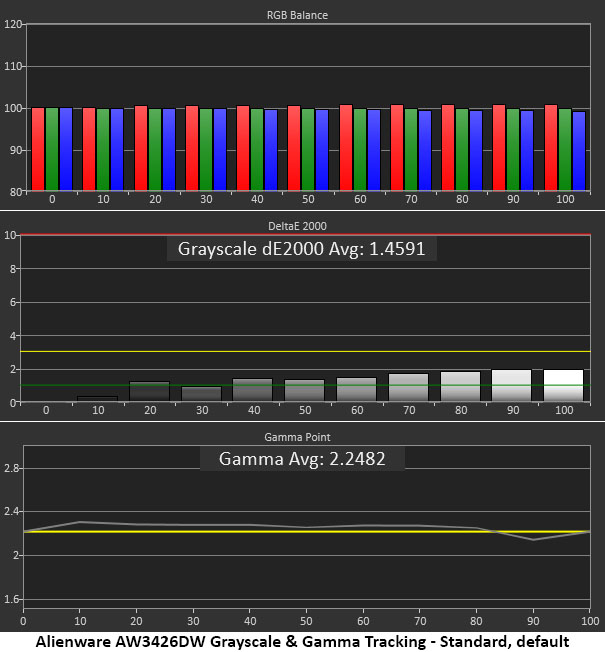
If I were just going to put the AW3426DW on my desk and use it for gaming and productivity, I would not bother with adjustments. The first chart shows that it has no grayscale errors above 2dE, and the gamma is slightly dark but very close to the 2.2 reference. This is impressive out-of-box performance.
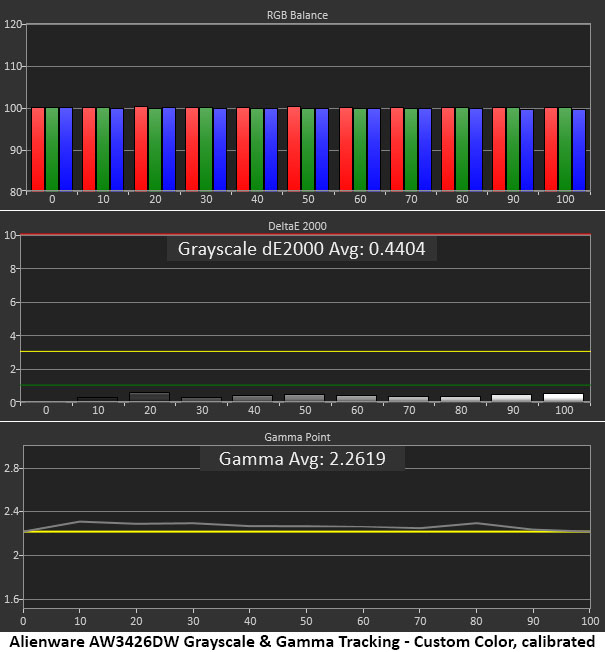
In the Custom Color mode, you get RGB gain and bias sliders. I didn't have to touch the bias, but I lowered red and green gain by one click each. The result was all errors below 0.5dE and a slightly tighter gamma. The visual difference is extremely small, but if you have the desire and the means, why not? This is a superlative performance.
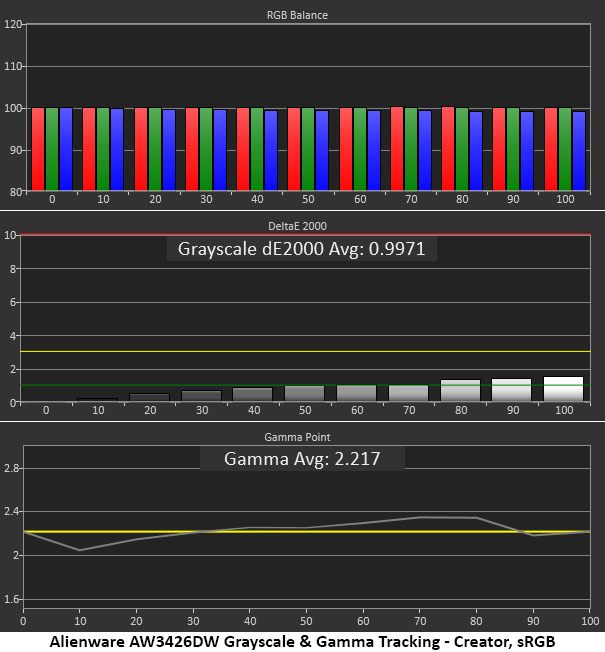
The Creator sRGB mode has very accurate grayscale, but gamma is a tad wonky. It's too light at 10%, making the shadow areas less black. And there's a rise between 60 and 80%, which takes a bit of definition out of the brighter mid-tones. This is a minor error, but it would be nice to have tighter gamma. You can change the preset, but you can't alter the curve's shape.
Comparisons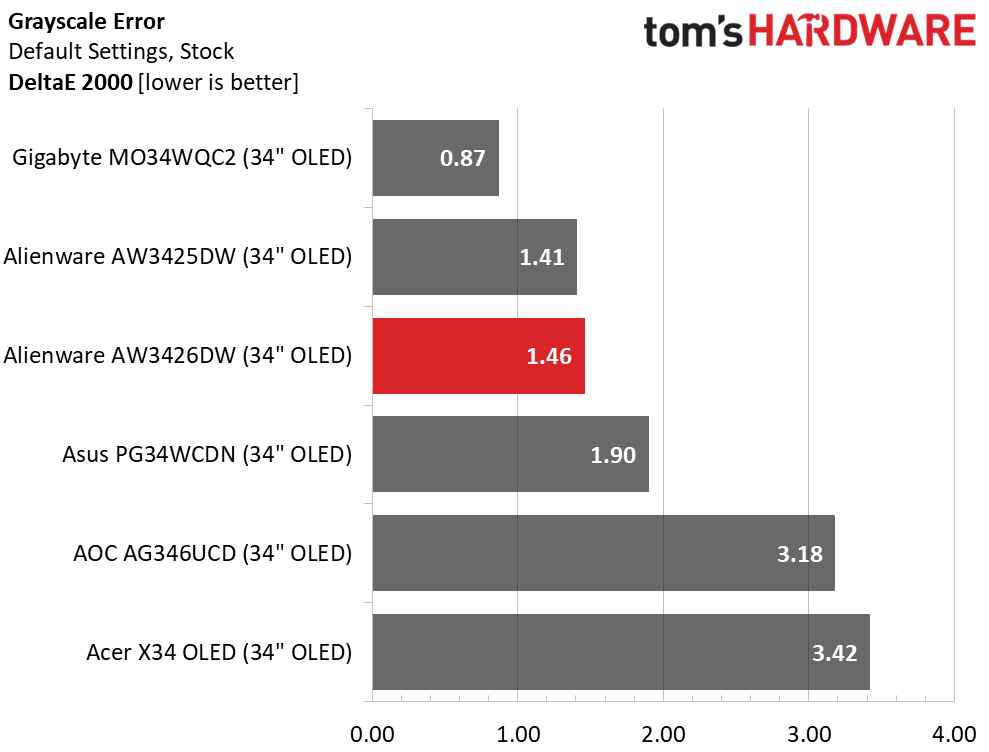 Tom's Hardware
 Tom's Hardware
 Tom's Hardware
 Tom's Hardware
Though the AW3426DW impresses with a 1.46dE default grayscale score, it is slightly bested by its predecessor and by the Gigabyte. These numbers are more like talking points as the visual difference can't be seen with the naked eye. But I am here to be precise in my testing.
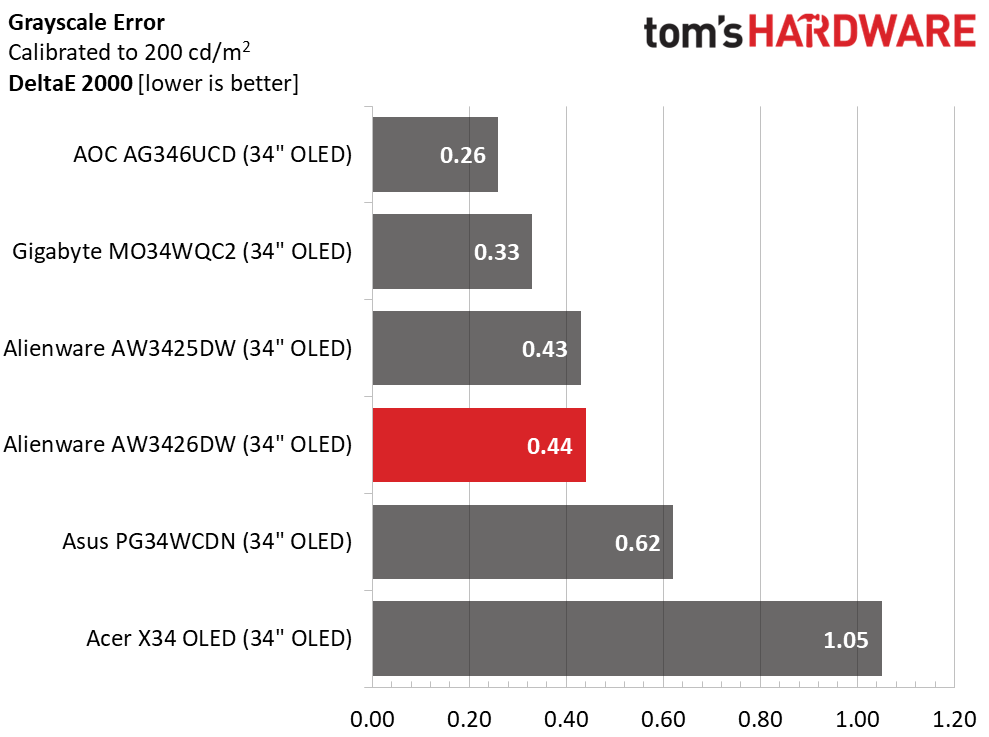
Calibration takes the AW3426DW down to 0.44dE, but again, it is pipped by the AW3425DW by 0.01dE. Yes, that is a hair at best. All the monitors here test extremely well.
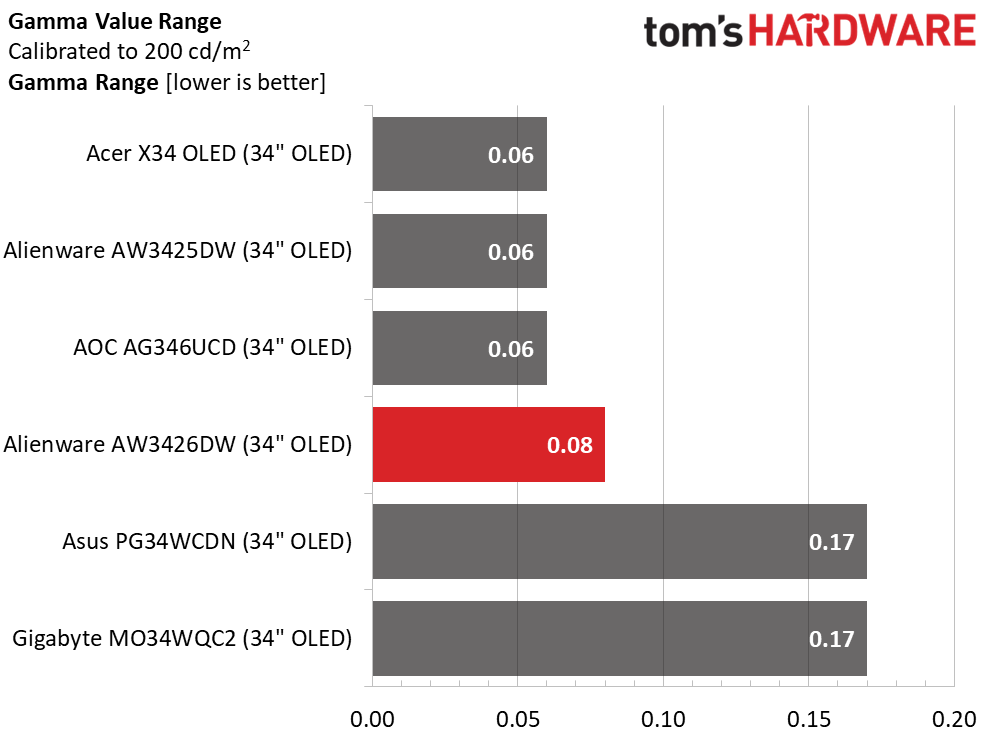
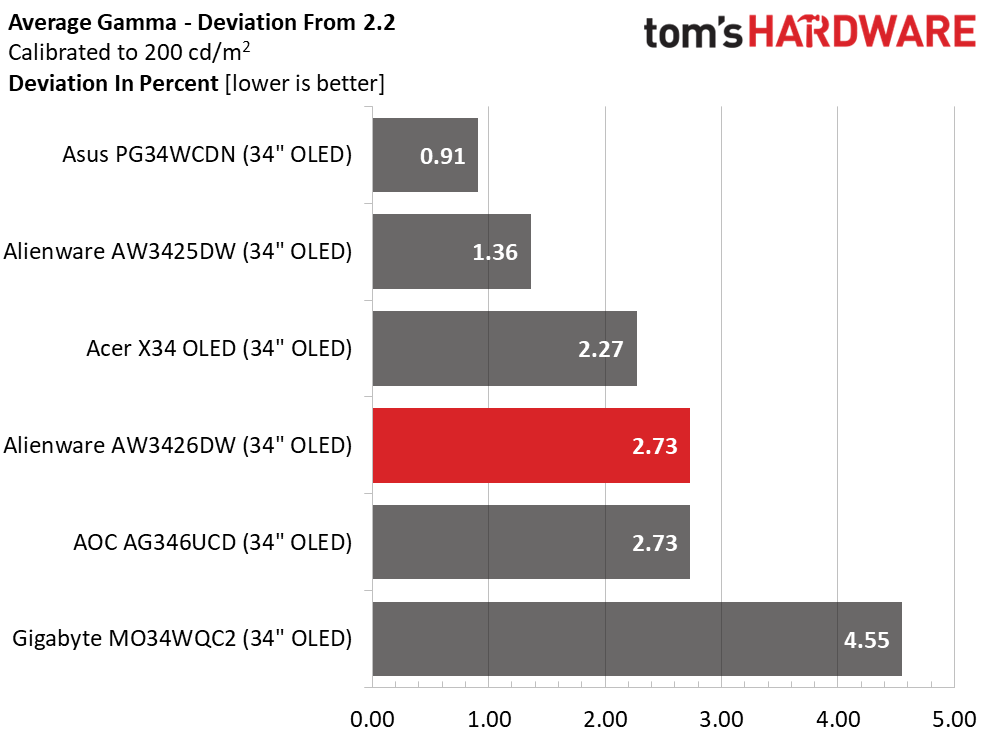
Gamma performance is excellent but middling by comparison. The range of values is very tight at 0.08 from lowest to highest. The deviation is 2.73% with an actual average of 2.26. This is excellent performance.
Color Gamut AccuracyOur color gamut and volume testing use Portrait Displays' Calman software. For details on our color gamut testing and volume calculations, click here.
 Portrait Displays Calman
 Portrait Displays Calman
 Portrait Displays Calman
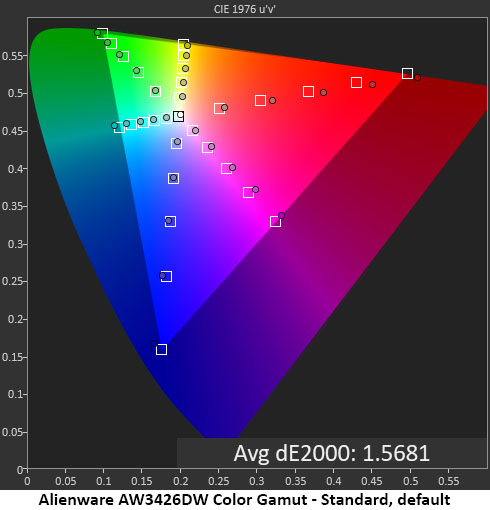
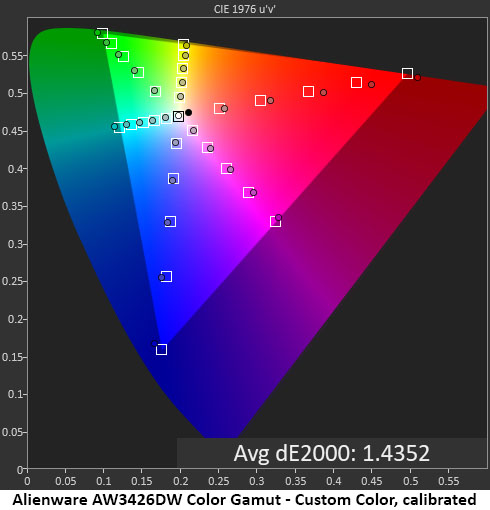
The color test result clearly shows the advantage of Quantum Dot technology. The AW3426DW fully covers all primaries, including green with slight oversaturation at all points. This means the picture will be very colorful but also well-balanced. Calibration barely makes a difference, but you can see slightly better hue tracking in cyan, magenta, and yellow.
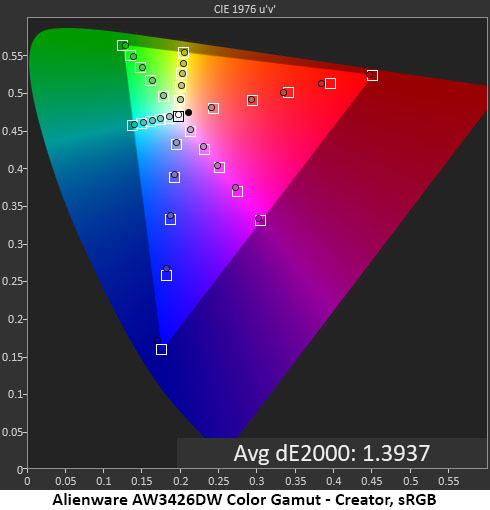
The sRGB chart is very good overall, but with some slight undersaturation in the midrange red tones. This is an extremely small error. The AW3426DW is qualified for color-critical applications.
Comparisons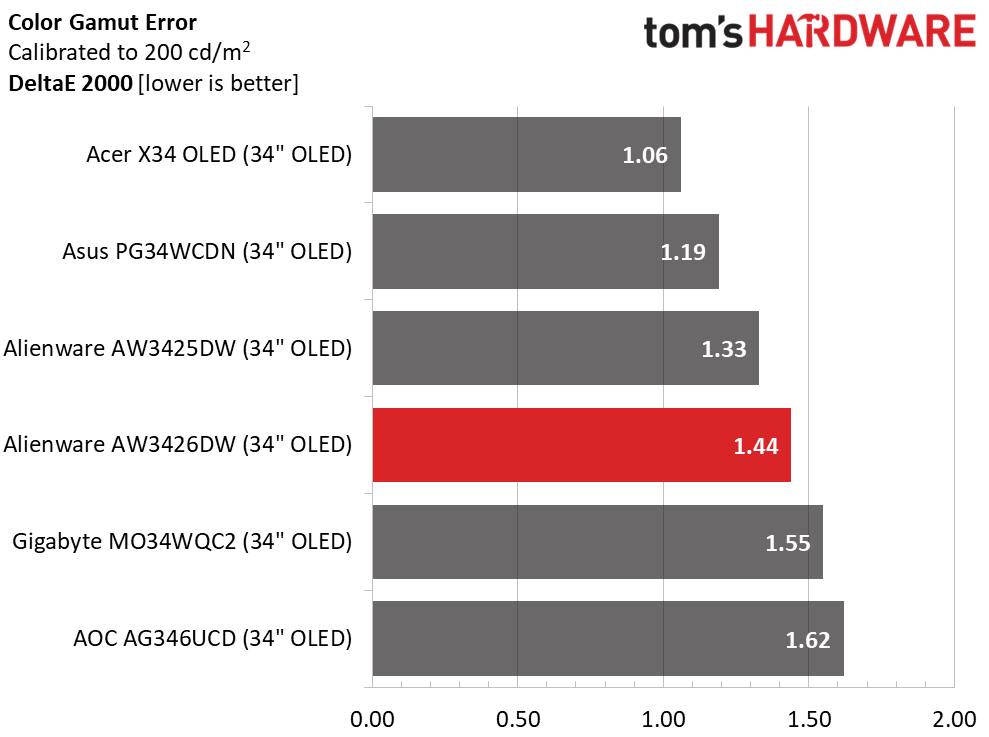 Tom's Hardware
 Tom's Hardware
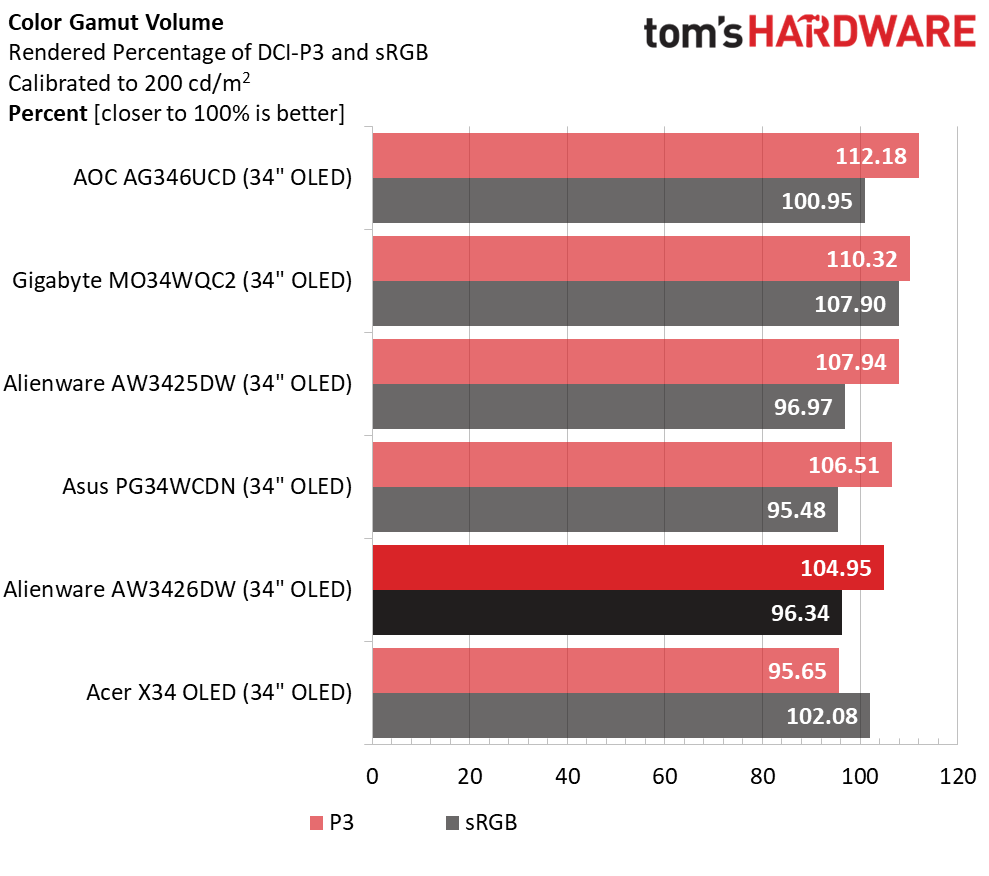
The color difference between all six monitors is extremely small. From an error standpoint, there is no visible difference. The only variation comes in the volume test, where the AW3426DW sits at the bottom of the Quantum Dot screens. It has about 1.5% less color volume than the AW3425DW, which is an invisible difference. The AOC and Gigabyte screens have a touch more green and red, but you'll only see that in the brightest content. For everyday games, videos, and applications, all six monitors will look the same.
Test Takeaway: The AW3426DW has exemplary out-of-box color, grayscale, and gamma accuracy. It does not need calibration, but a couple of tweaks generated awesome numbers in my tests. Its color volume is on par with other Quantum Dot screens at a hair shy of 105% of DCI-P3. No one would complain about its colorful and clear image.
MORE: Best Gaming Monitors
MORE: How We Test PC Monitors
MORE: How to Buy a PC Monitor
Our HDR benchmarking uses Portrait Displays' Calman software. To learn about our HDR testing, see our breakdown of how we test PC monitors.
The AW3426DW offers higher brightness than its predecessor for both SDR and HDR content. It's rated for 1,300 nits from a 3% window and certified by VESA for DisplayHDR 500. HDR10 signals get seven specific modes, and it supports Dolby Vision.
HDR Brightness and Contrast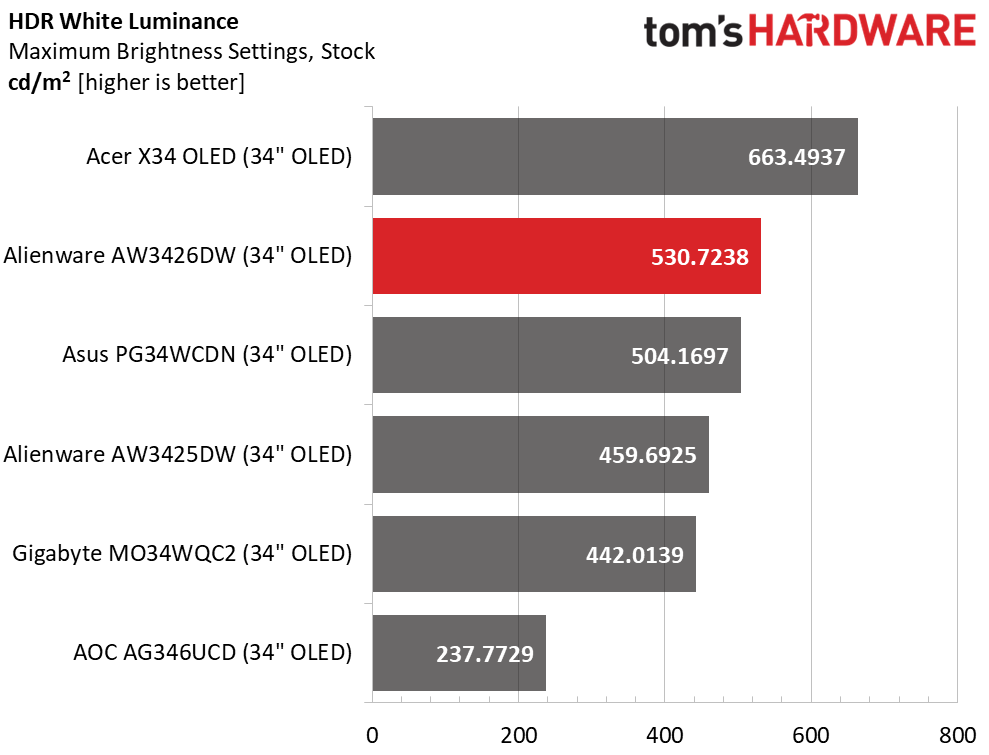 Tom's Hardware
 Tom's Hardware
 Tom's Hardware
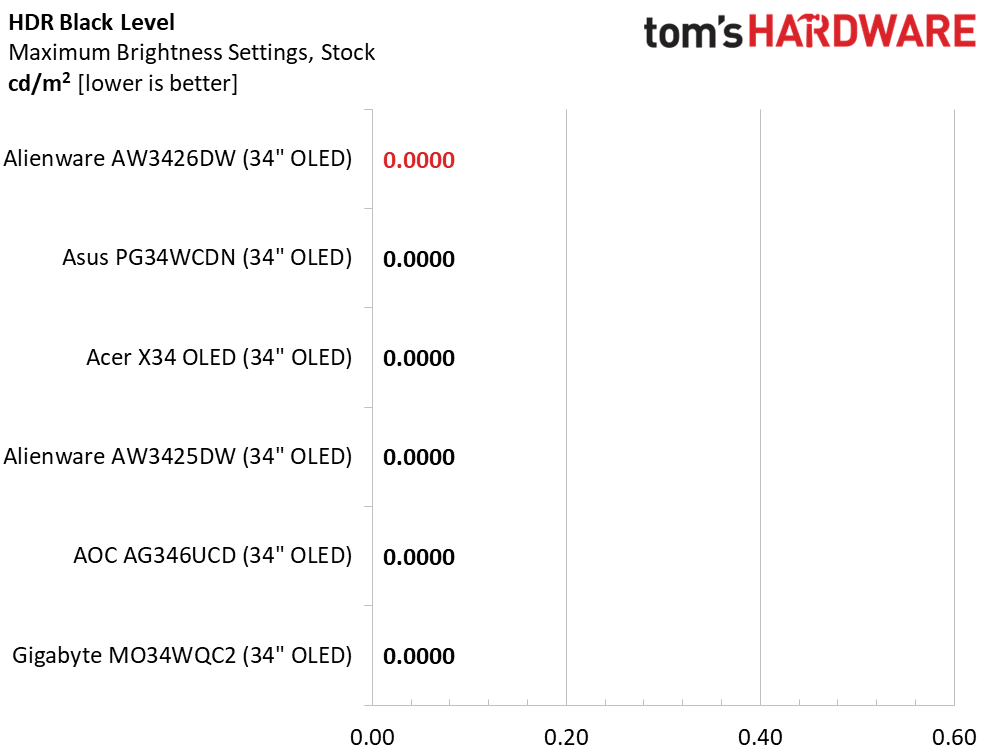
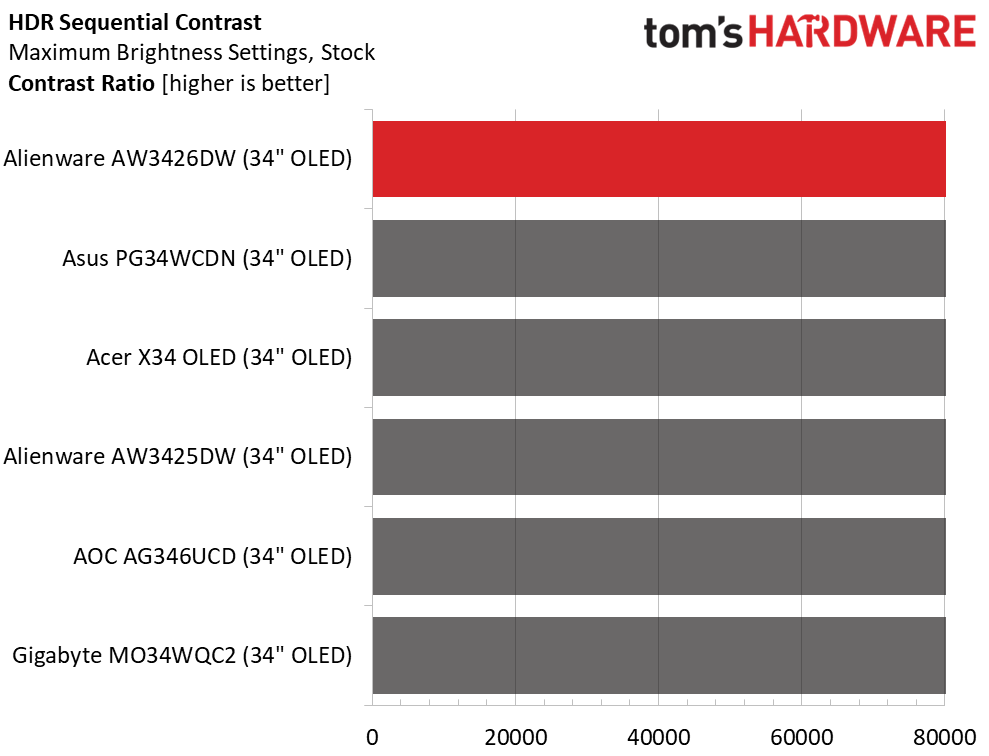
For my tests, I measured HDR10 performance and noted a 70-nit higher peak for the AW3426DW over the AW3425DW. This is from a 25% window pattern. A 3% window is claimed at 1,300 nits, and this result leaves no reason for doubt. The AW3426DW is definitely brighter than before, and its HDR is more impactful. Variable brightness is in play here and cannot be turned off, not that you'd want to. This is excellent performance.
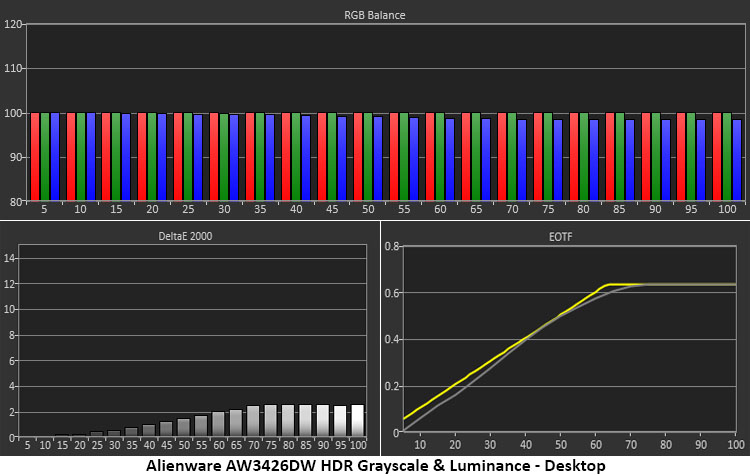
Grayscale, EOTF and Color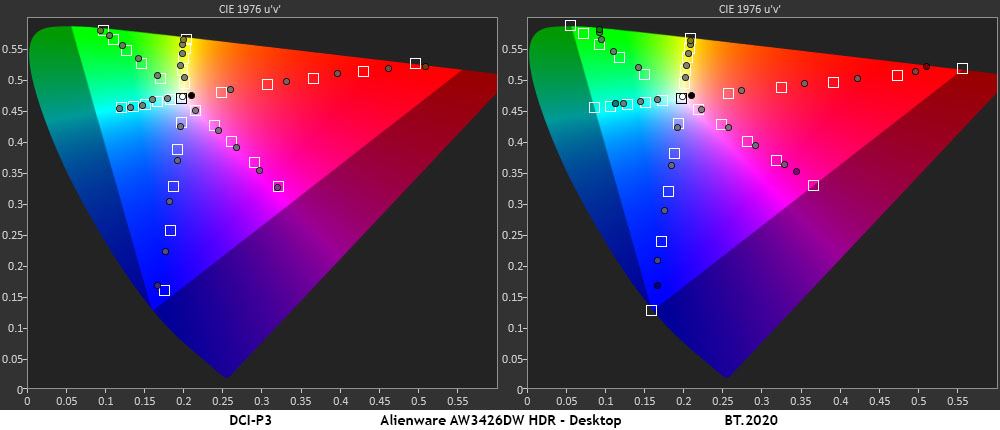 Portrait Displays Calman
 Portrait Displays Calman
I measured the Desktop and HDR Peak 1300 Bright modes and got similar color and grayscale results. There are no visible errors in the first chart, and EOTF tracking is solid. The trace starts a tad dark, but I could still see all the steps in a test pattern. Shadow detail is clear and visible in all cases. The tone map transition is at 65%, which is correct for the measured white and black thresholds.
In the color gamut test, the AW3426DW uses all available coverage with extra saturation for P3 and almost 80% coverage of BT.2020. All points are slightly oversaturated, which is typical of the HDR monitors I've tested. They all push the envelope for extra impact, and it is effective. In the BT.2020 chart, the AW3426DW runs out of color at 90% red, 75% green, and 95% blue.
Test Takeaway: The AW3426DW presents a stunning HDR image with deep blacks and very bright highlights. It is a clear improvement over the AW3425DW. If you enjoy a lot of HDR content, it's a worthwhile upgrade. Color and grayscale are very accurate in both Desktop and Peak 1300 modes.
MORE: Best Gaming Monitors
MORE: How We Test PC Monitors
MORE: How to Buy a PC Monitor
The benefits of 34-inch 21:9 curved gaming monitors are many when compared to the vast array of sizes and shapes currently available. Play is enhanced by a screen that mimics VR headsets by encompassing the viewer's peripheral vision. And this size doesn't have a huge footprint. While jumbo screens are cool, they demand a larger desktop and can be costly. The AW3426DW strikes a good balance between usability, performance and cost. At this writing, it's brand new to the market with an opening price of $800, the same as last year's AW3425DW.
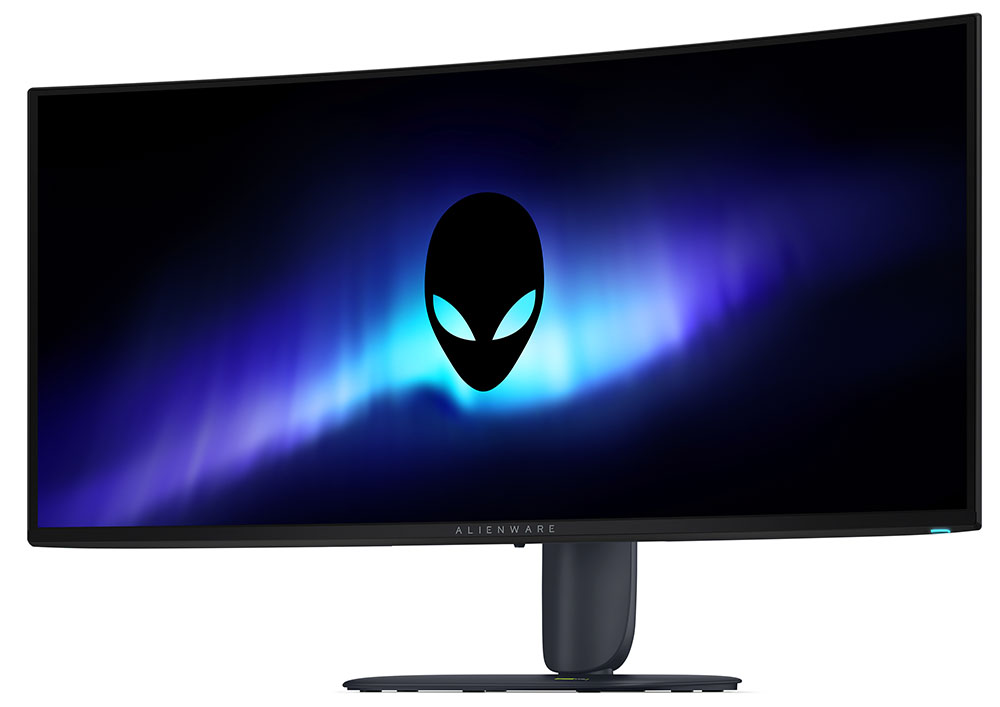
The AW3426DW offers several compelling reasons to upgrade. It's brighter for both SDR and HDR content by around 60 and 70 nits, respectively. It also boasts much brighter small highlights for HDR, around 1,300 nits for a 3% window. This is thanks to its new five-layer Tandem OLED tech. Color remains vivid, with 105% DCI-P3 coverage from its Quantum Dot layer.
(Image credit: Tom's Hardware)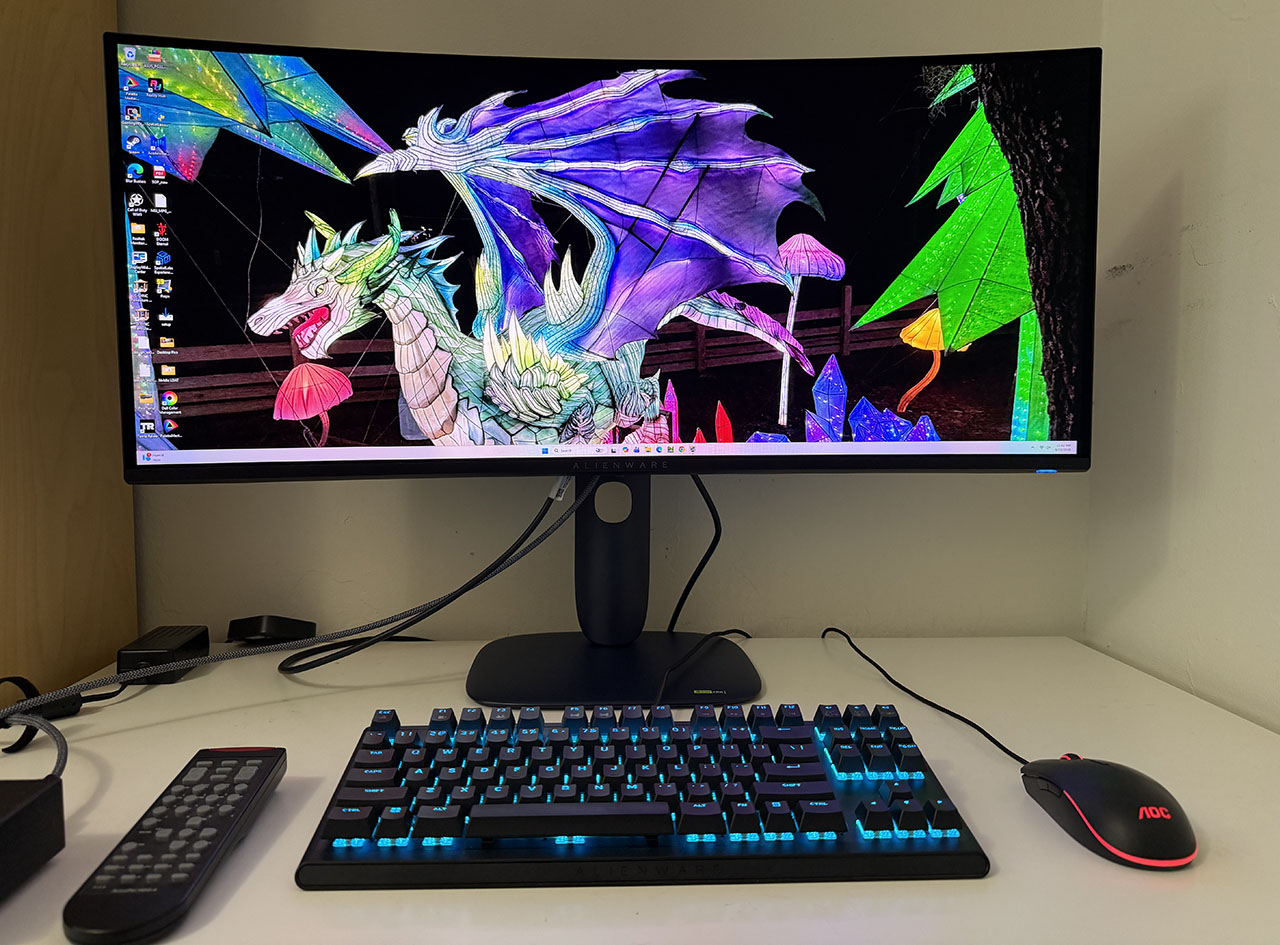
Speed has increased from 240 to 280 Hz, and that brings with it a 4ms drop in input lag, about 22%. That will be worthwhile to the most skilled gamers who want every possible advantage. The new anti-glare coating helps keep the image solid in bright rooms. And the V-Stripe RGB sub-pixel layout sharpens fine detail and text better as well.
At $800, the AW3426DW is a solid value among OLED gaming monitors. If you already own an AW3425DW, it's worth upgrading for the improvements in speed, brightness and clarity. If you're looking for your first OLED, it's a great choice for all-around use, work, and play that is worth checking out.
MORE: Best Gaming Monitors
MORE: How We Test PC Monitors
MORE: How to Buy a PC Monitor