Counting rooted trees
Combinatorial problems can be interesting for their own sake, but they are more interesting when there is a connection to a problem outside combinatorics, and the more unexpected the connection the better.
Counting the number of unlabeled rooted trees [1] with n nodes is a pure mathematics problem. Designing numerical methods for solving differential equations is an applied mathematics problem. And yet the two are closely linked.
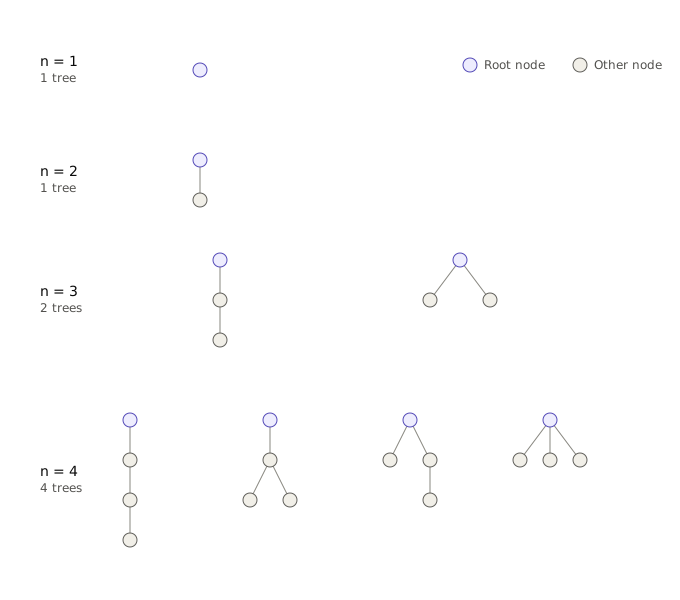
Let t(n) be the number of distinct unlabeled rooted trees with n nodes. The diagram below shows that the first few terms of this sequence are 1, 1, 2, and 4.
The values oft(n) can be computed recursively using
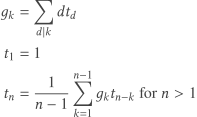
You can implement this in Python as follows.
from sympy import divisorsdef t(n): if n <= 1: return 1 if n == 1 else 0 return sum(g(k) * t(n - k) for k in range(1, n)) // (n - 1)def g(k): return sum(d * t(d) for d in divisors(k))
This code is correct, but it will run more efficiently if you cache function values to avoid calculating the same values over and over. You can do this by adding
from functools import lru_cache
and writing @lru_cache(maxsize=None) above both function definitions.
Connection to Runge-KuttaIn an earlier post I showed that designing a 4-stage explicit Runge-Kutta method required solving a system of 8 equations in 10 unknowns, leaving two degrees of freedom in the solutions.
The number of constraints c(s) needed to design an s-stage explicit RK method is equal to the number of rooted trees with up to s nodes:
c(s) = t(1) + t(2) + t(3) + ... + t(s)
This is because there is a one-to-one correspondence between constraints on the nth derivative of an RK formula and rooted trees, and ans stage method has to satisfy the constraints of all stages up tos. In the example of the 4th order RK method, we have
c(4) =t(1) +t(2) +t(3) +t(4) = 1 + 1 + 2 + 4 = 8.
The first few values [2] of t(n) are
1, 1, 2, 4, 9, 20, 48, 115, 286, 719, 1842, 4766, 12486, 32973, ...
and so you can see thatt(n) grows quickly. In fact, it grows exponentially [3].
However, the number of parameters in ans stage RK method iss(s + 1)/2. The number of equations grows exponentially and the number of variables grows only quadratically, so at some point you have more equations than variables. That's already the case for s = 5 because you have 17 constraints on 15 variables.The system has a solution because symmetry considerations render some of the equations redundant.
A 10th order RK method requires 17 stages. (See the previous post for why the number of stages exceeds the order when the order is greater than 4.) Designing such a method would require solving over a million equations in 153 variables, and yet it can be done. [4]
Related posts[1] This is a slightly contradictory term. Unlabeled means the we don't distinguish the nodes. But we do distinguish one node, namely the root.
[2] See OEIS A000081.
[2] Richard Otter proved in 1948 that the number of unlabeled rooted trees withn nodes is asymptotically C n / n-3/2 whereC = 0.4399... and = 2.9557.... The cumulative sum is at least this large since Otter's estimate gives the size of the last term in the sum.
[3] E. Hairer. A Runge-Kutta Method of Order 10. J. Inst. Maths Applics (1978) 21, 47-59
The post Counting rooted trees first appeared on John D. Cook.