Mathematical alchemy
After writing the previous post about metallic ratios, I thought about the analogy to alchemy and the attempt to make precious metals out of base metals.
When can you make one metallic ratio out of another? Can you make the golden ratio out of the lead ratio?
Before we can make gold out of lead, we have to say what lead is.
Defining metallic ratiosThe metallic ratiosM(n) can be defined several ways. The most interesting definition is the number whose continued fraction representation contains all ns. A more prosaic but more convenient definition is the larger number that equals its reciprocal plus n, which can be found using the quadratic formula.
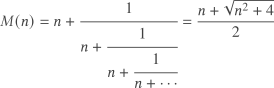
The golden ratio isM(1), the silver ratio isM(2), and the bronze ratio isM(3).
Gold from silver and bronze?Can you make the golden ratio out of the silver and bronze ratios? Not by integer arithmetic. The golden ratio involves 5, the silver ratio 2 and the bronze ratio 13. No integer operations on the latter two radicals will produce the former, though you can come arbitrarily close.
Gold from leadThe metallic ratios for n > 3 don't have standard names, but let's call M(4) the lead ratio. Can you make the golden ratio out of the lead ratio? Yes you can:
M(1) = (M(4) - 1)/2.
General solutionIn general, when can you makeM(n) out ofM(m)? In abstract terms the question is when the fields
((n^2 + 4))
and
((m^2 + 4))
are the same, i.e. when adjoining (n^2 + 4) to the rational numbers gives the same field as adjoining (m^2 + 4) to the rational numbers. This occurs if and only if
(n^2 + 4)/(m^2 + 4)
is the square of a rational number.
Bronze from copper and tinCan you make bronze out of copper and tin? Yes, if you defineM(36) to be the copper ratio andM(393) to be the tin ratio, because
(3^2 + 4)/(36^2 + 4) = (1/10)^2
and
(3^2 + 4)/(292^2 + 4) = (1/109)^2.
The post Mathematical alchemy first appeared on John D. Cook.