Owner of original Intel 8080 pre-production layout seeks restorer — handcrafted Rubylith mask shows 5,000 transistors and interconnect patterns of the fabled 2 MHz CPU
The owner of what is claimed to be the original engineering copy of the Intel 8080 rubylith mask" has shared a social media shout-out, looking for a skilled restorer. From the shared photograph, this important artifact from the history of computing looks like it would benefit from remounting and reframing. Hopefully, the handcrafted, largescale sheet of red film (Rubylith) has remained in good condition under glass, though. The framed artifact is likely genuine and original, as its current owner is thought to be related to Internet Hall of Fame inductee Dan Lynch, a pivotal figure in the early Internet's success.
Hey uhh long shotBut i own the original engineering copy of the intel 8080 rubylith maskI need to get it restoredAnyone know the right guy? pic.twitter.com/ckqcSylvV6August 3, 2026
In you unfurl the tweet above, you can see Tom Lynch, a self-described arborist and the owner of an AI infrastructure startup, standing behind the framed chip artwork. Folks comment on the Rubylith looking just like the one that the Intel Trinity: Andy Grove, Robert Noyce, and Gordon Moore, were photographed beside in 1978.
Andy Grove, Robert Noyce, and Gordon Moore stand next to an Intel 8080 rubylith in 1978 (Image credit: Intel Free Press)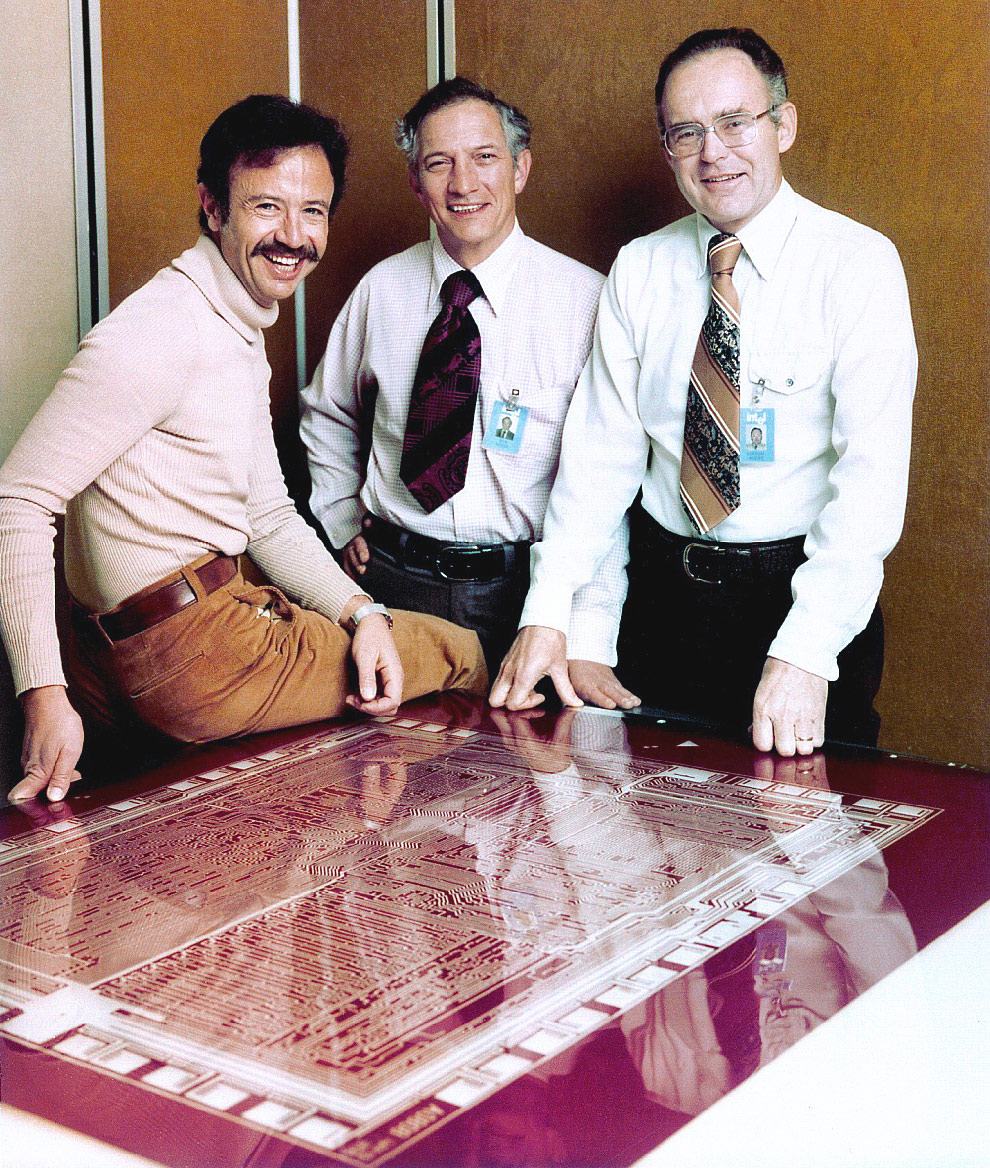
Rubylith is simply an adhesive, peelable red film that found favor in graphic arts and chip design before designers went digital. Engineers could cut away parts of the film to define where light would be exposed during photolithography processes. Rubyliths would often be marked with pens, tape, and overlays, especially as designs were iterated and refined ahead of tape-out.
The Intel 8080's primary architect was Federico Faggin, and it was manually drafted in the age before modern CAD. This human-scale draft is likely 100x magnification compared to the finished processor die. Even scaled this large, it would still be quite an intricate drawing as it had to map around 5,000 transistors, traces, etc., into an approximate 20- x 16-inch sheet. The commercial Intel 8080 release ended up being manufactured on a 6 m silicon gate process. It originally ran at 2.0 MHz clocks, but later revisions would boast clock speeds up to 3.125 MHz.
Intel's 8080 was an important 8-bit microprocessor for both the company and the advancement of personal computing. This 8-bit CPU was the one chosen for the Altair 8800, was the original target architecture for the CP/M operating system, and would be a big influence on the later x86 architecture. We also recently wrote how the 8080 bottlenecked the Space Invaders arcade design, unintentionally resulting in the space shoot-em-up's thrilling increase in pacing as aliens were zapped from the sky.