What MLB History Tells Us About Cal Raleigh’s Unprecedented 2026 Collapse
by from Latest Sports News & Videos from FOX Sports on (#77R99)
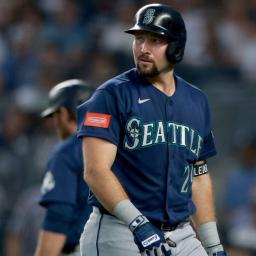 Cal Raleigh's 2025 was historic, on a number of levels. His 60 home runs were tied for the ninth-most in MLB history as well as the third-most for an American League player. He set new all-time single-season marks for home runs by a switch-hitter and by a catcher, easily outpacing Mickey Mantle's prior mark of 54 and Salvador Perez's 48. It was the most homers in a single season by a Mariners' player, too, which is an achievement unto itself considering the organization had Hall of Famers Ken Griffey Jr. and Alex Rodriguez in it for a combined 19 seasons and 606 home runs - Griffey crushed 56 long balls twice while with the Mariners, even. Cal Raleigh's 2026 is also historic, but not in the way anyone wants to be remembered. The lows of this campaign are low enough as is, but once you add in the highs of 25, the whiplash takes on historic notoriety. Consider OPS+: this takes OPS and adjusts it for ballpark and level of competition, allowing players to be compared directly across eras. And when you look at the difference between Raleigh's 2025 OPS+ of 168, and compare it to 2026's mark of 65, you find the largest negative year-to-year change in the stat in MLB history, minimum 300 plate appearances. What's more is that none of the other players who saw a similar dip - or as similar as one can get to Raleigh's rapid descent - perfectly fit the scenario he finds himself in. Many of them were much older players who had one last gasp of greatness before their bodies and time betrayed them. Raleigh? He's 29 years old, which should mean he's still in his prime, even as a catcher who is worked harder than other position players. The younger players who did crater like this were, oftentimes, significantly and obviously injured in a way that impacted their performance, sometimes before and after surgery, with effects lingering after a return. Raleigh went on the IL with an oblique strain earlier this year, but was playing horrifically before that, with his struggles even dating back to the World Baseball Classic, where, as a member of the United States, Raleigh drew four walks and had no hits in 14 plate appearances and was benched for the final two games. So, the exact reason for Raleigh's struggles are difficult to pinpoint, though there is certainly room for speculation. Is this the result of an undisclosed injury? Or Raleigh's mechanics being wrecked somehow? Or is it even just horrific luck: Raleigh's batting average on balls in play is a mere .198, which is so low that even if there were something awry with his mechanics, you would expect a higher figure than that. Discovering the reason isn't the purpose here, though: it's to identify just how rare this kind of collapse has been even in MLB's lengthy history. The good news for Raleigh is that some all-time players have suffered significant dropoffs at nearly the same level before. Just by raw OPS, Raleigh's dip is, through Aug. 16, tied for the second-worst in MLB history, behind Hall of Famers Rogers Hornsby and Hack Wilson. Hornsby, in his age-30 season exactly a century ago, saw his OPS drop .394 points, while Wilson's fell .380 points from 1930 to 1931. Both players won their leagues' respective MVP in the prior season; Raleigh finished in second behind Aaron Judge in 2025. Here's the key difference, though: while Hornsby (30) and Wilson (31) were close to Raleigh's age when this happened, they didn't become one of the league's worst hitters, either. Hornsby's OPS was still .851, and his OPS+ a well above-average 124 - for comparison, Brewers' second baseman Brice Turang has a 124 OPS+ in 2026. Wilson's was worse, at 112, but compared to Raleigh - whose OPS+ of 65 is built of the worst OPS in the majors minimum 300 plate appearances - it's practically MVP-like. Hornsby went on to recover, with 1926 being a one-off: he was back to a 175 OPS+ in 1927 to lead the NL, and would stick in the majors into his 40s with a collective 170 OPS+ from 27 through 37. Wilson had one last season as a highly productive batter, but his career tapered off and he retired after his age-34 campaign, but you can't mention his professional slide - and early death, at the age of 48 - without bringing up his well-known alcoholism, either, as the Society For American Baseball Research does inhis bio. Max Carey's career was never the same after his 1925, which shares similarities with Raleigh in terms of the drop: his OPS was .909 in 1925, then just .594 in 1926. However, Carey was also 36 a century ago when he fell apart, and while his bat recovered to a degree in the years that followed, he was never even an average hitter again before retiring following the 1929 season. Chances are good that Raleigh isn't following this path, given the age difference. There is Christian Yelich to consider: the Brewers' slugger won MVP and finished second in 2018 and 2019, respectively, and dipped during the shortened 2020 season. He's since recovered and had a normal downward trajectory for his age/profile, however, and it's difficult to say that he would not have recovered his numbers at some point in 2020, had it been its typical length. Along the same lines is Jeff Bagwell, who in 1994 produced one of the all-time great modern seasons, to still receiving MVP votes during an injury-shortened 1995 in which he just looked great instead of historically relevant. He continued to have a Hall of Fame career after this, and was even inducted despite injuries cutting his career short in terms of both production and years. Bryce Harper had a similar situation in 2015, when the 22-year-old posted one of the best seasons of this century with a 198 OPS+ and NL MVP. Harper was merely pretty good in the follow-up at 23, but has had a Hall of Fame trajectory since. It's difficult to pinpoint situations like Raleigh's, which is both ongoing and involved a collapse of this size. Looking at OPS+ instead of raw OPS gets you a little closer contextually, though. George Scott's OPS+ dropped from 139 to 40 from 1967 to 1968 at age 24, and it took him some time to recover before reaching those levels again - but he did. Yasmani Grandal's bat completely collapsed from 2021 to 2022, but he was already nearing his mid-30s and was out of the league a couple years afterward - that he is so much older than Raleigh is now should give reason to assume a different outcome. Victor Martinez similarly collapsed, but did recover a bit, and was also 36 when it happened - a little less unexpected, especially since his 2014 was out of nowhere. Also with Martinez is that he was great for a long time, but his 2014 was well above anything he'd done before or since, too, so a slide wasn't unexpected in that regard. Maybe the closest comp out there is another catcher, Brooklyn Dodgers' great Roy Campanella. After a strong 1953 in which the 31-year-old was worth 6.8 wins above replacement and posted a 154 OPS+, Campanella suffered from an early-season wrist injury and then numbness issues following surgery for the malady in 1954. Healthy again in 55, he was Roy Campanella once more. Of course, that assumes something physical is wrong with Raleigh, but even if he ismedically fine, something is off in his swing, much like with an injury. With an offseason to get right by fixing what is wrong with his swing and contact, he's more likely to follow the Campanella path than anyone else here: he isn't a player who was never any good before 2025, to the point that his homer outburst, while not expected to be repeated, made sense with him being a tremendous power-hitting catcher and threat from both sides of the plate. In his first three full seasons in the majors, Raleigh averaged 139 games and 30.3 homers with a 117 OPS+: coming down from a spike to 168 and 60 dingers was reasonable, but to 65 and just 13 homers in 91 games? No, not like that. For now, the Mariners - and Raleigh - just have to hope more of the previous Big Dumper comes through. Even if it's "only" the one that mashed for Seattle from 2022 through 2024, who was merely one of the best hitting catchers in the league instead of overall hitters. If history is any indication, though, we at least know everyone might have to wait until next year to see that happen.