CM Saka is developing a city ordinance aimed at codifying Vision Zero work, requiring city contractors to install truck side guards
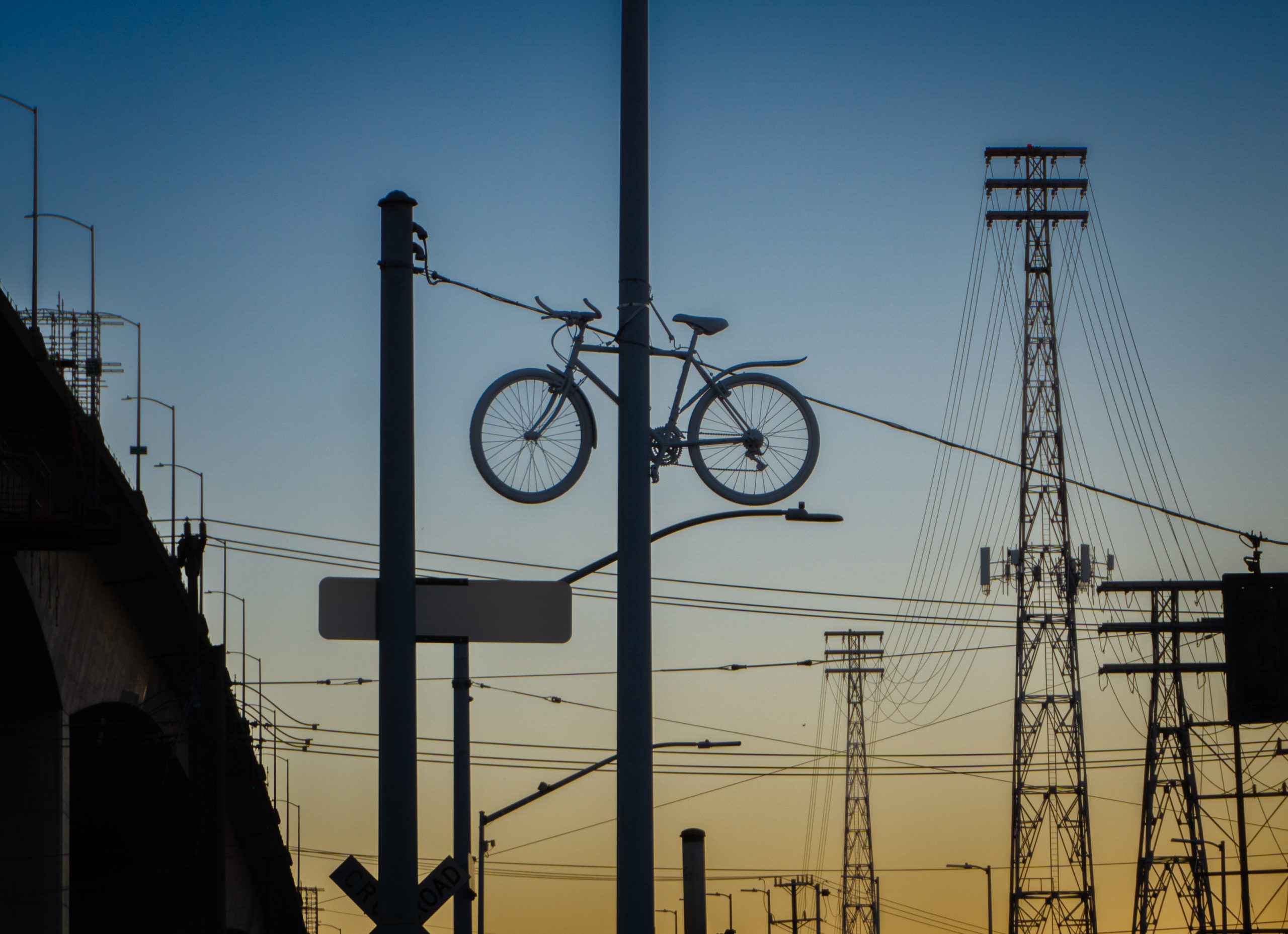 A ghost bike for Robb Mason near the Spokane Street Bridge. Shortly after his death, then-SDOT Director announced that the City Traffic Engineer would also be the Chief Safety Officer.
Proposed ordinances would rewrite sections of Seattle's code to give the City Traffic Engineer more direct authority and responsibility to make safe streets changes. They would also grant emergency authority" to the Traffic Engineer to expedite safety fixes in locations with imminent risks," presumably including locations where a serious or fatal collision has occurred.
City Councilmember and Transportation Committee Chair Rob Saka is set to introduce the ordinances during Thursday's committee meeting (PDF 1, PDF 2). The wording and scope of the changes are still very much in development, and Saka has signaled that he has additional goals that are not yet in ordinance draft form, including a new rule mandating truck side guards for all contractors working for the city. SDOT already requires side guards on all SDOT-owned trucks, following the lead of the University of Washington. Boston started requiring truck side guards for city contractors more than a decade ago, so the concept has successful precedent. Side guards are designed to push people away from the rear wheels in the case of a collision and are a proven safety device that the NTSB recommends for all trucks. They cost a couple thousand dollars to install, but in addition to preventing serious injury or death they can also improve fuel efficiency to help pay back their own costs.
Dubbed the SAFER (Safe, Accountable, Flexible, Equitable, Responsive") Streets Act, the set of proposed ordinances attempt to codify that the City Traffic Engineer also holds the responsibilities of being the city's Chief Safety Officer, a change that Mayor Bruce Harrell and then-SDOT Director Greg Spotts made following a Vision Zero review in 2023. By codifying the safety role within the legal description of the Traffic Engineer's authority, work to improve safety should be protected from the whims of future administrations.
One of the more interesting lines in the proposed traffic safety ordinance would add daylighting of intersections by prohibiting parking within an appropriate distance from crosswalks and curb returns" to the list of the regular duties of the Traffic Engineer alongside installing stop signs, marking crosswalks, etc. A presentation (PDF) to the committee notes that this change requires that SDOT add intersection daylighting as a part of work it conducts at an intersection on a street with parking." Parking is already illegal within 20 or 30 feet of any crosswalk (marked or unmarked), but people essentially never follow this law voluntarily. By creating some kind of physical barrier to prevent parking (such as a sidewalk extension, a bike parking corral, a stormwater bioswale, etc), SDOT can ensure that everyone approaching an intersection can see each other. This problem is only getting worse as cars and trucks get bigger and taller. I can't tell from the ordinance language how strong a requirement this would be, but a dramatic expansion of intersection daylighting would prevent a lot of deaths and serious injuries and make the city's crosswalks much safer and more comfortable to use.
(Side note: 11.16.340 section re-lettered J erroneously states that the citywide default speed limit is 30, but it is actually 25. I'm guessing this speed reference was missed back when the speed limit ordinance passed unanimously in 2016. I'm not sure why this Traffic Engineer section even lists a specific speed here, and it can probably just say something like the arterial speed limit as designated in 11.52.080.)
The legislation also includes a request that WSDOT respond quickly when SDOT seeks to make changes near highway ramps. This grew from an idea I suggested to Councilmember Saka a few months ago during a phone interview. I am not a lawyer and have no idea what the best way to codify this is or if the language in the draft ordinance would accomplish the goal, but I suggested that the city must do something to address dangerous conditions near highway access points. SDOT routinely avoids making changes to city streets near freeway ramps because WSDOT must sign off on any changes within a certain distance of a freeway ramp since city street changes could impact freeway operations. However, as we saw with a failed attempt to make the NE 45th Street bridge safer, WSDOT and SDOT struggle to work together to fix known problem areas near freeway ramps. Seattle cannot achieve Vision Zero without positive collaboration from WSDOT to prioritize safety near every freeway access point. We need WSDOT to receive an SDOT safe streets concept and then work to figure out how to make it or another safe concept work. Pretty much every single freeway ramp area is terrible, and there is insufficient urgency to do anything about them.
The five priorities of the legislation, according to a press release by CM Saka's office, are:
- Make safety part of the system.
- Require proven safety measures.
- Protect the most vulnerable road users by using the City's contracting power to promote safer trucks performing municipal work
- Empower Seattle Department of Transportation safety leadership to make decisions.
- Respond faster after fatal crashes.
I am not a lawyer, but it is unclear what immediate impact the proposed changes to the Traffic Engineer sections would have or if they would achieve the stated goals as currently drafted. If they speed up delivery of safety improvements by empowering the city's professional experts to make more decisions about projects, then that would be a great outcome. If they protect street safety work from a hypothetical future anti-bike mayor, that is also a good thing. Changes that require proven safety measures" are also very appealing, though I can't figure out if the language as drafted achieves that goal (it may rely on one's interpretation of phrases like as appropriate," take into account" and consider the needs").
However, if the changes potentially increase liability exposure for the Traffic Engineer or SDOT, then they could counterintuitively have an opposite and unintended effect. We do want SDOT to be liable for the safety of our streets, but in the twisted world of U.S. traffic engineering the widely-accepted standard road designs that are well-protected from legal liability are often the fast, wide and dangerous designs we need SDOT to fix. For example, let's say there's a dangerous crosswalk, SDOT could either try to make it safer or they could put up a no crossing" sign and then it's the victim's fault for ignoring the sign. We want SDOT and the City Traffic Engineer to make the crosswalk safer. I hope that Council makes sure the ordinances really would achieve the excellent stated goals in real world conditions.