Second solutions
This post provides a couple examples to go along with two earlier posts.
The pattern we're illustrating is families of polynomialspn(x) that each satisfy a differential equation and a three-term recurrence. The differential equations have a second solutionqn(x) that is the larger solution with respect tox but the smaller solution with respect ton.
In both the examples below pn(x) is a polynomial, and so bounded on the interval [-1, 1], and qn(x) is not a polynomial, with singularities at 1. This is analogous to the previous examples with Bessel functions Jn(x) and Qn(x) that satisfy the same differential equation but have contrasting behavior with respect tox versusn.
Legendre polynomialsThe differential equation

has two solutions for each n, Pn(x) and Qn(x).
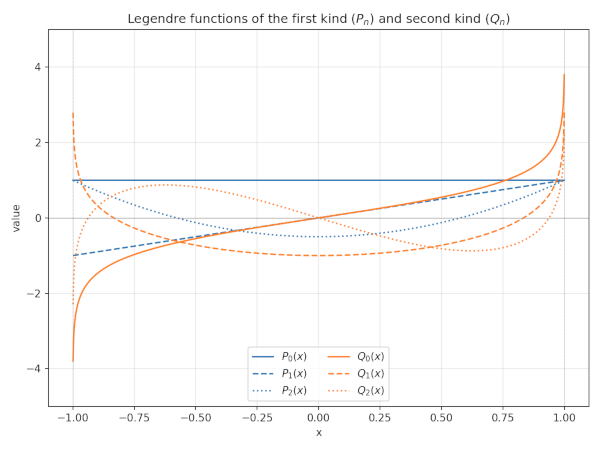
The solutions Pn(x) are the Legendre polynomials. The solutions Qn(x) are not polynomials but involve a term log((1 + x)/(1 - x)) that blows up at 1 and -1. But for fixed x and increasing n, Pn(x) grows exponentially and Qn(x) decays exponentially, provided |x| > 1.
Chebyshev polynomialsThe differential equation

has two solutions for each n, Tn(x) and Vn(x).
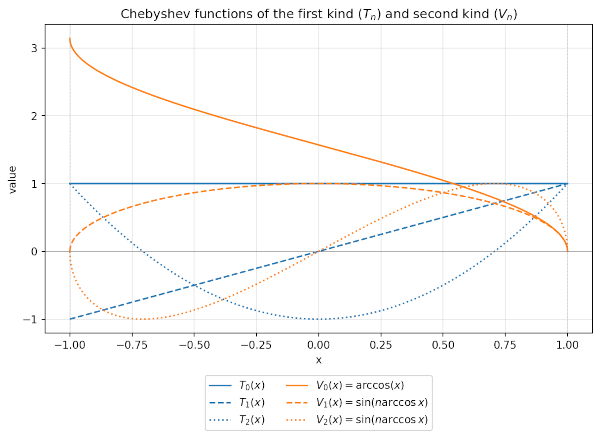
The solutions Tn(x) are the Chebyshev polynomials. The solutions Vn(x) are not polynomials but involve a term (x^2 - 1) that become vertical up at 1 and -1. But for fixed x with |x| > 1 and increasing n, Tn(x) grows exponentially and Vn(x) decays exponentially.
The post Second solutions first appeared on John D. Cook.