Proof of the rank-trace theorem
The previous post discussed the motivation for and application of the rank-trace theorem. This post will give a proof.
SupposeA is a real symmetric matrix. The rank-trace inequality says
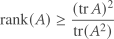
where tr is the trace operator, the sum of the elements along the diagonal of the matrix.
Terse proofHere's the proof in a nutshell: diagonalizeA and use the Cauchy-Schwarz inequality.
Detailed proofNow let's unpack that. Any real symmetric matrix A is similar to a matrix D with the eigenvalues ofA along the diagonal.

The trace of a matrix stays the same under a similarity transformation, i.e. multiplying byP on one side and its inverse on the other side. So without loss of generality we may as well assumeA is diagonal.
The rank of a matrix equals the number of non-zero eigenvalues, so a vector containing the non-zero eigenvalues ofA

has length r where r is the rank of A. Define w to be the vector of dimensionr consisting of all 1's.

Then by the Cauchy-Schwarz inequality we have

Why should a matrixA and its diagonalizationD have the same trace?
The trace of a matrix productAB equals the trace of the productBA. To prove this, write out matrix products and the traces, then note that the two expressions are equal.
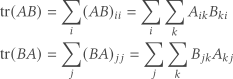
Therefore

More generally, trace has the cyclic property

However, not all permutations preserve the trace. For example, let

Then
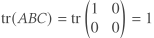
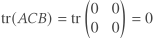
but