Self-taught tinkerer demos working room-sized Cold War-era supercomputer with vacuum tubes — takes 15 minutes to warm up and smells like burning dust, 8-bit design uses 460 recycled 1950s Soviet
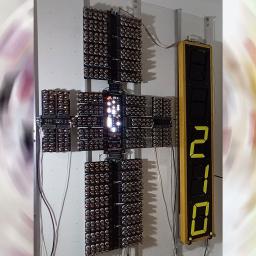
A self-taught electronics tinkerer called Mike recently shared details of his retro-computing project on Hackaday. It certainly is retro, as the design eschews modern computer component niceties like microprocessors or microcontrollers. Instead, Mike's computer is a modern 8-bit design, built with recycled 1950s vacuum tubes." It uses 460 Soviet-era 6N3P (Cyrillic 63-) double triode tubes, which were manufactured around 50 years ago, combined with era-appropriate germanium diodes.
The wall-mounted vacuum tube-based computer you see in the video above is apparently the third tube computer Mike has engineered this decade. Previous iterations have sometimes come to an explosive end...
Of course, there have been a number of famous historically significant computers based on arrays of these tubes or valves, which offer similar functionality to the transistors that largely succeeded them. There are plenty of reasons the computer industry moved from tubes to transistors, and then silicon ICs, but enthusiasts aren't bound by such practicalities.
Mike notes a few drawbacks with vacuum tubes, actually. Most notably, this simple 8-bit computer design needs 460 of these fragile, rather bulky, white-hot glowing tubes to run. Furthermore, these used/old stock 6N3P models only have about a 500-hour operational life, so a few handy spares are required, as is a stepladder to reach the whole array of tubes, which may fizzle out at any time. The tubes run hot, so Mike's computer room is always toasty whether the season makes that a nice thing or not. A fire extinguisher is always kept handy, and the room smells of burning dust.
Performance and capabilities are about as limited as one might expect. Mike notes that starting The Tube Computer (MK3) means waiting 10 to 15 mins after power-on for the machine to literally warm up. This is followed by a mandatory reset to get the tubes into a unified operational state.
For compute functionality, Mike's Tube Computer architecture uses an arithmetic logic design to perform just the five essential functions needed for its instruction set (sum, carry, not, increment, and XNOR). Meanwhile, its instruction cycle relies on a non-pipelined architecture with a six-step fetch and single-execute cycle.
Components:
- 460 * 6N3P vacuum tube
- 46 * 10 tube pcbs
- 1 * 190cmx130cm 4mm acrylic panel
- 3 * 2m 30mmx30mm Aluminium box section
- 5 * Backplane pcbs
User interaction with this wall-mounted homemade computer varies depending on the program in use. Currently, Mike has it set up to run an Airship Simulator piloting a British R80 airship from Brighton to Paris. By pressing controls on the image of the bridge of the R80, you can direct the airship software," says Mike. These membrane buttons simply put 5 volts directly to the input board of The Tube Computer. You can control the ballast, gas release, engine power, elevators, rudder and the bow mooring gear, which is used to release the airship from the tower."
Another charming feature of this admittedly build it now, fix it later" computer design is the very audible accompanying ex-British Rail flip-digit display. That add-on will invoke another entirely different flavor of nostalgia for some of our readers.