What counts as a large cosine similarity?
Machine learning represents words as vectors and measures the similarity of words by the angles between the vectors.
For vectorsxandy,

where is the angle between the vectors, and so
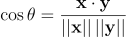
This is the cosine similarity between the words represented by x and y.
Small angles have large cosines, and so words with larger cosine similarities are closer together than words with smaller cosine similarities. The cosine similarity between a word and itself equals 1, and we'd expect unrelated words to have a cosine similarity near 0.
You can do a sort of arithmetic with vector embeddings of words. The canonical example is that
king" - man" + woman" queen"
Implicit in this equation is that we're really adding vector representations of the words. Leta,b,c, andd be the vector embeddings of the wordsking,man,woman, andqueen. What we're really asserting is that
a -b +c d,
except that's not true! Or at least it's not true unless you view it in the right context.
The angle between a -b +c andd is about 49, which corresponds to a cosine similarity of 0.656. Here I'm using the gensim glove-twitter-200 embedding that represents words as 200-dimensional vectors.
The way to interpret the equation above is not that a 49 degree angle is approximately 0, or that a similarity of 0.656 is approximately 1.
In high dimensions, such as 200-dimensional word embeddings, nearly all vectors are nearly perpendicular. I wrote a post about this here. So the angle between randomly selected words will usually be close to 90, and so in that context an angle of 49 is relatively small. For example, the angle between the vector representations ofking andfireplace is 89.25.
If you divide word vectors by their norm, you can think of each vector as a point on a high-dimensional sphere, in our case a sphere in 200 dimensions. The proportion of vectors within 49 of a given point is surprisingly small in high dimensions.
Let's say our point of interest is the north pole of an n-dimensional sphere. We'd like to calculate the proportion of the area of the sphere that is within an angle of the pole. I go through the calculations here. (Update: I give an approximation here that's easier to work with than the exact formula.)
When n = 3, 17% of the area is with 49 degrees of the pole. But when n = 200, the proportion is on the order of 10-26, essentially zero.
The vector d above representing queen is within a relatively tiny region around the vector a -b +c.
In terms of cosine similarity, 0.656 is a large similarity. Words with a cosine similarity in this range are quite close, even though we wouldn't normally think of 0.656 being close to 1. In this context, 0.656is close to 1.
Related posts- Angles between words
- Area and volume of a hypersphere cap
- Cosine similarity does not satisfy the triangle inequality