Bambu Lab’s 3D printing patent application for a new heatbed design may improve peeling issues
Shenzhen Tuozhu Technology, Bambu Lab's parent company, has filed a patent application in the U.S. for a new heatbed design, which was published on September 10, 2026. This design aims to heat a printbed more evenly, reducing issues with prints as commonly reported by many users of various 3D printer brands. The patent describes the construction, heating method, and its claim of better adhesion to improve print quality.
The abstract of patent US20260264331A1 states: The heated bed comprises a heated bed body, a heating unit, and a bottom case, wherein one end of the heating unit is configured to be electrically connected to one end of a power supply, and the other end of the heating unit is configured to be electrically connected to the other end of the power supply; the heating unit is disposed between the heated bed body and the bottom case. The heating unit is attached to a surface, proximal to the bottom case, of the heated bed body, and the heating unit is configured to heat the heated bed body. By implementing the present application, the adhesion capability of the print panel can be improved and the print quality can be improved."
It's hard to imagine from the abstract alone, but the patent's sheets visually show us what Bambu Lab is trying to achieve, and the claims tell us more details. The current heatbeds use a laminated heating sheet, adhered to a sheet of aluminum with magnets to hold a build plate. Bambu Lab's new design wants to replace the laminated heating sandwich with a heated bed body." Looking at FIG. 3 of the patent, you can see what looks to be a monolithic heatbed with a machined channel where the heating element will run through; claim 5 describes the recess' shape resembling the Chinese character ," which also happens to mean sunken or depressed.
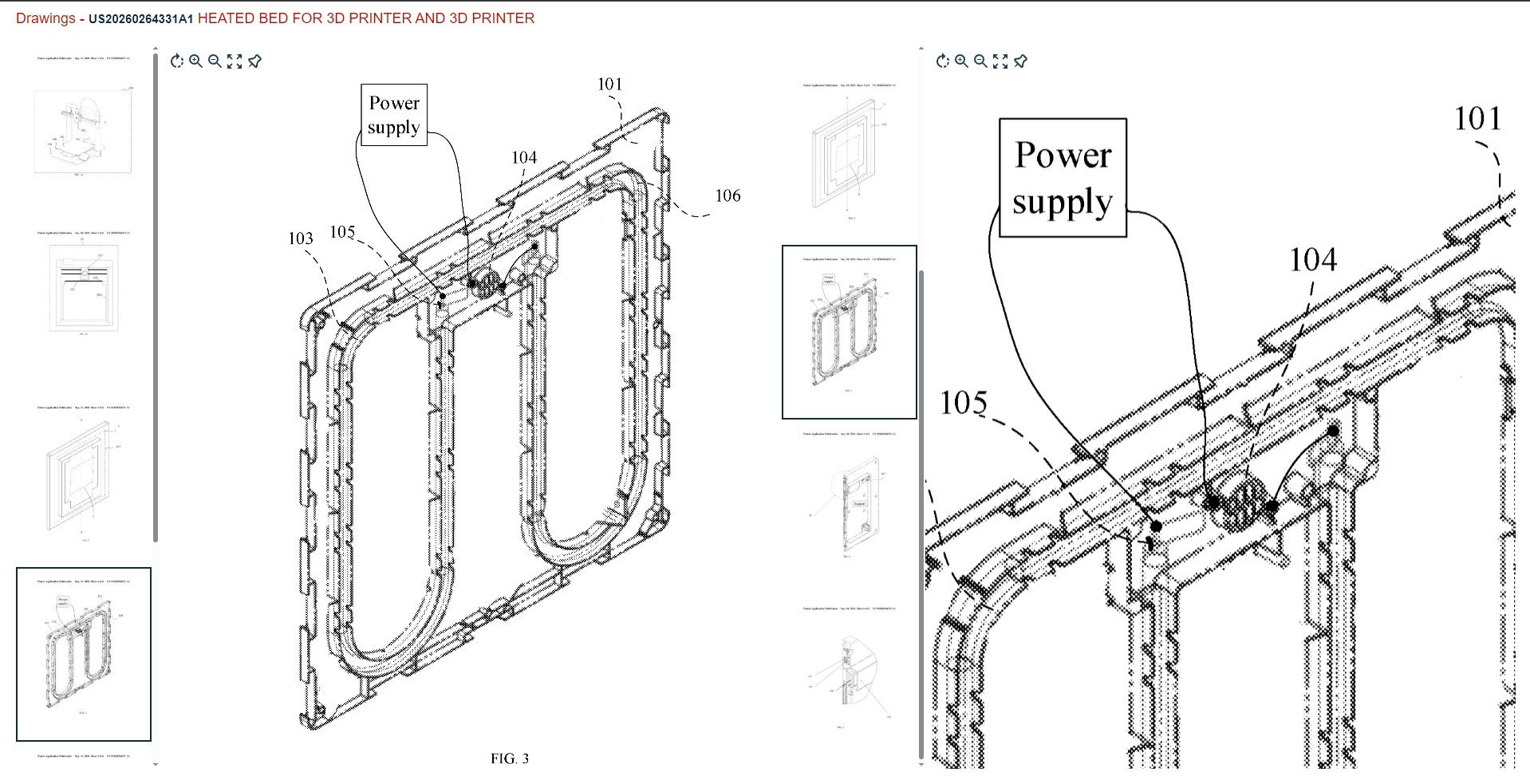
As previously described, the heating element loops around inside a recess in the heatbed, but it is one long unit that is connected to a single power supply at each end. The loops reach the corners, potentially reducing peeling for large prints that use most of the bed's surface; this configuration may also improve the time to reach target temperatures. It does not describe being able to heat zones independently, however.
Machining a recess in a large piece of aluminum is quite costly, in both materials and machining costs, though it is possible for Bambu Lab to create this heated bed body from multiple pieces, possibly from multiple layers of aluminum sheets to avoid using large and expensive billets.
Besides the new heatbed, included are claims describing a 3D printer. It describes a fairly generic CoreXY 3D printer, but don't panic; this doesn't mean every brand is suddenly going to infringe on this patent. The claims describing a 3D printer are tied to the heatbed design, so it would take a printer that has Bambu Lab's patented heatbed design to potentially fall within the patent's scope - the PCT application is still pending, however, so the patent cannot be enforced yet.
If the patent does get granted and the performance is superior to the current heatbed design, this could potentially mean Bambu Lab would be tempted to charge more for their replacement heatbeds and possibly the printer as a whole. In the meantime, there is no information on the performance of this design, so we will have to wait and use a bit more glue on our buildplates.