LaTeX package for Pascal-like triangles
When I wrote about the harmonic triangle yesterday, I displayed the triangle left-aligned using fixed-width text because that was easier than producing the format you usually see for Pascal's triangle and related triangles.
1 1/2 1/2 1/3 1/6 1/3 1/4 1/12 1/12 1/4 1/5 1/20 1/30 1/20 1/5 ...
I asked Claude to write a LaTeX package to make it easier to create Pascal-like triangles and it did a great job, including handy features I didn't think to ask for. You can download it here: numtriangle.sty.
I used this package to create the more attractive display below.
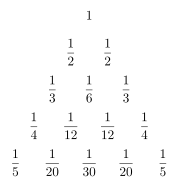
Here's the LaTeX code that produced the image above.
\documentclass[border=4pt]{standalone}\usepackage{numtriangle}\NewTriangle{\Leibniz}{start=1, edges=1/\n, rule=\L - \P, fractions, format=\displaystyle, xsep=2.8em, ysep=2.8em}\begin{document}\Leibniz[rows=5]\end{document}I then compiled the code to an SVG file with the following.
pdflatex leibniz.pdfpdftocairo -svg leibniz.pdf leibniz.svg
Bell's triangle is not defined in a way that the LaTeX package supports, but I can produce the triangle by listing the content. I made the triangle left-aligned rather than centered just to show that this can be done.
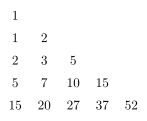
The LaTeX code was the following:
\ListTriangle[shape=left]{ 1; 1, 2; 2, 3, 5; 5, 7, 10, 15; 15, 20, 27, 37, 52}Here's a particularly photogenic image, Pascal's triangle with odd numbers highlighted, showing the Sierpiski triangle pattern.
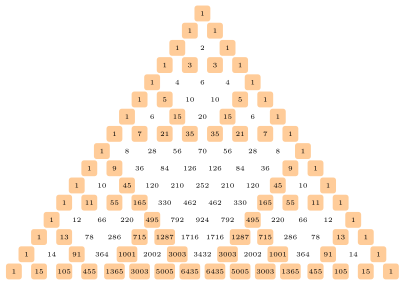
The code to produce the image:
\PascalTriangle[rows=16, mod=2, xsep=1.9em, ysep=1.3em, cell style={font=\tiny, minimum size=1.2em}, highlight style={fill=orange!40}]The post LaTeX package for Pascal-like triangles first appeared on John D. Cook.