Leaked 256-core Zen 6c EPYC CPU destroys Zen 5 in early single-threaded benchmarks hints at 24% IPC gain
AMD's Zen 6 processors are out! Well, the EPYC 9006 family of server CPUs is out, anyway. These aren't chips that mere mortals like you and I can reasonably acquire, so there aren't really many third-party benchmarks out there yet, but somebody ran GeekBench 7 on one, and you know what that means: time for some wild speculation, such as the supposed 15% single-threaded IPC increase you might have seen reported this week. However, it isn't quite that clear yet. Well-known enthusiast and occasional leaker HXL (@9550pro) spotted the EPYC 9996 result, and now Russian enthusiast "three twenty six" (@326powah) has done a direct comparison with his Ryzen 7 9700X at the same clock.
Let's lay out the details: the AMD EPYC 9996 is an absolutely gargantuan server processor with 256 "Zen 6c" cores spread across eight "Monarch" CCDs with 32 cores apiece. Each CCD has 128MB of L3 cache, which is reportedly split into two 64MB domains for each 16-core CCX. This gives us 4 megabytes of L3 cache per CPU core, which happens to be the exact ratio that AMD has maintained since Zen 2. Meanwhile, 326's Ryzen 7 9700X is a desktop CPU with eight Zen 5 CPU cores and 32MB of L3 cache, giving it the same cache-per-core ratio yet an overall smaller local cache for the CPU cores, to say nothing of the 1GB of L3 cache on the full EPYC 9996.
Yes, 1GB of L3 cache. That enormous CPU is also served by a 1024-bit memory bus, likely running at 12,800 MT/s, giving it a colossal 1.64 TB/second of memory bandwidth. However, the specific benchmarks we're comparing here are single-threaded benchmarks, and as a result, they aren't likely to be bottlenecked by memory bandwidth on either machine; even 326's relatively pedestrian DDR5 memory at 6000 MT/s CL34 is more than sufficient for a single-threaded, lightly vectorized workload like Geekbench 7. Matching the CPU core clock rates at 4.1 GHz actually gives us a pretty decent core-to-core comparison of performance, even if all factors are not equal.
Comparing the Linux results, the gain over the desktop chip varies quite a bit depending on the specific test, but there are no regressions. (Image credit: @326powah on X)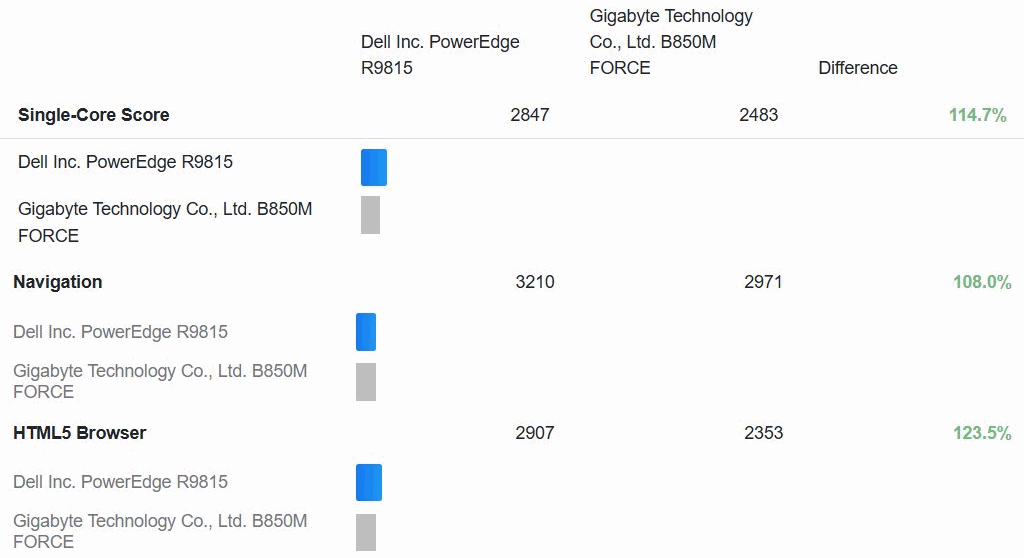
So how does it come out? Frankly, it's a massacre. That's true whether we look at the Windows 11 results he posted first or the CachyOS Linux results that he posted later, although the Zen 5 part doesn't get embarrassed quite as badly in Linux. The Dell PowerEdge R9815 server hosting the big EPYC part scored 2847 in the single-threaded test; 326's Ryzen desktop scores 2483 in Linux and 2318 in Windows.
Looking at the Gala-to-Honeycrisp Linux results, the biggest performance gulf is some 24% in the HTML5 Browser test, which is normally quite sensitive to memory latency. That could easily be caused by the massive L3 cache of the EPYC CPU. Other tests aren't so easily dismissed by configuration mismatches, though. The 19% gain in asset compression, the 21% gain in video encoding, and the 17% gain in photo editing all point to real architectural differences between Zen 5 and Zen 6 that seem quite promising for its desktop debut next year.
What's fascinating is that these results won't have been affected much by the considerable SIMD horsepower of the Zen 6 CPU core, as Geekbench-at least historically speaking-makes relatively light use of CPU SIMD, and in fact, this specific test is marked as "AVX2," meaning it definitely isn't using the muscular AVX-512 units present in either CPU. In fact, most of these tests are actually measuring CPU integer arithmetic and memory subsystem performance more than raw CPU number-crunching power, so Zen 6 coming out so far ahead here is really interesting.
Media processing seems to be especially strong on Zen 6. (Image credit: @326powah on X)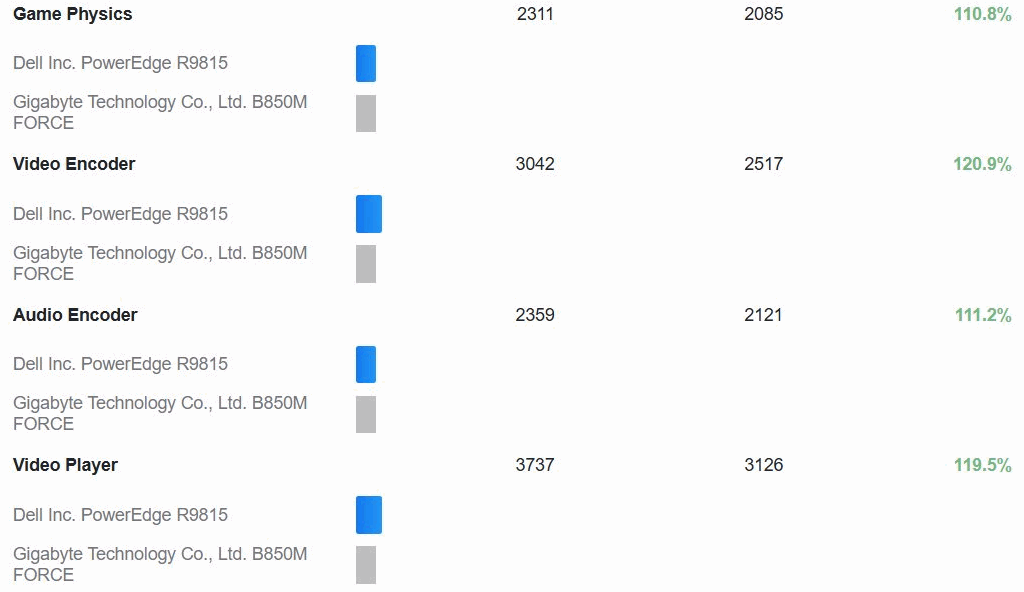
Obviously, you shouldn't take this as gospel that "Zen 6 has 15% higher IPC than Zen 5," though that's arguably a plausible conclusion; there are just too many confounding factors to say that so far. Indeed, another one of those factors is that this isn't the Zen 6 CPU core that we'll be getting in desktop CPUs. The EPYC 9996 is a high-density part that uses Zen 6c, the specialized dense core design meant for increased area efficiency at the cost of its ability to scale to high clocks. After all, 4.1 GHz isn't exactly a high clock rate these days, and particularly not for chips manufactured on a bleeding-edge 2nm-class manufacturing process.
That's the part that should get you excited. Zen 5 had a very modest IPC uplift over Zen 4 (including even some regressions), and combined with a similarly modest clock rate gain, it wasn't a very exciting release for most desktop users. Zen 6 seemingly may have a significant IPC advantage as well as, if rumors hold, a fairly extreme clock jump over the current-generation parts. If that holds, this may be another leap like from Core 2 to Core i7, and these parts are confirmed to be coming to an AM5 socket near you. We'll be waiting with bated breath for the launch early next year. Hopefully there's RAM to buy by that point.