China builds massive 800-megawatt AI data center campus to rival US Stargate project
China is building an 800MW AI data center campus in Inner Mongolia that could challenge the economics of America's Stargate project, according to a new report from SemiAnalysis. Envision has built the first 120 MW of Galaxy AI data center campus in less than a year, a cost the researchers put at just one-fifth of comparable US projects, after visiting the site in September.
But getting the buildings up is only half of the battle. AI data centers need enormous amounts of electricity, and Envision is taking an unusual route to secure it- building its own wind farms and battery storage alongside the computing facility.
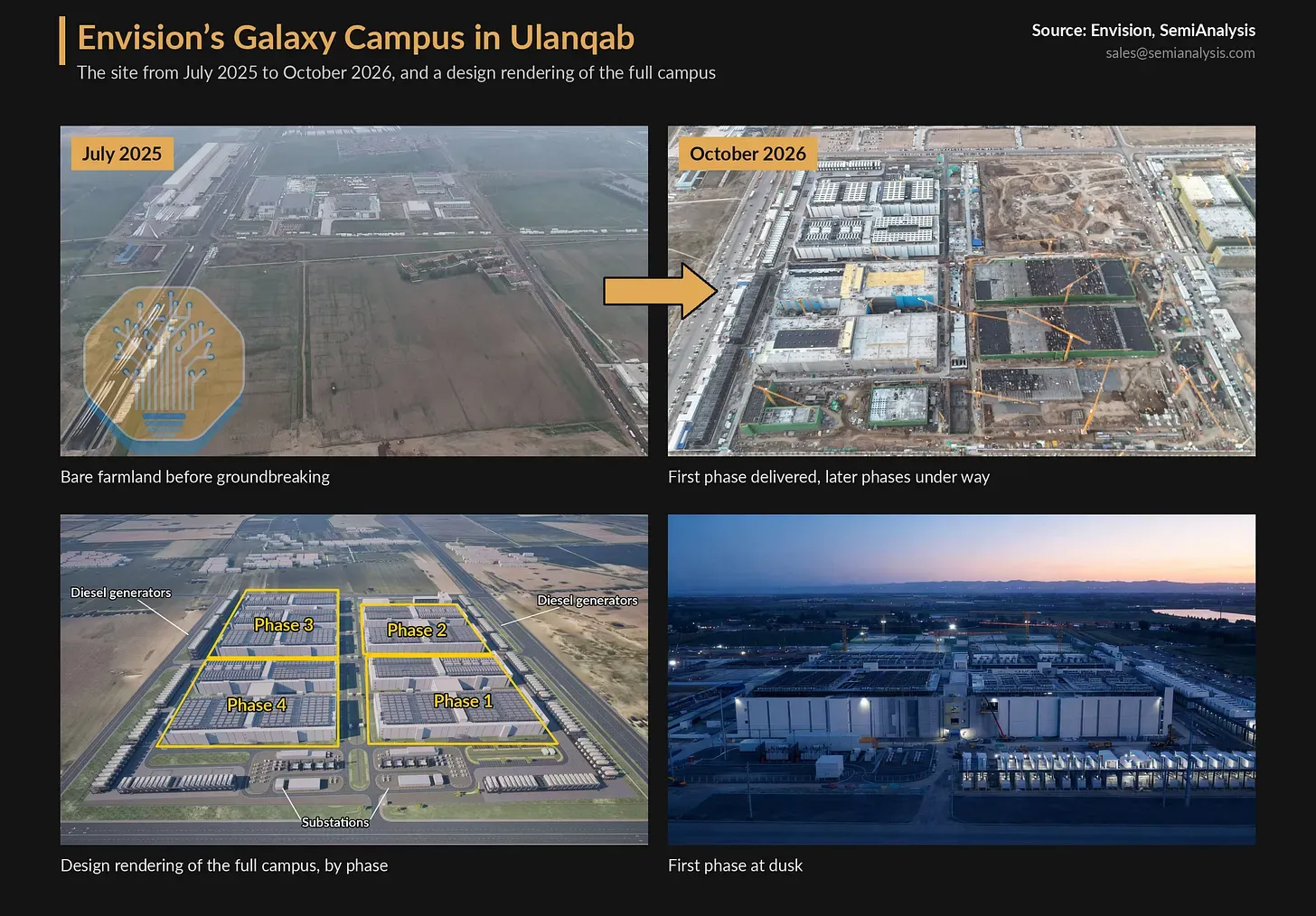
While US developers are turning to on-site gas turbinesto work around grid constraints, Envision is building its data center alongside wind farms, battery storage, and dedicated power infrastructure. Galaxy is located in Ulanqab, Inner Mongolia, and is being developed across four phases for two unnamed internet companies. The completed campus is planned to provide up to 800MW of IT capacity by the end of 2027, putting it closer to the approximately 820MW of critical IT capacity at the Stargate campus in Abilene, Texas.
Envision is building its own power supply for Galaxy rather than leaving everything to the local grid. So far, the company has installed more than 100GW of wind turbines and wants its wind farms to provide over 60% of the electricity needed by the campus's first two phases. Those farms, located about 80 kilometers apart, have a combined capacity of 420MW. That's well above the 240MW load expected from the first two phases, although wind turbines rarely get to run flat out. Ulanqab's wind capacity factor is between 355 and 40%, so Envision is adding four-hour battery storage to keep the electricity coming when the wind dies down.
Power equipment is proving rather hard to come by for some US data center builders. We have previously reported on turbine shortages that have pushed delivery estimates to 2030, whileSpaceX is looking to manufacture its own turbine blades for its gas-powered AI facilities. Envision, meanwhile, is putting wind generation and battery storage right alongside its servers.
The power hardware inside the Galaxy is worth a look, too. Semianalyss visited a 5MW hall where solid-state transformers take 10kV AC electricity and convert it directly into 800V DC for the server racks. That's a fairly substantial departure from conventional data-center power distribution, which typically involves several intermediate conversion stages. In one 5MW hall, we saw the 800V system at work," the researchers wrote. They explained that Solid-state transformers (SSTs) take 10kV AC from the grid and convert it straight to 800V DC for the racks."
The design removes several intermediate components found in conventional data center power systems, including low voltage transformers, uninterruptible power supplies and rectifiers. Fewer conversion stages can reduce equipment requirements and energy losses, although SemiAnalysis did not provide a measured efficiency improvement for Galaxy's pilot. The 5MW installation is only a small part of the campus, but it puts the technology into operation at a live facility. Envision, however, plans an even larger deployment in the next construction phases, a move that aligns with Nvidia's push for 800V DC distribution in future high-density AI systems.
Galaxy's campus uses a cooling arrangement in which liquid-cooled and air-cooled servers share a single water loop, eliminating the need for conventional central chiller plants. That matters as AI servers generate more heat and require increasingly sophisticated cooling systems. Removing central chillers can simplify infrastructure, although the design depends on local climate conditions and the facility's ability to reject heat through its water loop. China has previously experimented with other unconventional cooling methods, including a wind-powered underwater datacenter off Shanghai that uses surrounding seawater to help cool its servers.
That said, Galaxy is the first major project in Invision's wider Inner Mongolia datacentre plans, which Semianalysis says add up to 3GW, with the rest of the campus still a busy construction site. The surrounding Chahar High-tech Zone is also expanding rapidly, with nearly 30,000 construction workers spread across 22 data center projects, according to a local report cited by the researchers.
The wider Chinese expansion is also attracting some of the world's largest technology companies. Alibaba, Huawei and ByteDance are among the firms expanding infrastructure in the region, which benefits from relatively cheap electricity, available land and abundant wind resources. However access to electricity and datacenter buildings does not automatically translate to available AI computing power. China's access to advanced accelerators remains a separate constraint, particularly as US export restrictions limit its ability to acquire Nvidia's most powerful chips.