Seagate resurrects hybrid storage: Hands-on with the FireCuda Forge – 8 or 20TB external hard drive requires you to bring your own NVMe SSD
What's old is new again. Seagate started adding faster flash-based storage to its hard drives in 2010, when solid-state storage was prohibitively expensive. And now that SSDs are stupid-expensive again (thanks, AI hyperscaler demand) the hard drive maker is offering up another hybrid drive, of sorts, with the Firecuda Forge.
Available in 8TB and 20TB capacities, the Forge is an external hard drive that requires that you bring and install your own SSD. That's right, the drive won't work unless you partially disassemble and install your own M.2 2280 SSD, which mounts in the side of the enclosure. 1TB drives with DRAM are recommended. Performance maxes out at PCIe Gen3 drives; newer, faster, and roomier SSDs are supported, but won't improve performance. The Firecuda Forge only has a mounting point for 2280-length drives, and while drives that are less than 1TB are supported, that means less room for frequently used files, so "performance may be reduced."
Interestingly, Seagate sent us a 2TB FireCuda 530R SSD to test with the Forge hard drive, which is both faster (PCIe 4.0) and more spacious than what the company says you should pair with its hard drive. The list of SSD that Seagate has officially qualified to work with the Firecuda Forge is also pretty sparse, including just three other drives: Samsung's 990 Pro, WD/Sandisk SN850X/GX Pro 850X, and the WD/SanDisk SN710/GX7100.
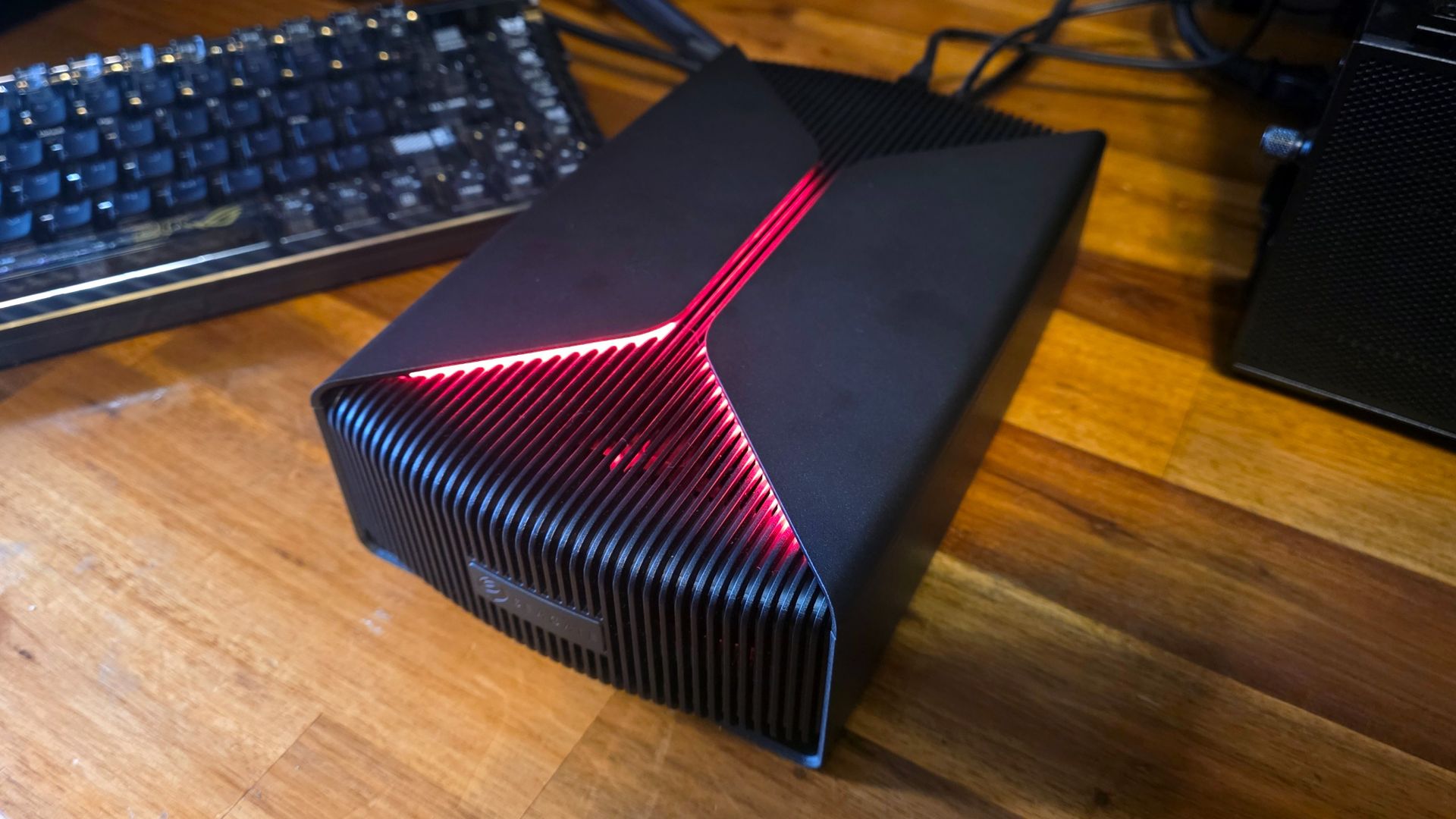
We only received a review sample a few days before launch, and haven't yet had a chance to put the FireCuda Forge through its paces for a full review. But I was impressed that, after I installed the SSD and plugged the drive in, it just showed up in Windows 11 as an 8TB drive. (The company says it also works with macOS 26 and later). There was no software setup involved, and Seagate says you can even remove and upgrade the hard drive to something roomier down the line. Seagate calls the "product architecture" that handles unifying and data handling between the spinning platter drive and the SSD "Alkemi," and says it combines "onboard processing" with the hard drive and the user-supplied SSD to "prioritize active data without requiring users to manually manage separate drives."
Seagate says Alkemi observes workloads and gives priority to currently relevant or often-used data, that it adapts over time to user behavior, and describes it as an "on-device device dynamic caching and workload-aware data-prioritization technology." That sounds pretty similar to the SSD caching used on hybrid drives of the early 2010s, although with up to 1TB of fast SSD storage, you're getting a much bigger fast data pool than those drives of the past, which often made do with 4-16GB.
Interestingly, Seagate says that machine learning is a part of what Alkemi does, but repeatedly points out in its review materials that it is not using generative AI. It's likely the company is worried about customers connecting the many reported instances of LLMs and agents deleting data with this new product. I can understand why Seagate would want to distance its hybrid storage tech from reports of catastrophic data deletion.
What's the FireCuda Forge like to use?Getting past the somewhat odd-feeling aspect of having to crack open an external drive right out of the box and install another drive into it in order for it to work, the process was pretty painless. You have to remove four screws from the bottom (with a tiny included hex-bit driver) to get the outer shell off the FireCuda Forge. From there, the M.2 drive bay is clearly visible on the side. If you want to remove six more hex screws, you can also pop out the hard drive for future upgrades. But for now, we're just going to install an M.2 SSD.
SSD installation is pretty much the same as putting one of these drives in any laptop or motherboard. Though you'll need a tool; the drive requires a a tiny screw and Seagate does not include a suitable Phillips head screwdriver. The drive bay is somewhat recessed, and there are two thick thermal pads included in the box that should ensure the drive makes contact with both the inner edge of the bay and the external shroud.
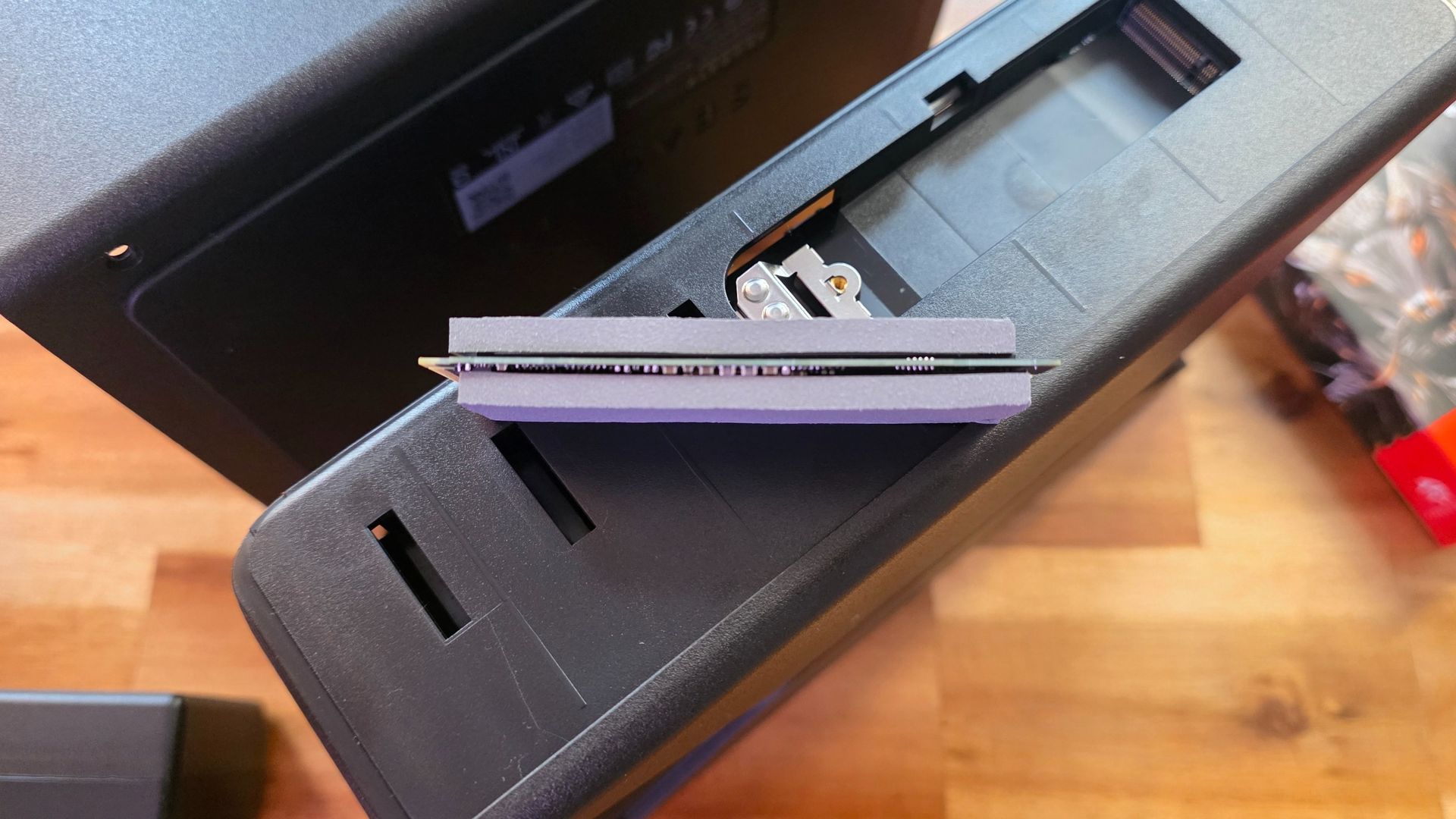
This should provide some heat dissipation, but these surfaces are all's plastic, with only a foil layer on the outer shroud to draw some of the drive's heat away from the SSD itself. This is probably fine for most bursty game and creative workloads. But this design does not feel ideal for workloads that hit the drive consistently for hours on end. During our testing, the edge of the drive where the SSD is installed got noticeably warmer than the rest of the enclosure, but it didn't get hot.
In terms of design, the FireCuda Forge looks very similar to the FireCuda X Vault HDD we looked at earlier this year, complete with some gamer-friendly RGB lighting. The primary physical difference is that you'll need the supplied USB-C cable and external power adapter to use the Forge, while the X Vault only has a USB-C port. Presumably, powering both a 3.5-inch hard drive and an M.2 SSD draws too much power for most (or at least some) USB-C ports. I still would love for drives like this to be able to run off of one single cable, though, which was my favorite feature of the X Vault hard drive.
Preliminary testingWe only received the FireCuda Forge a couple of working days before its announcement. But we were able to run some benchmarks with the Forge drive and a 530R SSD that Seagate provided, and saw some interesting results. The Forge's USB-C connection is USB4, and Seagate's performance claims are up to 2,500 MB/s read and 2,000 MB/s write. That's obviously much faster than a hard drive, but you're also going to be sacrificing the speed of the SSD you're dropping into this drive - especially if it's a PCIe 4.0 SSD.
Trace Testing - PCMark 10 Storage BenchmarkPCMark 10 is a trace-based benchmark that uses a wide-ranging set of real-world traces from popular applications and everyday tasks to measure the performance of storage devices.
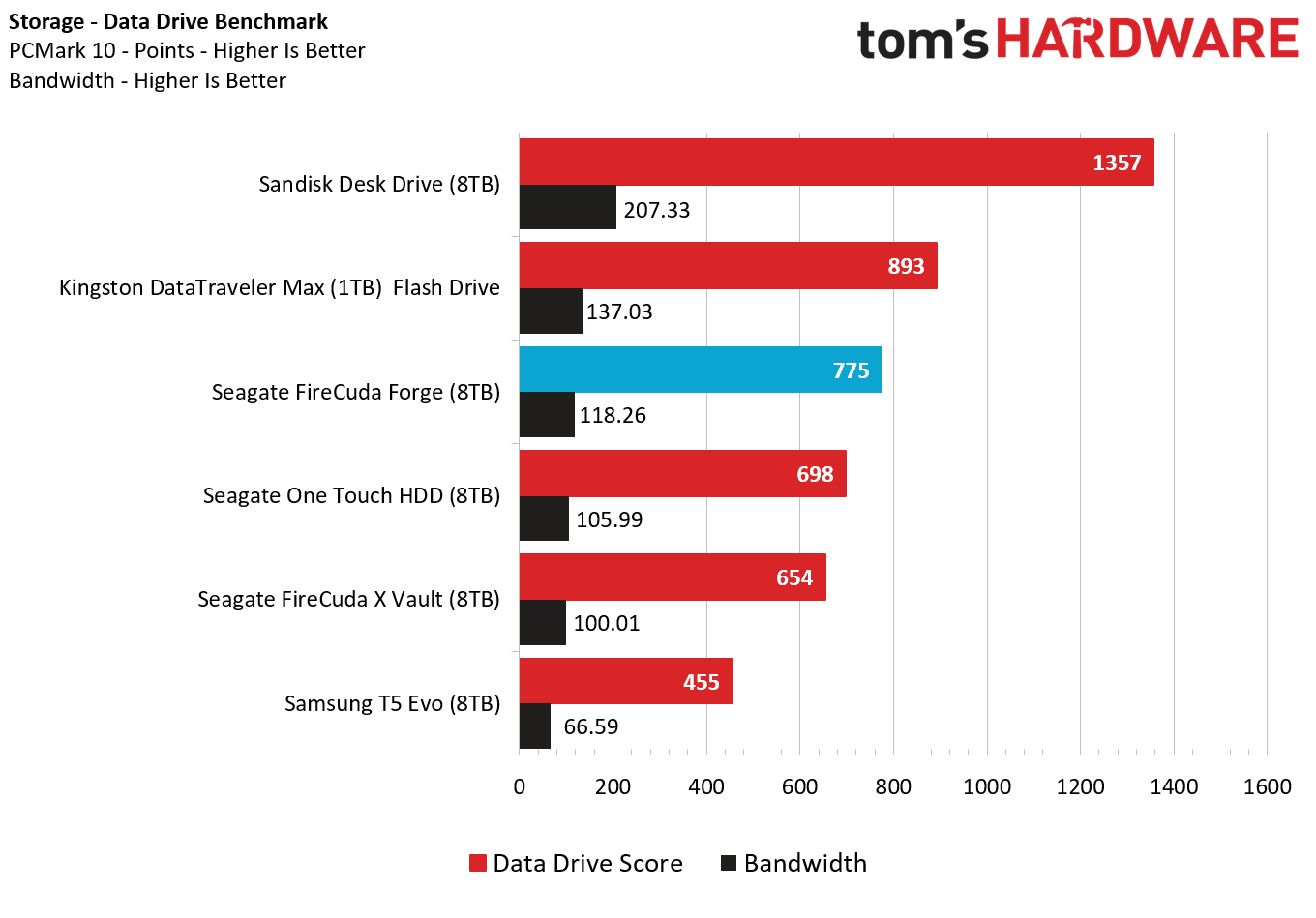
On this synthetic test, Seagate's Forge beats recent traditional hard drives (and the slowest external SSD we've tested, Samsung's T5). But Kingston's fast flash drive does better, as does Sandisk's Desk Drive, which nearly doubles the score of the Forge, which isn't surprising given it's a full-fledged external SSD.
Transfer Rates - DiskBenchWe use the DiskBench storage benchmarking tool to test file transfer performance with a custom 50GB dataset. We copy 4,617 files (images, videos, and software ISO files) to a folder on the test drive (write). Then, after leaving the system idle for five minutes, we run the same test in reverse, moving the test folder to a different location on our PCIe 4.0 testing drive.
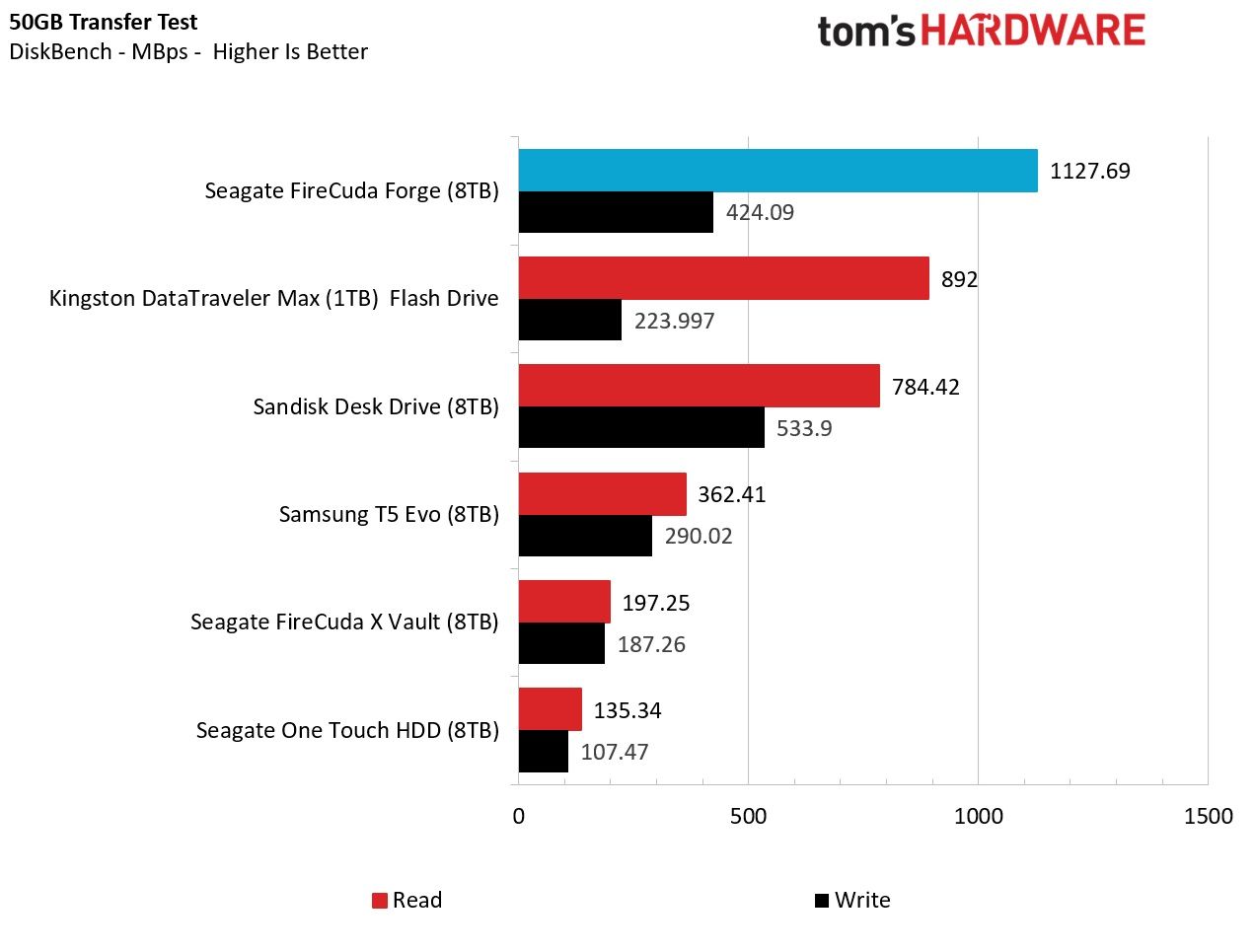
Here , we see the Forge drive easily beating the spinning-platter-only drives and Samsung's T5 Evo on writes, only falling to the SanDisk Desk Drive desktop SSD. But on reads, the Forge leads by the pack.
Synthetic Testing: CrystalDiskMarkCrystalDiskMark (CDM) is a free and easy-to-run storage benchmarking tool that SSD companies commonly use to assign performance specifications to their products. It gives us insight into how each device handles different file sizes. We run this test at its default settings.
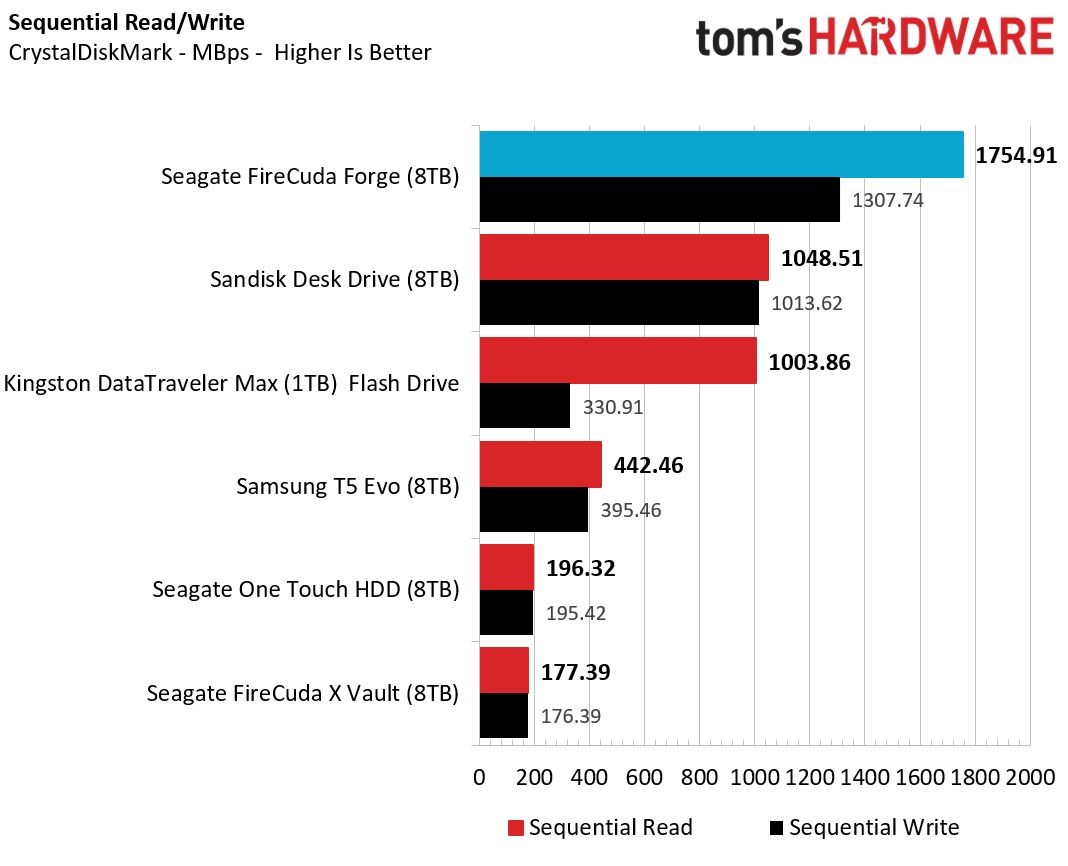
Last up (for now), CrystalDiskMark proves the Force does benefit significantly from its USB4 interface, with its performance on sequential reads and writes jumping well ahead of everything else on our chart - because all other drives here top out at 10 Gbps. There are, of course, faster external SSDs (like Samsung's recent P9). But at 8TB, solid-state options are generally more expensive, and faster external SSDs at 8TB are much more expensive. And of course, 20TB external SSDs aren't really an option, at least in the consumer drive space.
Pricing and final thoughtsThe whole reason a product like the Seagate Forge exists is because SSDs are expensive. The problem is, hard drives have faced similar price jumps due to demand. And Seagate says the 8TB Force will launch at $699 for the 8TB drive, and $899 for the 20TB option. That's a lot of money for a drive you need to also put your own M.2 SSD into for it to function.
We'll also need to do more testing with things like game load times before passing judgment on the FireCuda Forge. But it likely makes much more sense in the 20TB capacity, where no single-drive consumer SSD-based option exists. At 8TB, there are options like SanDisk's Desk drive, which has a slower 10GBps interface, but is a full-fledged SSD, rather than a hard drive with some fast SSD cache. Surprisingly, that Sandisk drive is still on sale for $999. And unless you happen to have an old M.2 SSD lying around to install into the Forge, its price, including the SSD it needs to function, isn't going to be far off traditional solid-state options.