Intel reclaims overall CPU market share for the first time since 2025
Shipments of x86 CPUs declined quarter-over-quarter and year-over-year in the third quarter as demand for client processors dropped sharply due to high component prices, while server CPU unit sales grew by a whopping 20% year-over-year, according to the latest report from Mercury Research. Intel regained overall CPU market share from AMD for the first time since Q2 2025, largely due to surprisingly strong performance in desktop PCs. Meanwhile, AMD continued to set new records in the mobile and server CPU segments, the report claims. In total, the industry supplied 68.93 million x86 CPUs, Jon Peddie Research reports.
Segment | AMD Q3 2026 | Intel Q3 2026 | AMD QoQ gain | AMD Q3 2025 | Intel Q3 2025 | AMD YoY gain |
|---|---|---|---|---|---|---|
Overall x86 | 30.10% | 69.90% | -0.7% | 25.60% | 74.40% | 4.50% |
Client | 29.30% | 70.70% | -0.9% | 25.40% | 74.60% | 4.00% |
Desktop | 29.90% | 70.10% | -5.1% | 33.60% | 66.40% | -3.7% |
Mobile | 29.20% | 70.80% | 0.20% | 21.90% | 78.10% | 7.20% |
Server | 35.50% | 64.50% | 1.00% | 27.80% | 72.20% | 7.70% |
All CPUs, including IoT and SoCs | 33.90% | 66.10% | -0.2% | 30.90% | 69.10% | 3.00% |
The overall CPU market contracted both sequentially and year-over-year in unit shipments in Q3 2026, after a much stronger-than-expected second quarter, according to Mercury Research. AMD and Intel shipped 60.8 million client CPUs and 8.13 million data center processors during the quarter. One thing to keep in mind about the reports from JPR and Mercury Research is that they count CPU shipments, which happen months before those CPUs are sold in actual systems.
"After a far better than expected second quarter market for client processors, the third quarter PC CPU market declined far more than expected, entirely due to a downturn in mobile CPUs - this was the same segment that was unexpectedly higher last quarter, hinting that part of the downturn may have been due to CPU demand pulling in sales from the third quarter," said Dean McCarron, principal analyst at Mercury Research.
"Both Intel and AMD indicated in their earnings results that there was a rapid softening in PC demand late in the third quarter that impacted client processor shipments and that the outlook for client CPUs in the fourth quarter will be a decline in excess of 20%. Unlike client CPUs, however, server processors continued to grow strongly in the past quarter, as did embedded CPUs."
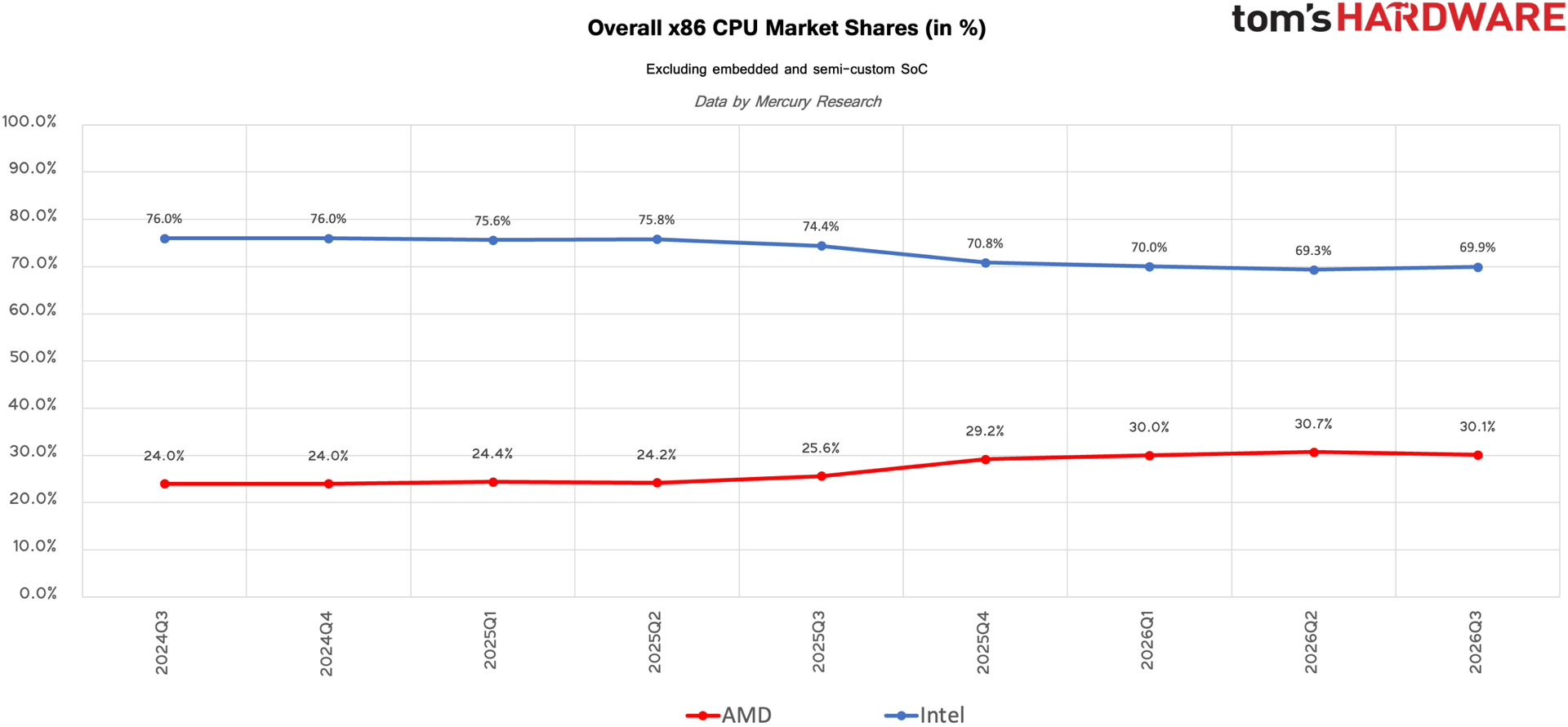
Quarter over quarter, the decline was driven primarily by significantly lower demand for mobile processors, as 86 notebook CPU shipments dropped by more than 10%. By contrast, desktop CPU shipments recovered, largely thanks to Intel, while server and embedded CPU shipments continued to grow strongly. Excluding IoT, semi-custom SoCs, and embedded products, both AMD and Intel shipped fewer x86 processors than in the previous quarter, though AMD's decline was larger than Intel's.
Compared with the third quarter of 2025, CPU shipments declined across all major market segments except servers. Desktop and notebook CPU shipments decreased due to weaker PC demand amid rising component costs, particularly memory prices. Embedded processor and semi-custom SoC shipments also declined, primarily due to AMD's shrinking game console business. By contrast, fueled by the ongoing buildout of AI infrastructure, server CPU shipments increased by more than 20% YoY, their highest annual growth rate in nearly five years.
"Client CPU shipments softened in Q3 as OEMs kept inventories lean and the DIY channel remained weak," said Dr. Jon Peddie, president of Jon Peddie Research. "Server CPUs continued growing, with AMD gaining share and AI-related demand supporting the market. We expect PC conditions to remain difficult into the first half of 2027."
Due to weakness in the client PC space, AMD's overall x86 market share (excluding embedded and semi-custom SoC) declined by 0.6% QoQ for the first time in years, but still grew by a significant 4.5% YoY, according to Mercury Research.
Client CPUs: AMD loses share for the first time since 2022In the x86 client PC segment, Intel regained some ground on AMD in Q3 2026 as overall client CPU shipments declined more sharply than expected, according to both Jon Peddie Research and Mercury Research. JPR estimates that AMD and Intel shipped 60.8 million client processors in Q3 2026, down from 62.93 million a quarter before and roughly 65 million in Q3 2025.
(Image credit: Mercury Research)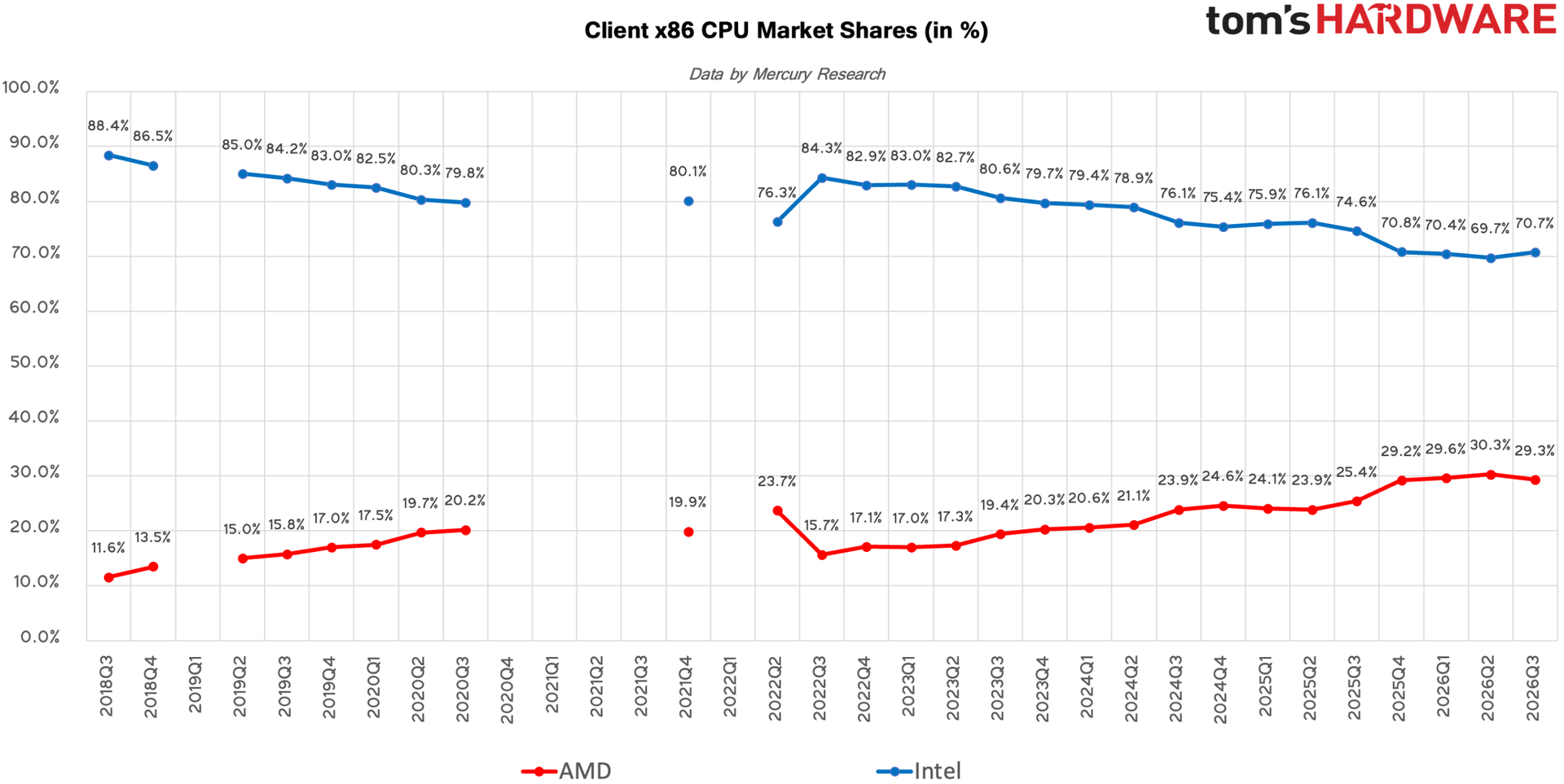
AMD's client CPU unit share dropped to 29.3%, down from a record 30.3% in Q2, but still notably higher than the 25.4% it commanded a year earlier. Meanwhile, Intel increased its share to 70.7%, though its position remained considerably weaker than in Q3 2025, when it controlled 74.6% of the market.
Intel's sequential market share gains were driven entirely by a substantial increase in desktop CPU shipments, while AMD continued to gain ground in notebooks, albeit at a much slower pace than in previous quarters. Mercury Research believes that weaker demand for mobile CPUs may have enabled Intel to allocate more silicon to desktop processors, a market that the company had undersupplied for some time.
However, the outlook for both companies' client CPU businesses is rather gloomy, as rising component costs (especially DRAM and 3D NAND prices) are weighing on PC demand. Both AMD and Intel anticipate a sequential decline in client CPU shipments of more than 20% in the fourth quarter and further declines in the year to come. Meanwhile, one has to keep in mind that CPUs sold in Q4 are meant for systems to be shipped in Q1, which is traditionally weak. Hence, while the 20% YoY decline is extraordinary, a substantial part of that decline is seasonal.
Desktop CPUs: Intel is bringing vengeanceIn the desktop PC segment, Intel made a spectacular comeback in Q3 2026, reclaiming 5% of the market in one quarter. Intel's desktop CPU unit share climbed to 70.1%, up 5% sequentially and 3.7% in the same quarter a year ago. By contrast, AMD's share dropped to 29.9%, down from 34.9% in Q2 2026 and 33.6% in Q3 2025, meaning the company wiped out its market share gains over the past year.
(Image credit: Mercury Research)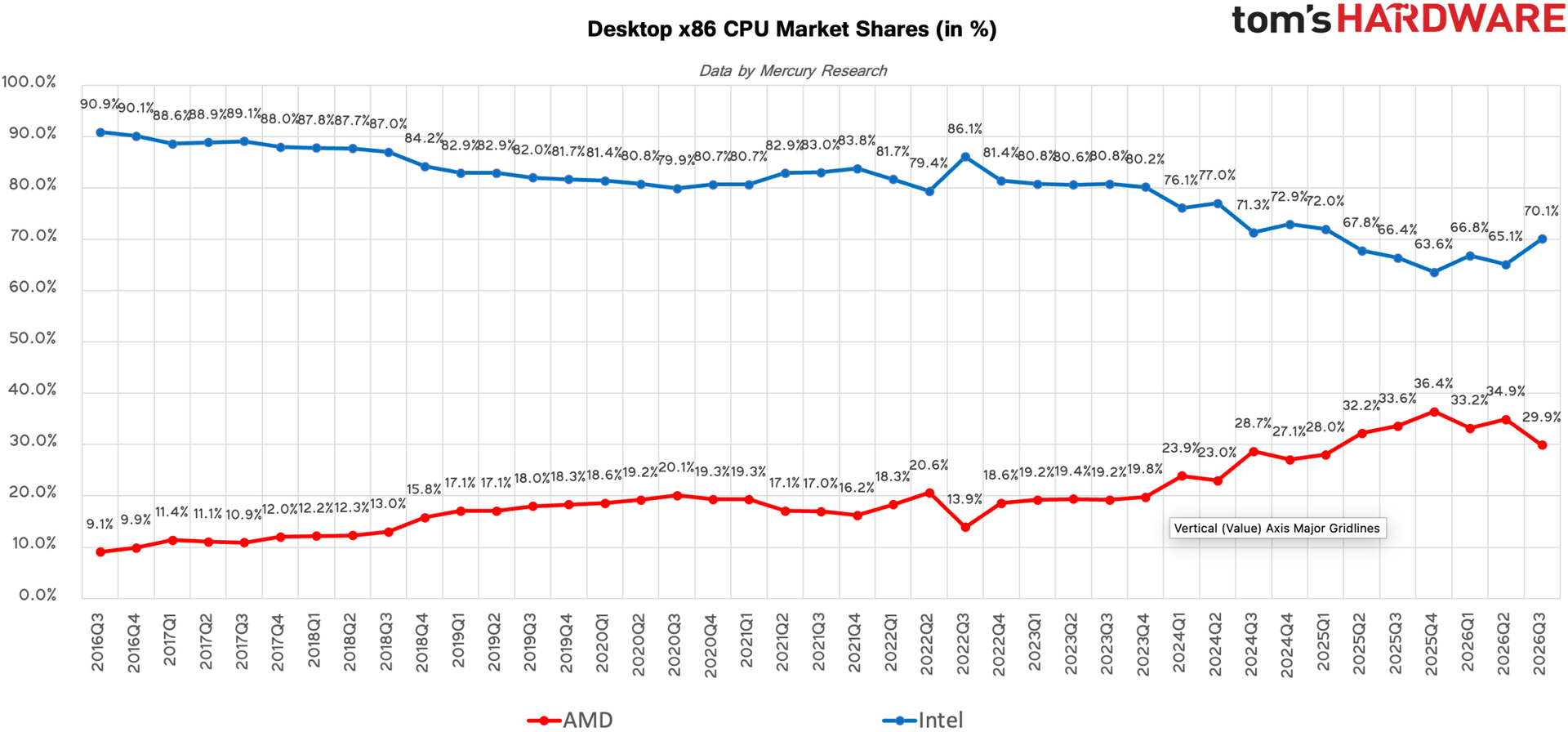
Mercury Research speculates that weaker demand for notebook processors enabled Intel to allocate more silicon to mainstream desktop CPUs, a market that both companies have underserved for some time. Another factor behind AMD's poor performance was its greater exposure to the gaming PC market, which suffered from limited availability of gaming graphics cards and unusually high costs for other components, such as memory modules and SSDs.
Yet, desktops became the only major x86 CPU market segment where AMD lost unit share both sequentially and year-over-year.
Mobile CPUs: AMD gains amid market declinesIn the mobile PC segment, both AMD and Intel saw a substantial decline in CPU shipments in Q3 2026 as the market contracted more than 10% sequentially, according to Mercury Research. However, AMD's shipments declined slightly less than Intel's, which enabled the company to increase its mobile CPU unit share to a record 29.2%, up from 28.9% in Q2 2026 and 21.9% in Q3 2025. Intel remained the dominant supplier with a 70.8% share, down from 71.1% in the previous quarter and 78.1% a year earlier.
(Image credit: Mercury Research)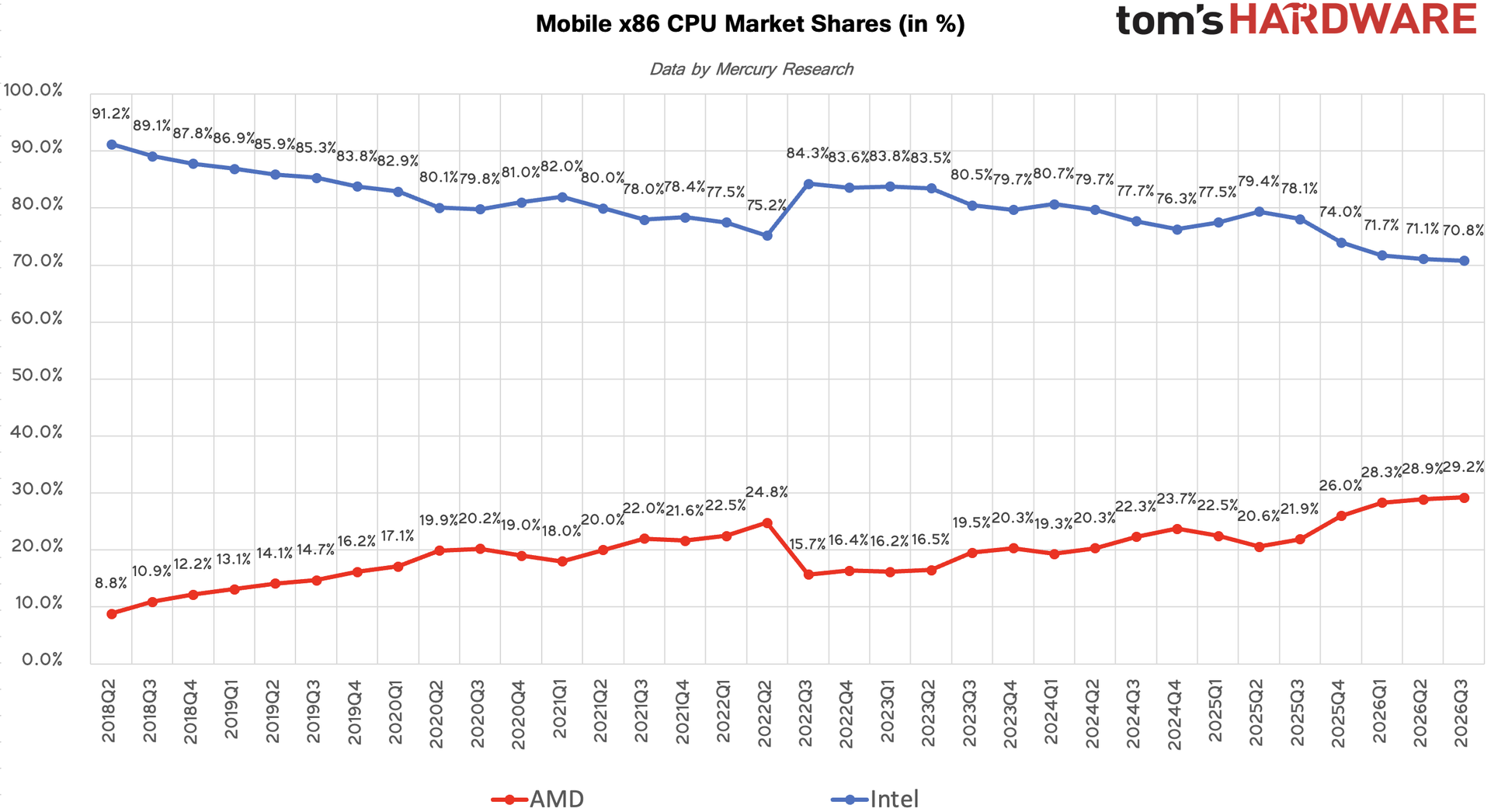
Although AMD's sequential market share gain of 0.2% was negligible, its 7.2% YoY gain was impressive, especially given Intel's historically strong position in the notebook market. Mercury Research attributes the sharp sequential decline in mobile CPU shipments partly to PC makers pulling forward their CPU procurements into the unusually strong second quarter.
Unfortunately for both AMD and Intel, the outlook for the fourth quarter is gloomy, as rising memory and other component prices drive up notebook prices and reduce end-user demand.
Server CPUs: Best quarter ever?Unlike the bleak client CPU market, server CPUs are thriving, with shipments of data center processors reaching 8.13 million units in Q3 2026, according to Jon Peddie Research. The market again grew 20% year-over-year, the highest annual growth rate in nearly five years, according to Mercury Research.
In the server CPU segment, AMD continued its winning spree as its unit share reached a record 35.5%, up from 34.5% in Q2 2026 and 27.8% in Q3 2025. Intel remained the dominant supplier with a 64.5% share, down 1% sequentially and 7.7% year-over-year.
(Image credit: Mercury Research)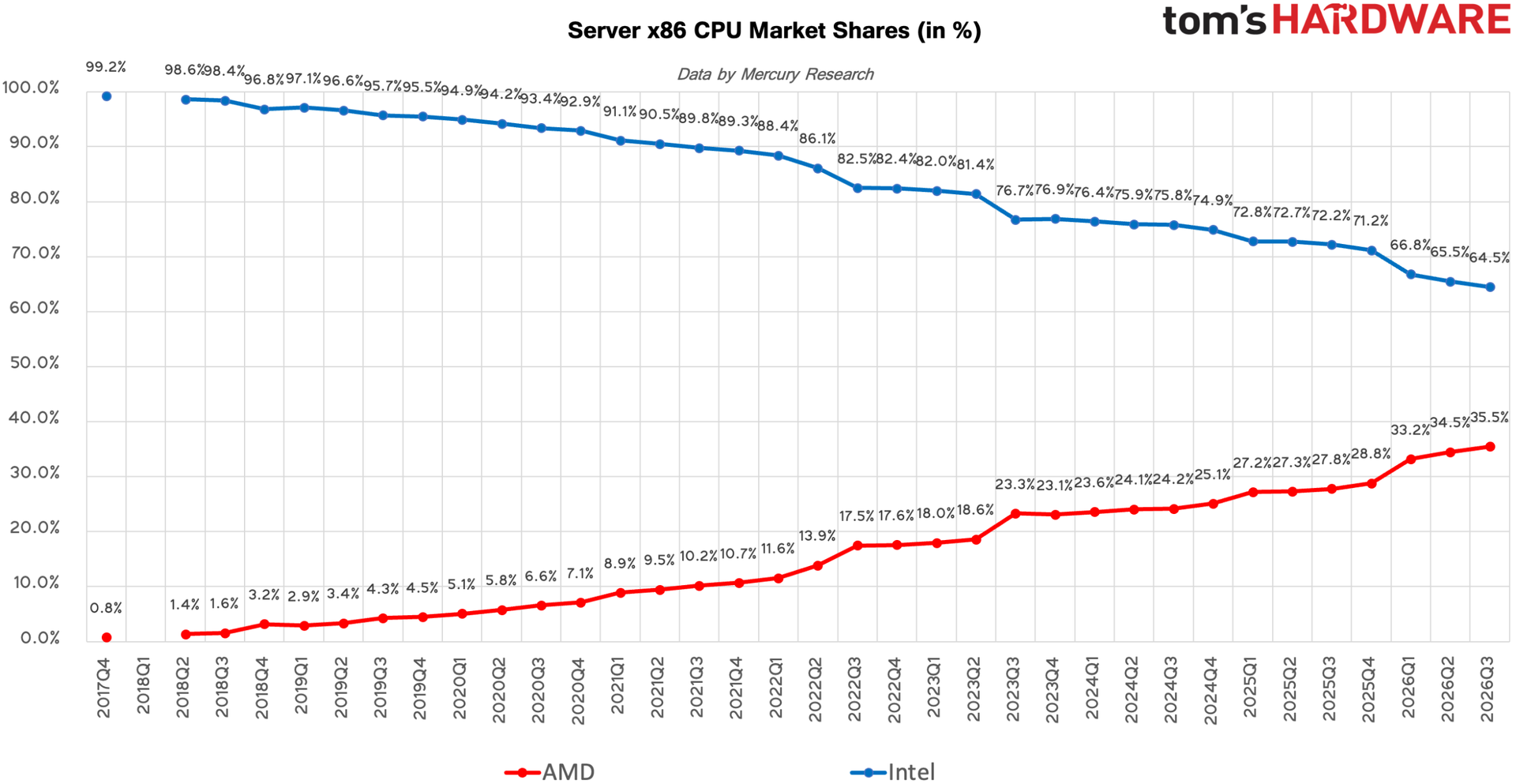
Interestingly, Intel managed to slow AMD's advance in the core data center CPU market by apparently substantially increasing shipments of its Xeon SP processors, McCarron believes. When the comparison is limited to AMD's EPYC and Intel's Xeon SP processors, AMD's unit share reached 46.8%, up just 0.4% sequentially, which represents AMD's smallest sequential gain over the past year, as the company's quarterly share gains by this metric averaged 3% over the preceding three quarters.
Unlike the client CPU market, the outlook for the server processor market remains particularly favorable for both AMD and Intel. The ongoing buildout of AI infrastructure drives demand not only for conventional data center-grade processors, but also for workstation-class CPUs used in smaller departmental AI servers.
SummaryShipments of x86 CPUs declined both sequentially and year-over-year in Q3 2026 to 68.93 million units as rising component prices weighed on client PC demand, while server CPU shipments grew more than 20% year-over-year.
Intel regained overall x86 CPU market share from AMD for the first time since Q2 2025, largely thanks to a spectacular comeback in the desktop CPU segment, where its share reached 70.1%. Meanwhile, AMD gained 0.3% of the mobile CPU market, now commanding 29.2%, its highest share ever. Furthermore, AMD reached a record unit share in the server CPU segment, where it now commands 35.5%.
Both companies expect client CPU shipments to drop by more than 20% sequentially in Q4, whereas demand for server processors continues to grow due to the ongoing buildout of AI infrastructure.