Vulnerability could let hacker hijack electric trailer braking system remotely via Bluetooth, apply any amount of force remotely
After noticing that his Elecbrakes remote had automatically paired to a stranger's trailer, Patrick Forck's cybersecurity spider senses tingled. Any feelings of foreboding were warranted, as it was discovered that a critical Bluetooth security flaw meant anyone could connect to an Elecbrakes controller "without pairing, authentication, a PIN, or any approval." Over the following 10 months, Forck and his Element Digital colleague Jeremy McCarthy would fully identify the vulnerabilities, make responsible disclosures to the vendor, work on fix verification, and more.
The story goes that Forck was a contented user of the Elecbrakes solution for the trailer towing fraternity. The firm's systems are claimed to be easy DIY plug-and-play controllers for enhanced braking response - important for trailer towing, especially with larger and heavier loads. The core functionality wasn't a problem, but Forck was alarmed when driving down the highway one day and noticed that his Elecbrakes In-Car Remote had connected to someone else's trailer. "It had connected mid-drive, without pairing or a prompt, to a brake controller that wasn't mine, on a trailer I'd never seen, belonging to a driver who had no idea," explained our tech-savvy protagonist. It wasn't long before he thought, "If a device I don't own will happily talk to my in-car remote driving past with zero friction... what exactly is stopping my phone or any other Bluetooth device from talking back?" Clearly, Elecbrakes ' ease of use was unintentionally too powerful.
Forck and McCarthy's first step on the road to a solution was to use Claude to do the heavy lifting on the reverse engineering of the Elecbrakes Android app. McCarthy built a Web Bluetooth research tool that runs in Chrome, again using Claude. Then Forck tested the newly built tool with his car and trailer on some gravel roads on his family estate. It was confirmed that any attacker could connect via Bluetooth from nearby without Bluetooth pairing or authentication. Moreover, they could send simple commands to the trailer, apply braking at any force level, and receive confirmation that the brake had engaged.
As per the blog post documenting the finding and fixing of these vulnerabilities, the danger of a security flaw which "outputs torque to a wheel on a public road," is difficult to overstate. Especially when the attack surface and opportunity are open to anyone within Bluetooth range."
With the bulk of research complete, the Element Digital colleagues disclosed the information to Elecbrakes in May 2026. They were pleased with the small firm's responsiveness and openness. By July, firmware updates to patch the EB2 and VM1 models currently on the market were released.
(Image credit: Element Digital Blog)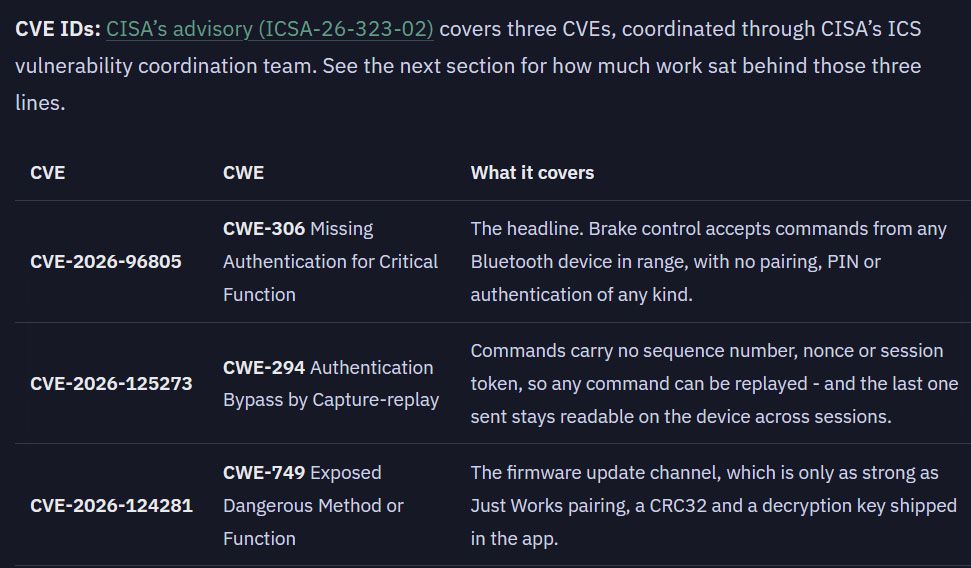
An older Elecbrakes controller called the ELBC 2000 was discovered to have the same Bluetooth security flaws. The vulnerability of this model, which hasn't been sold for a number of years, has now been confirmed by the maker. Nevertheless, some folks will be using it on public roads. Elecbrakes has advised owners to keep an eye on firmware update notices for an impending fix.