Inside Bob Chesney's Fearless Embrace Of Success And Failure With UCLA
by from Latest Sports News & Videos from FOX Sports on (#7A0QF)
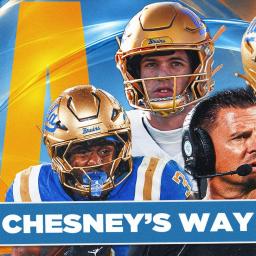 This story is part of an exclusive look at Bob Chesney's first year at UCLA. Read Bob Chesney Has UCLA Football Ready To Dream Crazy'. LOS ANGELES - There's poetry at work here. Inside his office overlooking UCLA's practice field in a football facility bathed in blue and gold, Bob Chesney laid out how he built the UCLA Bruins into one of the best teams in America on the cusp of securing the program's first trip to the College Football Playoff. Alongside my college sports reporting partner, Ben Portnoy, Chesney said the process starts with how he, his coaches and his players handle details. "Everything you did, grades, you know, locker on the field, weight room, no matter just constant competition. I think then that just kind of becomes who you are, and you're not afraid of any situation you're going to walk into." The Bruins weren't afraid after winning the first four games of their season. When they came back off of their bye week, they found themselves ranked No. 21 in the country. Chesney implored his team not to pay attention to that ranking. He knew the moment his players showed awe at people like me ranking his team, believing UCLA is one of the 25 best teams in the country, that ranking would likely disappear. They weren't afraid when they took that ranking to Autzen Stadium against Oregon, lost their starting quarterback, Nico Iamaleava, for the year and survived to beat the Ducks, 17-15, in a game that featured 10 turnovers. Two weeks before losing to Michigan, ending UCLA's attempt at an undefeated regular season, Chesney told Portnoy and me - Crockett to my Tubbs - he knew success and failure to be partners, too. "Creating an environment where there's constant success and failure, and you're learning how to deal with those successes and failures, your teammates are there to help pick you up when you fail," Chesney said. "They're here to celebrate with you when you win. I think that all leads you to the moment that when you finally get to game day, you've been through it so many times, and your mental armor is so strong that you can almost withstand anything. I think that we're not better than a lot of these teams, right? But we are playing better, and we're playing together. And I think that has a lot to do with it." If you can keep your head when all about you Are losing theirs and blaming it on you, If you can trust yourself when all men doubt you, But make allowance for their doubting too; If you can wait and not be tired by waiting, Or being lied about, don't deal in lies, Or being hated, don't give way to hating, And yet don't look too good, nor talk too wise; Most coaches love seeing failures from great effort. Not only is there something to coach, to get better at doing, but there's also a hidden rep for resilience in every failure. Great coaches don't like talking about success. There's simply too little to be gained from it, and yet it is the only metric that keeps many employed. In a sport that is about winning and winning often, making failure a part of the culture is a gamble. It's even more of a gamble to say that (supposedly quiet part) out loud. Chesney was relaxed. He made strong eye contact, and he was leaning into the opportunity to not just talk about his team but his philosophy toward coaching. Successes and failures go hand-in-hand. Coaches don't talk about the symbiosis between those two ultimate results. Results are quantitative - ones and zeros - rather than qualitative. They do want to talk about process. They do want to talk about the next step. They do want to talk about presence. Doesn't matter what you did. It doesn't matter what you're going to do. It matters what you're doing today. Chesney himself has made famous the phrase:Doesn't matter. Get better. However, there's a difference between being raring to go in August and being hurt, being banged up, under pressure unlike many of these Bruins have ever experienced before. "What are the things that you are looking for within your team to try to keep them in the same mindset you had in August after that eight months of work you put in?" I asked the then-still-undefeated UCLA coach. Because now, it's November. And at that point, the Bruins were three games from an undefeated regular season. They had not failed in the win-loss column. But what can a coach possibly say to his team other than, "Hey, I know you hear me say be in the moment right now. What can I do to help you stay in the moment right now?" Because failure found them. And it wore maize and blue. If you can dream-and not make dreams your master; If you can think-and not make thoughts your aim; If you can meet with Triumph and Disaster And treat those two impostors just the same; If you can bear to hear the truth you've spoken Twisted by knaves to make a trap for fools, Or watch the things you gave your life to, broken, And stoop and build 'em up with worn-out tools; Inside the Wasserman Football Center, on the first floor against a backdrop fit for Foot Locker with a display case full of Jordans, Chesney stood up from a table decorated with microphones at his press availability just days before UCLA played Illinois. He made way for one of his players. "I can't wait to hear what Scooter Jackson has to say," Chesney said. Said it like it was a treat. Said it like a fan before attending a reading by his favorite author. Said it like a proud coach. After greeting Portnoy and me, he asked if we were willing to wait to talk with him until after Jackson finished speaking? "Of course." Then Chesney did something I've never seen a head coach do before. He took a seat at the back of the room, inside a Bruins football locker display, put up his feet and locked into a question-and-answer session that ensued with Jackson. As Jackson, a senior cornerback who leads UCLA with five interceptions, spoke cheerily about how much fun it is to play for Chesney. Jackson, along with linebacker Sammy Omosigho, has proven to be a star on the UCLA defense. He attributed much of his success to Chesney. "Coach Chesney has shown me a different way of how to play football, how to win," Jackson said. "Everything you guys see in media, that's him in real life." For his part, Chesney laughed and smiled alongside media members as Jackson fielded questions. In a sport where coaches are loath to let their players and even assistant coaches talk to media members, Chesney not only embraced the practice but enjoyed it himself. Chesney was watching Jackson grow in front of him. He was showing support, allegiance and even love for one of his players publicly. Those chances are rare, even for star players. Chesney wants his players to know he'll be there for them, too. If you can make one heap of all your winnings And risk it on one turn of pitch-and-toss, And lose, and start again at your beginnings And never breathe a word about your loss; If you can force your heart and nerve and sinew To serve your turn long after they are gone, And so hold on when there is nothing in you Except the Will which says to them: Hold on!' Chesney coached at Holy Cross from 2018 to 2023. While in Worcester, Massachusetts, in 2019, former Crusaders wide receiver Kalif Raymond was playing for the Tennessee Titans. The Titans faced the New Orleans Saints with a chance to make the NFL playoffs. With just shy of four minutes left to play, the Titans trailed the Saints, 31-28, when quarterback Ryan Tannehill threw a pass to Raymond. Raymond caught the ball and was immediately targeted by safety C.J. Gardner-Johnson with a hit so vicious that the NFL fined Gardner-Johnson $28,075 for the hit. Still, Raymond fumbled the ball, Gardner-Johnson recovered the fumble and returned it to the Titans' 25-yard line. The Titans lost, 38-28, in Nashville. Tennessee ended up making the playoffs, but not before Raymond was maligned online for fumbling the ball and costing the Titans the win. Chesney asked Raymond to speak with his Holy Cross team about how he dealt with negative criticism from strangers. "'I shut off my social media,'" Chesney recalled Raymond saying. "'I don't pay attention to what anybody says. I only listen to what my family says and what my teammates say.'" At first, that sounded pretty good to Chesney. Then he thought about it a little more. "Well, even on this team, if you're starting above me," Chesney said, "I might not always have your best interest in mind. And there are also family members that may not have your best interests in mind. So I thought when you put them in a box of family and teammates, that's not necessarily true. "And then I came up with this thing of what you really do: You treat people the way they treat you. The biggest question about any relationship is: Is that person being real to you? Have they been open to you? And they have shared something that maybe made them vulnerable in front of you." R.O.V. - real, open and vulnerable. This is how Chesney builds trust within his team and at a university that is bathed in excellence - the No. 1 public university in the country - and has everything it desires except a championship football team. His 1-on-1 relationships with people as persons are paramount in a sport where the business of it - NIL, coaching salaries, money from television - has become the focal point of play. "You could say whatever you want in the media," Chesney said. "I would hope [the players] would be like, I don't know who this guy is. I really don't care what he says. It's nice that he wants to say that. But the same way he's saying that about us, if we lose a game, he's going to say something different.' "So you don't know him. He's not real. He's not open. He's not vulnerable to you. It's irrelevant. Don't let him make you feel good, because if you let him make you feel good, then when he says the other things, you're going to have to allow him to make you feel bad. And I want you to feel any of those things." If you can talk with crowds and keep your virtue, Or walk with Kings-nor lose the common touch, If neither foes nor loving friends can hurt you, If all men count with you, but none too much; If you can fill the unforgiving minute With sixty seconds' worth of distance run, Yours is the Earth and everything that's in it, And-which is more-you'll be a Man, my son! They lost a game. They lost a game to a mediocre Michigan team after Bruins wide receiver Semaj Morgan, a former Michigan Wolverine, disparaged the Michigan fans who show up to home games at Michigan Stadium. He told his teammates what he thought the atmosphere was like, and then he told media members what he told his teammates. "It's a nice big stadium, older fans, so it's not that loud, so we're gonna have fun," he said. They did not have fun. They played a brutal, low-scoring game that went into overtime and left them without their No. 2 turned starting quarterback, Ty Dieffenbach, for the most pivotal overtime period of the season. Dieffenbach might miss the crosstown rivalry game against USC on Saturday, and UCLA - previously the favorite to win the Big Ten title when I was in Westwood - could limp into the College Football Playoff, wounded and vulnerable. This week is when Chesney's philosophy gets tested; when his players and staff must rely on the relationships they've built with each other, to play for each other, must prove strong. It's also when he expects the lessons he's imparted, the attitude with which they approach work, grounds UCLA after failure. Winning and losing, success and failure are pairings. Meet triumph and disaster as impostors who are the same. "Our job is to find a way to get better," Chesney said. "I think those are really good lessons to learn when you're winning because they'll work for you someday if it doesn't go your way. And I think that's really the truth of it for me. I want them to understand how they got here and realize that whatever the result is on that Saturday, it doesn't matter. Get better." Rudyard Kipling wrote "If"as a part of his book of poetry and short fiction called "Rewards and Fairies" in 1910. Muhammad Ali used to carry a copy of If in his wallet. In 1996,"If" was voted the United Kingdom's favorite poem. It holds the same inspirational and charging quality as Marianne Williamson's"Our Deepest Fear," William Ernest Henley's"Invictus" and President Theodore Roosevelt's"The Man in the Arena." "If," read gently, it is called to one's best self at all times, especially, when the world would have you believe you are greater or lesser than those who love you most. I know this because"If" and"Invictus"are tattooed on my body, and I titillate when I see the traits defined in those poems displayed in others. Chesney is such a man, such a coach and leader, that he, too, might inspire men in his charge to be good, to do good work and to accept where they are in the journey, along with the responsibility for taking yourself where you want to go. It is a wonder that UCLA has arrived here in Chesney's Year 1. It is no wonder that the process is ongoing, and they are not finished yet.