The tree of life: with Darwin from Genesis to genomics | Petter Hellström
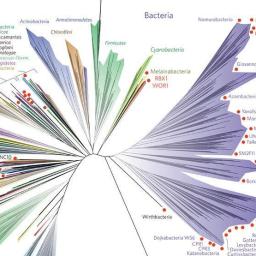
A new "tree of life" has prompted a re-evaluation of our place in evolution. But why are these diagrams named after the tree in the biblical Garden of Eden?
Last week a team of scientists published a new "tree of life" in the journal Nature Microbiology. The evolutionary diagram, representing the interconnected family history of all life forms, deviates from earlier ones by granting significantly more space to bacteria, while eukaryotes - including fungi, plants, and animals - are relegated to one slender branch. But why is a multi-coloured, sprawling diagram like this one referred to as a tree in the first place? And why do scientists invoke the biblical image of immortality when they trace the course of evolution?
Trees of life are often misread as chronologies of evolutionary history. However, because scientists cannot travel back in time, they cannot know with certainty how one species evolved into another. Instead they compare extant life forms and fossils to infer how closely related they are. In the past, trees of life were constructed by comparing visible physical characteristics. Following recent advancements in molecular biology, scientists can now calculate organisms' degrees of affinity by comparing their genomes. The methods have been refined, yet even the most advanced representations remain approximations of life's history. Trees are not records but models.
Continue reading...