Minimum of cosine sum
Supposef(x) is the sum of terms of the form cos(kx) wherek is an integer from a set A with nelements.
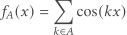
Then the maximum value of f isf(0) =n. But what is the minimum value off?
The Chowla cosine conjecture says that the minimum should be less than -n for large n. For now the best proven results are much smaller in absolute value [1].
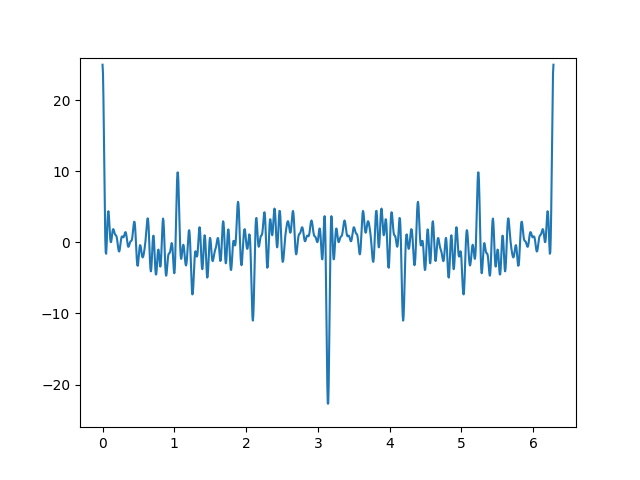
I was playing around with this problem, and the first thing I thought of was to let the setA be the firstn primes. This turned out to not be the most interesting example. Since all the primes except for the first are odd, and cos(k) = -1 for oddk, the minimum is 2 -n and occurs at .
Here's a plot whereA is the set of primes less than 100.
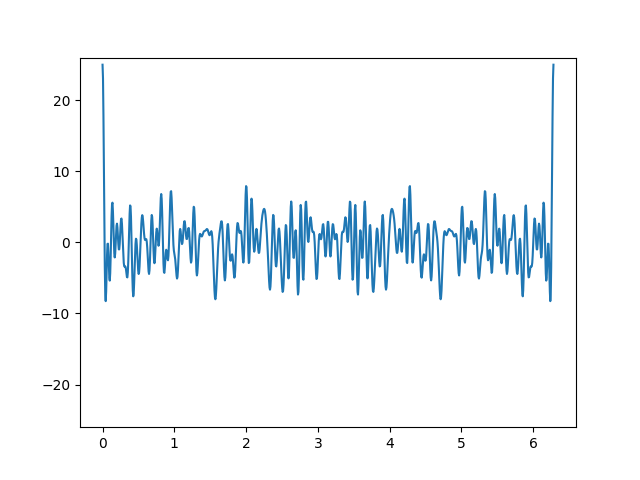
For the cosine conjecture to be interesting, the setA should contain a mix of even and odd numbers.
Here's a plot with A equal to a random selection of 25 points between 1 and 100. (I chose 25 because there are 25 primes less than 100.)
Here's the Python code I used to generate the two setsA and the function to plot.
import numpy as npfrom sympy import primedef f(x, A): return sum([np.cos(k*x) for k in A])n = 25A_prime = [prime(i) for i in range(1, n+1)]np.random.seed(20260207)A_random = np.random.choice(range(1, 101), size=n, replace=False)
If you wanted to explore the Chowla conjecture numerically, direct use of minimization software is impractical. As you can tell from the plots above, there are a lot of local minima. If the values in A are not too large, you can look at a plot to see approximately where the minimum occurs, then use a numerical method to find the minimum in this region, but that doesn't scale.
Here's an approach that would scale better. You could find all the zeros of the derivative of fA and evaluate the function at each. One of these is the minimum. The derivative is a sum of sines with integer frequencies, and so it could be written as a polynomial in z = exp(ix) [2]. You could find all the zeros of this polynomial using the QR algorithm as discussed in the previous post.
[1] Benjamin Bedert. Polynomial bounds for the Chowla cosine problem. arXiv
[2] You get a polynomial of degree n in z and 1/z. Then multiply by z2n to get a polynomial in z only of degree 2n.
The post Minimum of cosine sum first appeared on John D. Cook.