Three examples suffice
You can't prove a theorem by just checking a few examples. Except sometimes you can.
A few weeks ago I wrote Pentagonal numbers are truncated triangular numbers. In a nutshell, if the pentagonal numbers are defined by
Pn= (3n^2 -n)/2
and the triangular numbers by
Tn= (n^2 +n)/2
then
Pn=T2n- 1-Tn- 1.
Here's a visualization of the equation.
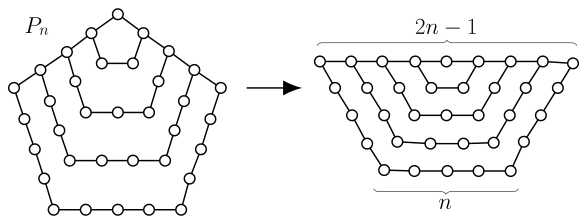
Note that the equation asserts that two quadratic polynomials are equal. If the two polynomials are equal at three points, then they're equal everywhere. We might as well make life easy and choose n = 0, 1, and 2.
If you'd like, you could do this in code.
>>> P = lambda n: (3*n**2 - n)/2>>> T = lambda n: (n**2 + n)/2>>> for n in [0, 1, 2]: assert(P(n) == T(2*n-1) - T(n-1))
This provides a rigorous proof, not just a sanity check.
Sometimes checking a few points is not enough to prove an equation with certainty, but it is enough to establish an equation with high probability. More on that here.
Related postsThe post Three examples suffice first appeared on John D. Cook.