Modern OLEDs are just as vulnerable to burn-in as 2017 panels in 10,000-hour test — twice the brightness and 27% efficiency gains offer crucial headroom
Rtings.com is back with another longevity test for OLED TVs - this time, comparing newer models from 2020 to 2023 against an older model from 2017. Results show that units from either era develop similar burn-in after 10,000 hours of simulated news channel usage. But modern TVs are much brighter and use less power, which can mitigate the typical burn-in period and extend your TV's overall lifespan.
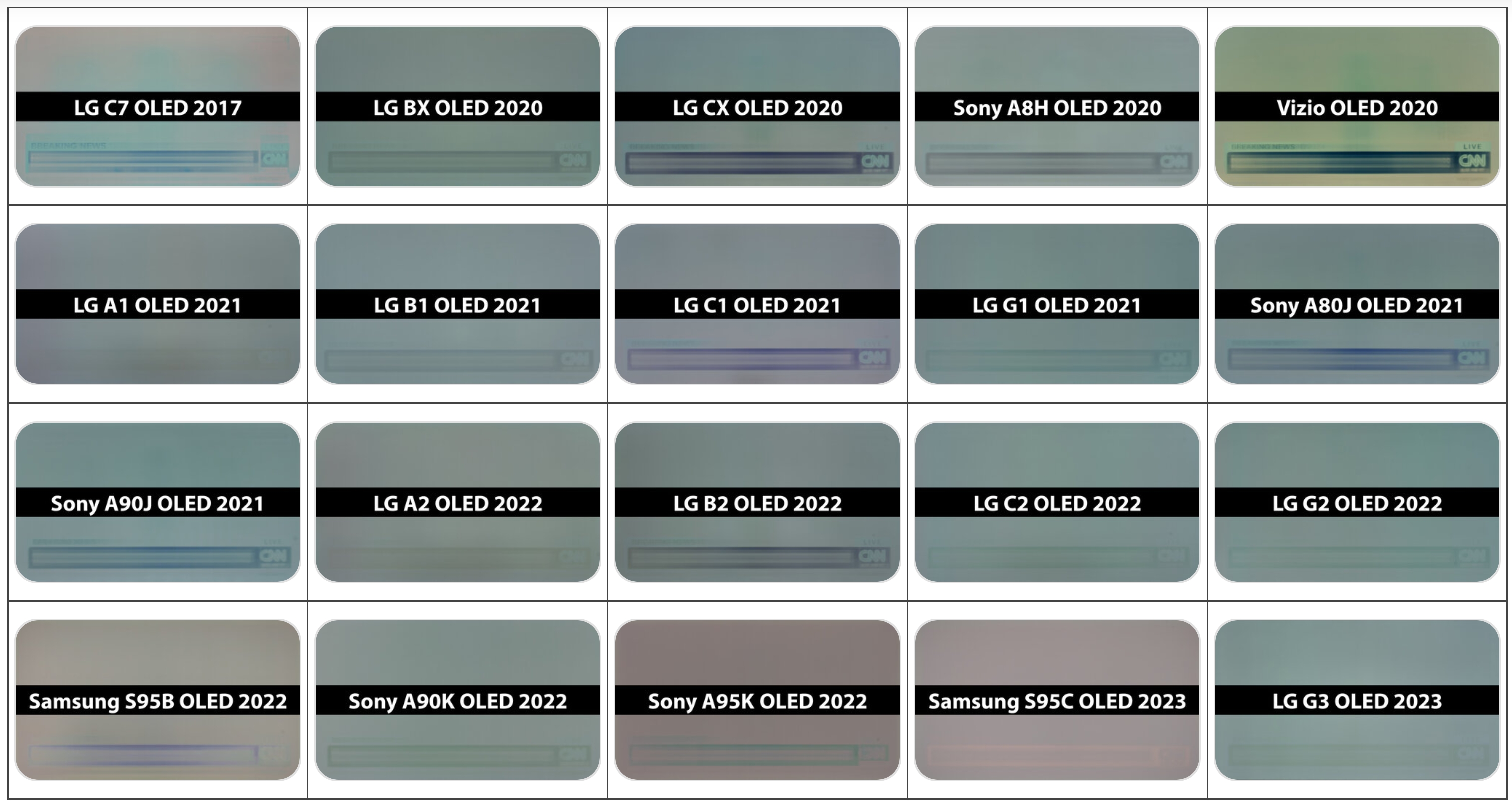
Rtings tested a single LG C7 from 2017, four models from 2020, six models from 2021, seven models from 2022, and just two models from 2023. At the end of the simulated longevity period, all TVs had suffered from image retention, as you can see above. Each TV was tested at its maximum SDR brightness rather than a universal luminance value matched across all models, to more accurately simulate daily usage.
This methodology makes sense when you consider that some panels are inherently brighter than others. For instance, a newer model could achieve the same luminance at 75%, whereas an older model would be pegged at 100%. People often use their TVs at their brightest setting, so this way, the testers are evaluating real-world usage rather than differences in panel durability over generations.
The results above show that the average 2023 OLED was 28% brighter than the 2017 OLED in terms of sustained brightness within 10% windows. When set to 100% window size (full-screen), the 2023 panel is more than twice as bright as the 2017 panel. These improvements don't come at the cost of power consumption either - in fact, quite the opposite. Models from 2023 are about 27% more efficient than those from 2017.
At 100 nits, the average OLED TV from 2017 consumed 130W, so 1.28 watts to power every nit, while the average OLED TV from 2023 only ate 95W, so 0.97W for every nit. If we go beyond the scope of the test and look at 2026 TVs, too, they are roughly twice as efficient as models from a decade ago while being much brighter, more feature-rich, and shipping with extra panel-care options.
The testers also compared the brightness capabilities of LCD TVs against OLED TVs and, as expected, saw the former dominate the latter. LCD panels have a backlight that can be supplied with more power to make the image brighter, and with the advent of mini-LEDs, that brightness is more controlled and precise as well. OLED panels cannot drive their organic pixels in the same way, because they'd wear out too quickly and cause burn-in.
OLED TVs have improved a lot in terms of brightness, to the point that the latest flagships can comfortably fight glare in a sunny room, but the brightest LCDs still outdo them. As such, Rtings asks whether panel preservation should've been prioritized over peak luminance for OLEDs. The answer is no because 10,000 hours of simulated usage works out to 5 hours per day for 10 years, and people don't just have static elements on-screen perpetually.
Instead, the data compels us to look at these results from a different perspective. Since these OLEDs have similar image retention vulnerabilities but at higher luminance levels, we now have more headroom to leverage. Instead of simply maxing out the panel's brightness, one can achieve the desired luminance at a lower level, giving the panel more breathing room. As we saw, that lower level will also use much less power.
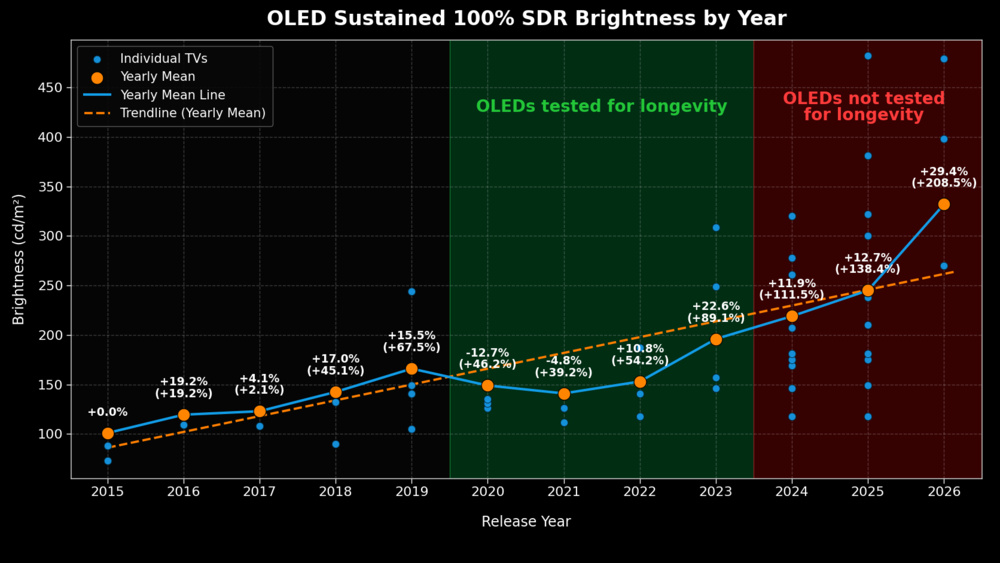
The publication points out that this is "a risk-reduction measure rather than a guaranteed lifespan control" because organic pixels will always wear over time no matter what. Plus, the data does not quantify the difference between running a new OLED at lower brightness levels (so that it matches the peak luminance of older models) and at its maximum, though the obvious can be inferred.
The pixels will be under less cumulative stress, potentially allowing them to last longer. In other words - delay the point of no return for image retention. We haven't even talked about panel materials that enable improvements in the OLED stack beyond just pumping more voltage. The latest OLED TVs are more than twice as bright as their decade-old counterparts.
The ultimate takeaway is that, for most users, mixed usage on modern OLED TVs will not be an issue, despite them not showing a clear advantage in terms of burn-in. Static elements can bend any OLED to their will. As long as you're not manually interfering with the built-in self-care features, the TV is smart enough to manage its delicate pixels, and you will likely move on to a newer model before burn-in becomes an issue.