What exactly is modified about a modified Bessel function?
Special functions often have arcane names that not very helpful without some context. The previous post goes into some reasons for this. This post will expand on a point at the end of the post about modified" functions.
Things are given their names for reasons. Discovering those reasons may help you understand their motivation and use.
Pure math perspectiveFor each integer n, the modified Bessel function In is essentially the Bessel function Jn evaluated along the imaginary axis. Specifically,

From a certain shallow perspective, that's the end of the story: modified Bessel functions are modified in the sense that the argument is multiplied byi. And there's a fiddly constant term up front for no apparent reason.
But of course that's not the end of the story or else this wouldn't be worth an entire post.
The equation above is analogous to the relationships between circular and hyperbolic functions
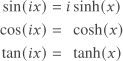
These relationships are interesting because the circular and hyperbolic functions are independently meaningful. If you view these equations merely as definitions you lose their significance. Circular and hyperbolic functions were widely used before Euler discovered the connection between them.
Similarly, there's a reason the modified Bessel functions were given a name their own. If you were led to Bessel functions and modified Bessel functions separately by different applications, you would regard the equation
as a discovery rather than just a definition. The following section explains why someone would be interested in modified Bessel functions.
Before we move on, I'd like to explain the reason for the term i-n term. In general

for all real .The reason for the exp(i/2) term is that it makes I(x) real for all real x.
Applied math perspectiveBessel functions often arise from solving problems with radial symmetry. Solving the wave equation in cylindrical coordinates using separation of variables leads to Bessel's differential equation

and its solutionsJn andYn, Bessel functions of the first and second kind.
Solving the heat equation in cylindrical coordinates with separation of variables leads to the modified Bessel equation

and its solutionsIn andKn, themodified Bessel functions of the first and second kind.
This is the reason behind the complex analysis perspective above: the change of variables sendingx toix changes the sign of the x^2 term in Bessel's equation.
Bessel functions describe radially symmetric oscillations, such as the vibrations of a drum head. Modified Bessel functions describe radially symmetric exponential growth or decay [1], such as in the heat in a cylinder.
Other modified functionsStruve functions are closely related to Bessel functions. The (modified) Struve functions also satisfy Bessel's (modified) differential equation, but with a non-zero right hand side. The modified Struve functions are proportional to the unmodified Struve functions evaluated along the imaginary axis, with a proportionality constant that makes the modified Struve functions real for real arguments.
There's a similar relationship between the Mathieu functions and modified Mathieu functions. The general pattern is that modified" in the context of special functions means evaluated atix and multiplied by a constant to make the function real for real arguments."
[1] The functions In grow exponentially and the functions Kn decay exponentially. For this reason, A&S didn't tabulate In andKn per se. Instead it tabulated e-xIn andexKn because these functions varied less over their range.
The post What exactly is modified about a modified Bessel function? first appeared on John D. Cook.