3D-printed ghost guns may now have a way to be traced to their source
A study published on October 22 in the journal Forensic Science International reports that researchers from Curtin University in Perth, Australia, have developed a forensic method to analyze 3D-printed PLA parts and match them to their respective filament, correctly matching 26 out of 28 samples of PLA. This potentially provides a way to link seized 3D-printed ghost-guns" with other seized filament, allowing police to form a clearer network for the manufacturing and distribution of the 3D-printed firearms.
3D-printed firearms have become a big problem worldwide, as they are untraceable and even compostable in the case of PLA, with tools like this AI 3D-printed gun generator making it scarily accessible. Serial numbers, registration, and a network of licensed distributors are usually the first line of investigation when it comes to crime involving firearms, but easily manufacturable, untraceable, disposable plastic firearms are a new threat with no clear way to crack down on them yet.
However, this research, by Dr. Georgina Sauzier et al. from Curtin University's School of Molecular and Life Sciences, along with forensics experts from ChemCentre, has devised a way to trace a printed object to a specific filament product, down to the brand and type.
The process of 3D printing changes the filament's physical properties, and this change can be measured. In this research, differential scanning calorimetry (DSC) is used, a thermoanalytical technique that lets the sample go through a range of temperatures, and the instrument measures how heat flows through the sample. It measures how much energy or power is used to keep the sample at a certain temperature or to change its temperature, giving us a graph of its thermal properties.
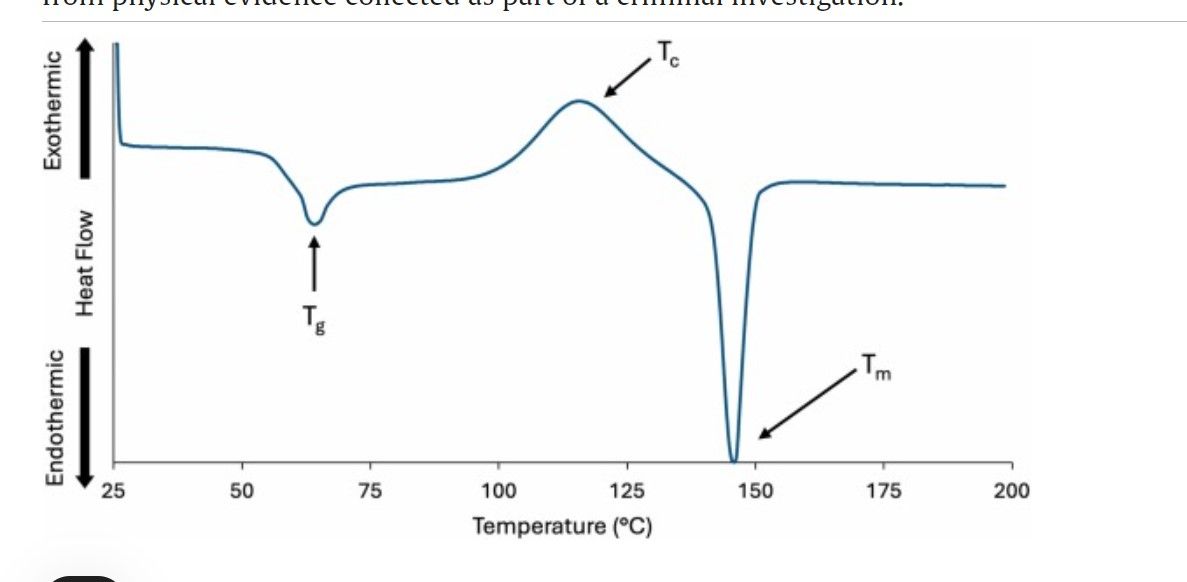
The sample's thermal properties can then be cross-referenced with its unprinted filament, creating an association between them. As of now, the tested PLA products are the only successfully identified material, with PETG and ABS not providing enough information to link them to their filament product. Sauzier blames the amorphous nature of those filaments, giving very similar results with no clear identifiers linking them to their respective filament products. PLA has a semi-crystalline molecular structure, which provides clearer temperature transition points under the temperature tests as the crystalline structures break down and rearrange.
However, ABS and PETG did show some promise when tested using ATR-FTIR (Attenuated Total Reflectance-Fourier Transform Infrared), which uses infrared to identify chemical bonds and material composition. The team did find differences in additives using this method, but still did not give enough information to link them back to their respective filament products.
The research is still very early, with more rigorous testing to be done, as the team printed using only one machine, printed small sample tiles cut with scissors, and left them for a year in monitored office conditions before testing. Properties could further change as cooling rates vary greatly depending on what the printer is printing: Faster cooling and slower print speeds on overhangs, or slower cooling and faster print speeds on infill sections. Different printers may also affect the physical properties, adding one more factor in the chain.
So far, correctly identifying 26 out of 28 samples is a great start to cracking down on dangerous, untraceable illegal firearms. When the research matures and can reliably identify a broad range of materials, it could potentially trace 3D-printed firearms to the printer and filament, potentially creating a list of where they were purchased and who purchased them.