Covering a body with eight smaller copies of itself
It's obvious that you could cover a cube with smaller cubes. You could, for example, take a cube with side 1 and cover it a cube of side centered on each corner.
It's not as obvious how you would cover a ball with smaller balls, but you could cover the unit ball with balls of radius 3 centered at the points (, , ).
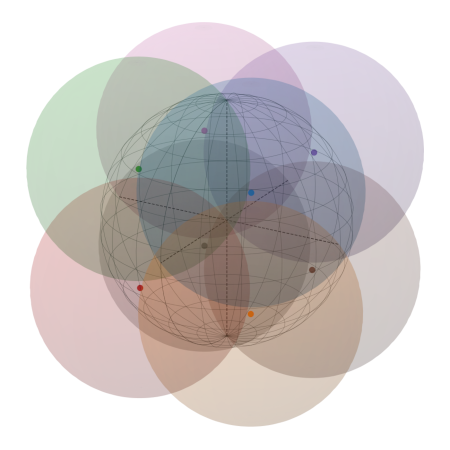
In fact, you could cover a ball with four smaller balls [1].
Now consider an arbitrary convex shapeK in three dimensions with non-empty interior. Is it possible to cover K by copies of itself? SinceK has non-empty interior, you could coverK by putting a smaller version ofK around every point. And ifK is compact, then this cover has a finite subcover. But there might be alot of elements in this finite cover. What's the minimum number possible in general? It takes eight cubes to cover a cube, so the minimum is at least 8. But could some odd shape take more?
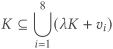
Hadwiger's covering conjecture says thatK can be covered by eight copies of itself. That is, there exists a scaling constant 0 < < 1 and shift vectors vi such that
Dror Aiger, Sariel Har-Peled, and Goran ui posted a proof of Hadwiger's conjecture on arXiv yesterday. The abstract to their paper says The proof was discovered using an experimental harness on top of Gemini 4 Carbon and formally verified in Lean 4."
I've heard good things about the Google's new Carbon model. This is the first announcement of a major theorem proved with the assistance of a Google model that I've noticed.
Related posts- Splitting a convex set through its center
- Convex hull of zeros
- Separation of Convex Sets in Linear Topological Spaces
[1] Inscribe the vertices of regular tetrahedron on the unit sphere, then multiply the vectors representing the vertices by . Center spheres of radius 2 at each vertex.
The post Covering a body with eight smaller copies of itself first appeared on John D. Cook.