 |
by Rusty Blazenhoff on (#49K8C)
There are old-school DJs and then there's DJ Amelia Foxtrot of Austin Phonograph Co. in Texas. Her turntables are antique hand-cranked phonographs and her records are scratchy-sounding 78s. Of course, I was immediately charmed all of this. I reached out to her and she shared: I've been doing phonograph DJ work for 7 years. I started in 2012 because I wanted to buy a phonograph. Being an entrepreneur at heart, I thought if I created a business DJing with it, my hobby would fund itself. And I got to buy two!She mostly plays private events like seances (!), weddings, and fancy birthday parties. Though, on March 24, you can catch her at the Jazz Age Sunday Social in Dallas. Amelia also co-owns and runs Sweet Ritual, a popular dairy-free ice cream shop in Austin. Additionally, she teaches Cool School for budding vegan ice cream parlor owners.photo by Sam OrtegaThanks, Maggie! Read the rest
|
Boing Boing
| Link | https://boingboing.net/ |
| Feed | https://boingboing.net/feed |
| Updated | 2026-10-02 09:04 |
 |
by Futility Closet on (#49K8G)
Moe Berg earned his reputation as the brainiest man in baseball -- he had two Ivy League degrees and studied at the Sorbonne. But when World War II broke out he found an unlikely second career, as a spy trying to prevent the Nazis from getting an atomic bomb. In this week's episode of the Futility Closet podcast we'll follow Berg's enigmatic life and its strange conclusion.We'll also consider the value of stripes and puzzle over a fateful accident.Show notesPlease support us on Patreon! Read the rest
|
 |
by Cory Doctorow on (#49K8J)
Wilson X was the sports manufacturer's entry into the market for smart basketballs, but maintaining the app that made sense of the telemetry from your sensor-equipped roundball was expensive and stupid and so the Wilson X app is no more, and the "B" in "B-ball" stands for "bricked." But wait, there's more! If you shelled out $350 for Nike's self-tying shoes, you got burned this week when Nike updated its shoe-tying app leaving it unable to pair with the shoes' "advanced power-lacing system" and thus the shoes no longer lace themselves and dynamically adjust their tensioning in response to your movement.The shoes? Also bricks.The ball still bounces, and you can still tie your own shoes, of course, but the sensor packages and their accompanying control infrastructure are gone."app wont pair with left shoe," reads one such review from Feb. 17. "paired with sneakers right after unboxing then completely crashed after last update."Others encountered a similar problem."the app has less functionality than the iOS app, and the first software update for the shoe threw an error while updating, bricking the right shoe," reads another. "needs serious work." Nike just bricked its self-lacing shoes by accident [Jack Morse/Mashable](via Four Short Links) Read the rest
|
 |
by Cory Doctorow on (#49JQB)
The Truth-In-Billing, Remedies, and User Empowerment over Fees Act [TRUE Fees] has been introduced by Rep Anna Eshoo [D-CA] and Sen Ed Markey [D-MA]; if passed, it will force ISPs and cable operators to advertise the true costs of their packages, including all surcharges.As Karl Bode writes on Motherboard, the bill seeks to remedy an epidemic of the kind of false advertising that is banned in Europe, but which American firms regard as "the height of capitalistic creativity," from hotels who use hidden "resort fees" to jack up prices over advertised rates to the misleading "regulatory recovery" fees on phone or utility bills that falsely suggest that they are the result of some statute, not the company's greed.And of course, no one practices this deceptive art with the virtuosity of the cable/ISP industry, whose monopolism, contempt for customers, and price gouging are legendary. “This legislation is simple, straightforward, and effective,†Consumer Reports said of this latest legislative effort. “The TRUE Fees Act would address the out-of-control fee problem in the telecommunications marketplace and deliver much-needed transparency for cable and internet providers’ unnecessarily-complicated billing practices.â€The government’s apathy has come with a steep price for cable and broadband customer wallets. Many of these fees have been jacked upwards of 241% in just the last few years, leaving American consumers paying even higher rates for what’s already some of the most expensive cable TV and broadband prices in the developed world.New Bill Would Stop Internet Service Providers From Screwing You With Hidden Fees [Karl Bode/Motherboard] Read the rest
|
 |
by Rob Beschizza on (#49JDS)
The twitter account @TheScaryNature posted this image with the caption "these two Bull Moose died in battle and became frozen in ice", and the only thing I can think of is "Toxic mooseculinity."The photographer, as revealed by Google's reverse image search feature, is Brad Webster:Webster says there are several theories on what happened to the moose, but the most likely scenario to play out is that the two moose were fighting over a female when one was knocked unconscious or suffered a broken neck, taking the other one down with it."There was a fight and one of them won, and they both lost," Webster said. "Once it's knocked out or once it's dead, you've got a live moose that won the fight, but the other moose is dragging you down into the water."I've already made a joke of it, but there's a weird power to Webster's photo and I can't stop thinking about it.UPDATE: Found Brad's website.Another word that I would [use to describe Alaska], [and] would take probably more explanation would just be: culture. … The culture of the village; the culture of the people; the beauty of the language and the beauty of the traditions and the heritage and the knowledge that’s been passed down. And wanting to learn from it and respect it, but still in a way that respects the people to continue to be who they are. Some kind of a weird balance, of an outsider coming in and wanting to see and experience those things, without imposing or changing the experience for them. Read the rest
|
 |
by Peter Sheridan on (#49JBF)
Is the National Enquirer running scared? There’s not a mention of either Amazon chief Jeff Bezos or president Donald Trump in this week’s edition. Could it be that the threat of investigation and possible prison time for hacks accused of extortion and blackmail against Bezos and burying sex scandals about Trump have finally silenced the nattering nabobs of negativism? Bezos and The Donald escape lightly this week, but others aren’t so lucky.Prince Charles “Disowns Harry!†proclaims the Globe cover. Prince Harry reportedly refused Charles’ demand that he divorce wife Meghan, and in the ensuing row Charles raged that DNA tests have proven he’s not Harry’s father. Which would explain why Charles allegedly said: “You’re a common-born bastard.†Aren’t we all? The odds that this conversation actually happened? Infinitesimally small. The odds that the Globe has a source inside Kensington Palace revealing this private conversation? Even smaller.The Globe claims that serial killer Ted Bundy’s daughter has been "found hiding in Britain" under an assumed name. No, it’s not “Meghan Markle.†And the woman their reporter approached said: “I’m sorry, I’m not the person you’re looking for.†Sounds like an admission of guilt if there ever was one.“Scientology Leader’s Missing Wife Found After 13 Years!†declares the Enquirer cover, though the headline above the inside spread is far less confident, asking: “Is This Shelly Miscavige?†It’s definitely a photograph of a dark-haired woman, reportedly seen disembarking a Scientology cruise ship and heading to Florida, which as we all know is a state where Scientologists have been known to live. Read the rest
|
 |
by Jason Weisberger on (#49HW6)
Six months ago I could not do a single chin-up. I got this chin-up bar and went to work. Perseverance developed body strength, and my vanity has pumped up a notch!I read something that said an average guy in my weight range should be able to do 10-12 chin-ups. There is a chin-up bar at a park I walk my dogs past, and I found I could not even manage one. I was doing 30+ push-ups and set after set of core abdominal exercises on the floor, but chin-ups were out of my range.I also learned that my 'frozen' right shoulder hurt so badly I couldn't maintain more than 1-2 seconds hanging on the bar with my hands facing out, as for pull-ups. Just trying a pull-up may be laughable for others, I was wincing with pain.I got a chin-up bar and installed it in the doorway of my home office. I can not walk in or out of my workspace without seeing the bar. This encourages me to use it.About a week of hanging on the bar and trying to get that first chin-up paid off. A pull-up seemed impossible. I watched some Youtube videos for technique. Strength was my problem, screw form.Another week went by and I was able to do 3 chin-ups and maybe kind pulled off a second set of two. My daughter, a USA Gymnastics Level-4 competitor started using chin-up competitions with me to get out of chores.A month into this project I was able to do 2 sets of 10 chin-ups but still could not pull off a single pull-up. Read the rest
|
 |
by Jason Weisberger on (#49HQ9)
Doesn't take a lot for me to imagine that creepy dancing Fleegle killing folks.Bloody Disgusting:In a bizarre move that was surely inspired by the success of Five Nights at Freddy’s, Warner Bros. Home Entertainment and Syfy are bringing back the characters from Hanna-Barbera’s variety program “The Banana Splits Adventure Hour†for… a horror movie?!As reported by Deadline, kid-friendly (originally, at least) animal characters Bingo, Fleegle, Drooper and Snorky will return in an original movie that’s set to “premiere this year from Blue Ribbon Content, Warner Bros Television Group’s digital studio, via a Warner Bros. Home Entertainment release that will be followed by the television debut on Syfy.â€In the upcoming horror thriller, “A boy named Harley and his family (brother Austin, mother Beth, and father Mitch) attend a taping of The Banana Splits TV show, which is supposed to be a fun-filled birthday for young Harley and business as usual for Rebecca, the producer of the series. But things take an unexpected turn — and the body count quickly rises. Can Harley, his mom and their new pals safely escape?†Read the rest
|
 |
by Carla Sinclair on (#49HQB)
After Twitter user @gabbytropea is accidentally locked out of her house, her cat gets to work by removing a sliding door stick so that she can open the door. Yay for smart cats. My sister accidentally locked me out of the house so I went to check if the back door was unlocked and this happened pic.twitter.com/2zkjeyFJk5— Gabby Tropea (@gabbytropea) February 18, 2019 Read the rest
|
 |
by Jason Weisberger on (#49HJ7)
I don't suppose you've seen those two boiled eggs I left sitting on the kitchen sideboard by any chance? pic.twitter.com/dV2YSbZL6R— Stevie K (@1StevieKilner) February 17, 2019I love the look on that puppy face. Read the rest
|
 |
by Rob Beschizza on (#49HJ9)
Philly.com: Justice Ruth Bader Ginsburg wrote the court's opinion in favor of Tyson Timbs, of Marion, Indiana. Police seized Timbs' $40,000 Land Rover when they arrested him for selling about $400 worth of heroin.Reading a summary of her opinion in the courtroom, Ginsburg noted that governments employ fines "out of accord with the penal goals of retribution and deterrence" because fines are a source of revenue. The 85-year-old justice missed arguments last month following lung cancer surgery, but returned to the bench on Tuesday.The Times:Civil forfeiture is a popular way to raise revenue, and its use has been the subject of widespread criticism across the political spectrum.The Supreme Court has ruled that the Eighth Amendment, which bars “excessive fines,†limits the ability of the federal government to seize property. On Wednesday, the court ruled that the clause also applies to the states.There's an element of insanity to it all: it's so difficult to believe that police are allowed to seize and sell people's property that it was correspondingly difficult to get people to accept that it is a widespread practice, rather than some kind of swivel-eyed libertarian conspiracy theory. Virtually every faction in American politics was firmly against it: the left, liberals, libertarians, movement conservatives, even Trumpkins. In fact, the only person I ever met who sincerely defended civil forfeiture was a self-described "moderate", a centrist. Read the rest
|
 |
by Carla Sinclair on (#49HJA)
Over 100,000 marine animals die every year after getting trapped in plastic, but this little fish got lucky. A diver in Phuket, Thailand found the creature trapped in a plastic bag and, after a bit of gentle shaking and maneuvering, was able to free set it free. It might just be a tiny fish, but I was sitting on the edge of my seat watching this video. Read the rest
|
 |
by Carla Sinclair on (#49HJC)
The president of a company called Pooch Patch, which sells tiny patches of grass meant for dogs to do their business on, was not pleased when one of his customers, Vanessa, returned the product. Rather than give her a refund, he emailed her and called her "Fatty McFat-Fat."This was after she wrote a negative review about the product on Google. The president, who signs his letters "Adam & Shanks (The Border Terrier) told Vanessa that he looked at photos of her online and that he thinks she's chubby."Looking a little chubs in that profile photo!!!"When she told him she reported him to Consumer Protection Canada he said, "lol Ooo so scared chubby wubby. I reported you to Jenny Craig."Vanessa then got a threatening legal letter, but when she researched the lawyer, Alyssa Steiner, she realized there was no such licensed lawyer in Ontario. When Global News contacted Pooch Patch for a response, their first reply was "Hahahahahhha hahahahahahah. I'm dying. This is pure gold. Pure gold!..." But later a manager tried to wiggle out of their outrageous behavior by pointing to the call center in India that they use. Customer service at its finest. Read the rest
|
 |
by Mark Frauenfelder on (#49HCQ)
Gildan crew T-shirts are very inexpensive and comfortable. Amazon just knocked the price down to what seems like an all-time low. With shirt this cheap I can slurp my curry with abandon -- if a shirt gets stained, it goes into the cleaning rag / painting / work clothes drawer. Read the rest
|
 |
by Jason Weisberger on (#49HCS)
The auto-magic braking feature on Teslas appears to work.I believe Elon Musk's face pops on the dashboard TV screen and says "told you so!" Read the rest
|
 |
by Mark Frauenfelder on (#49HCV)
Here's how Alexis Madrigal sets up his excellent Atlantic essay about why online protests usually flop:There is an Instagram account called FuckJerry, which grew by taking jokes and memes created by other people and posting them, eventually growing an audience hungry for ever more jokes. The account spawned a media company, Jerry Media, and desperate ad executives from the world’s biggest companies now pay to be seen on FuckJerry, on the premise that that’s where they’ll reach young people who don’t have their eyeballs on the places they used to.A call to unfollow FuckJerry (#FuckFuckJerry) for posting memes without credit resulted in its follower count dropping from 14.3 million to 14 million. In other words FuckJerry will suffer no economic hit. Why did the campaign fail? First of all, the world's biggest brands and platforms need FuckJerry. Madrigal: The economic system undergirding the influencer economy -- the advertising agencies, marketers, companies -- wants the FuckJerrys of the world to exist. So do the big platforms, which profit from these accounts’ ability to serve up and accelerate crowd-pleasing memes.The problem isn't FuckJerry. It's the way social media has been designed and deployed to support a desperate-for-attention economy:Really going after FuckJerry would require implicating the whole economic system of attention. In a world in which distribution power gets built through viral influence by any means, the FuckJerrys of the world will exist.Here's an original comic by @WholesomeNsuch that FuckJerry stole and turned into an Instagram ad for @hesstoytruck without payment or permission on one of their many accounts, "discojerry." #FuckFuckJerry pic.twitter.com/G6xyqzpqL9— Megh Wright (@megh_wright) February 20, 2019FuckJerry: Easier To Steal#FuckFuckJerry pic.twitter.com/MTAhN0t5Uo— Vic Berger IV (@VicBergerIV) February 1, 2019Image: Roman Samborskyi/Shutterstock Read the rest
|
 |
by Rob Beschizza on (#49H8F)
This Person Does Not Exist (previously) generated frighteningly convincing images of human faces. This Cat Does Not Exist, well, it generates frightening cats. Read the rest
|
 |
by Mark Frauenfelder on (#49H8H)
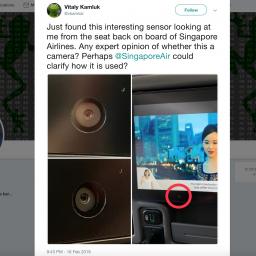
While on a Singapore Airlines flight, Vitaly Kamluk, noticed a camera in the seatback media system. He took photos and posted them on Twitter:Just found this interesting sensor looking at me from the seat back on board of Singapore Airlines. Any expert opinion of whether this a camera? Perhaps @SingaporeAir could clarify how it is used? pic.twitter.com/vy0usqruZG— Vitaly Kamluk (@vkamluk) February 17, 2019Here's Singapore Airlines response to Kamluk's tweet:Hi there, thank you for reaching out to us. We would like to share that some of our newer inflight entertainment systems provided by the original equipment manufacturers do have a camera embedded in the hardware... We have no plans to enable or develop any features using the cameras.Hi Peter, the cameras are in selected Business, Premium Economy and Economy Class. We would like to share that they have been permanently disabled on our aircraft and cannot be activated on board. We have no plans to enable or develop any features using the cameras. Thank you.— Singapore Airlines (@SingaporeAir) February 19, 2019Hi there, these cameras on our newer IFE systems were provided by the original equipment manufacturers. We have no plans to enable or develop any features using the cameras.— Singapore Airlines (@SingaporeAir) February 19, 2019It's not a bad idea to cover the camera with post-it note, anyway.Image: Twitter Read the rest
|
 |
by Xeni Jardin on (#49H49)
That's a lot of sea flap-flaps right there.
|
 |
by Xeni Jardin on (#49H3B)
He's either very content, or high.
|
 |
by Xeni Jardin on (#49H3D)
She has no experience in the news business, but plenty in Trump business.
|
 |
by Rob Beschizza on (#49H3F)
Move over, Australia: in the internet pantheon of unpleasant wildlife, Brazil has one up on you: cities infested with swarms of venomous scorpions.São Paulo is a dense city, with scarce green space and little to no animal life — no squirrels, no raccoons, not even a lot of birds. So I was astonished when, in January, I learned that scorpions had infested my neighborhood.It turns out, people across the city and São Paulo state were having the same problem with these dangerous, venomous bugs. Statewide, scorpion stings have increased threefold over the last two decades. Read the rest
|
 |
by Xeni Jardin on (#49H3H)
The Supreme Court today unanimously rules for Tyson Timbs, a small-time drug offender whose $42,000 Land Rover was seized by the state of Indiana as a civil forfeiture.In its opinion, the Supreme Court rules that the U.S. Constitution's 8th amendment clause on excessive fines clause applies to states and local governments, and curbs their power to levy fines and seize property. Here is a link to the full Opinion by Justice Ginsburg.This is the first time the highest court of the nation has weighed in so directly on the issue of excessive fines and civil assets forfeiture, an issue that has grown increasingly controversial as awareness of cases such as Timbs' grows online.Breaking: Supreme Court rules that excessive fines clause applies to states and local governments and limits ability to impose fines and seize property. Ginsburg write for unanimous court. this was the case: https://t.co/RNstzRXbug— Robert Barnes (@scotusreporter) February 20, 2019BREAKING: Supreme Court rules that excessive fines clause applies to states and local governments, curbing their power to levy fines and seize property. Opinion by Justice Ginsburg.— Greg Stohr (@GregStohr) February 20, 2019Today's SCOTUS opinion in Timbs finally subjects civil asset forfeiture to constitutional scrutiny and should rein in some of its most egregious abuses. Criminal justice reformers should be very happy right now. https://t.co/XxuXwb13Rh— Mark Joseph Stern (@mjs_DC) February 20, 2019Gorsuch comes out as a Privileges or Immunities Clause fan, which will delight libertarians and Clarence Thomas. https://t.co/XxuXwb13Rh pic.twitter.com/bUqcjLup4l— Mark Joseph Stern (@mjs_DC) February 20, 2019BREAKING: the Supreme Court unanimously applies the 8th am "excessive fines" clause to the states. Read the rest
|
 |
by Xeni Jardin on (#49GZE)
On Wednesday, the TV network France 3 was forced to cut off a live Facebook broadcast from a desecrated Jewish cemetery in eastern France when trolls swarmed the feed and filled it with anti-Semitic hate comments.You could say there's a problem with anti-Semitism in France.The night before on Tuesday evening, roughly 20,000 people and lawmakers from across the political spectrum gathered to denounce anti-Jewish hate at the Place de la Republique in central Paris. Other protests were held throughout France.From Reuters:France 3 said it went live from the cemetery in the village of Quatzenheim on Tuesday as President Emmanuel Macron was visiting to pay his respects after more than 90 graves were vandalized with swastikas and anti-Semitic abuse.But as it broadcast footage online to its more than 1.3 million Facebook followers, the feed was inundated with anti-Semitic commentary and abuse.“We are talking about explicit death threats, comments that were openly anti-Semitic and racist, including “Heil Hitlerâ€, “dirty Jew†or “dirty Jewsâ€, comments that were addressed at Emmanuel Macron and representatives of the Jewish community,†the channel said in a statement explaining its decision.“Within minutes, the number of vile and illegal comments had gone well beyond our capacity to moderate them,†it explained, adding that it would have taken 10 or 20 staff to handle the onslaught. “We refuse to traffic in hatred.â€The cemetery attack is only the latest hate crime in France in recent weeks.Macron spoke to members of the local community at the cemetery, and promised a tough response. Read the rest
|
 |
by Cory Doctorow on (#49GZG)
Nest is the Internet of Shit company Google bought and steadily expanded from "smart" thermostats to the current home security product, "Nest Secure," which has an undisclosed microphone -- but don't worry, it wasn't intended to be a secret, Google just forgot to mention it, and "the microphone has never been on and is only activated when users specifically enable the option." Read the rest
|
 |
by Xeni Jardin on (#49GYP)
“Overkill is an understatement,†the family’s lawyer said.
|
 |
by Rob Beschizza on (#49GTV)
Angela Lashbrook has followed the online recommendations for vacuum cleaners and found them wanting. The high-end brands that never get consideration in roundups of vacs are much better at sucking your carpet clean of filth. A simple task like cleaning my kitchen or vacuuming my rugs may seem small and relatively unimportant. But research shows that feeling control over elements of one’s life can help reduce stress, so is it any wonder that our generation is so attracted to the concept of home improvement? The capability to transform a chaotic environment into an orderly one can take my anxiety from a nine to a five or four; having a vacuum I don’t have to fight makes my pursuit of tidiness and eventual mental peace closer to effortless.This is, of course, why you don't see a professional cleaners or hotel mails hauling around a $100 Hoover Linx or whatever piece of crap Wirecutter recommends, but you do see them with models like the Miele Compact C2 [Amazon link] she recommends. It's currently $400 for the hard-floor model and $600 for the pet-hair model. Oof!When my Dyson broke I needed a cheap vac in a hurry, checked craigslist, and ended up with a barely-used Sebo X1 for less than a hundred dollars. It was and is a complete revelation: just whipping it around that first golden day filled its bag with stuff the supposedly premium Dyson couldn't even sniff. It's a discontinued model, but the current equivalent is about a grand new so, haha, you cheapskates should probably just get a Miele. Read the rest
|
 |
by Rusty Blazenhoff on (#49GST)
National emergency? Nah. Just some "Border Lies," according to Randy Rainbow's latest song parody. Gurl. Hit that Adderall. Then go get your border wall.Terrific, as always. Read the rest
|
 |
by Rob Beschizza on (#49GSW)
Never buy a new pillow insert without first delivering a solid, forceful karate chop. If you're in a rush, my favorite chop is at 2:20m, with others at 1:00m, 1:30m, 1:50m ("it's made to be karate chopped"), 2:50m, and 3:20m. [via] Read the rest
|
 |
by Rob Beschizza on (#49GSY)
r/vintageCGI is my new favorite subreddit. Embedded above is a collection of the rendered scenes from 1983 laserdisc game Star Rider, reputed to have cost Williams $50m in development, production and marketing costs. Below, Ronald Peterson's 1988 image demonstrating a ray-tracing package.Here's the Compleat Angler:And here is DISK.GIF:Finally, I made DISK.GIF.JPG for you. With luck WordPress's CDN will make it even worse. You're welcome. Read the rest
|
 |
by Cory Doctorow on (#49G7G)
Magic Lantern is a replacement OS for your Canon EOS camera that you load via a SD card; in addition to a suite of video-recording tools, Magic Lantern allows fine-grained gain adjustments, selection of input sources, wind filters, audio monitoring, and better tools for everything from white-balance to exposure presets to overlays to help with exposure and other settings. The source is available for inspection and modification, of course. (via Four Short Links) Read the rest
|
 |
by Cory Doctorow on (#49G6M)
MG has built a proof-of-concept malicious USB cable with a tiny wifi radio hidden inside of it, able to wirelessly exfilatrate stolen; he calls it the O. MG, and while the prototype cost him $4k and took 300 hours, he's working with a team on a small production run for other security researchers to play with. (via Four Short Links)You like wifi in your malicious USB cables? The O•MG cable (Offensive MG kit)https://t.co/Pkv9pQrmHtThis was a fun way to pick up a bunch of new skills. Not possible without help from: @d3d0c3d, @cnlohr, @IanColdwater, @hook_s3c, @exploit_agency #OMGCable pic.twitter.com/isQfMKHYQR— _MG_ (@_MG_) February 10, 2019 Read the rest
|
 |
by Cory Doctorow on (#49G42)
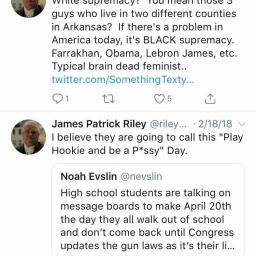
Riley's Farm is a staple of Los Angeles overnight school trips (my daughter visited last year with her elementary school); it's an apple farm with a pick-your-own apples sideline that branched out into civil war re-enactments, with some students staying overnight in tents.The farm's owner, James Riley, uses his Facebook and Twitter accounts to air Trumpian political views that complain about "black supremacy" ("If there's a problem in America today, it's BLACK supremacy. Farrakhan, Obama, LeBron James, etc"), nonbinary gender identity, etc.As news of Riley's political beliefs spread, parents in the Claremont Unified school district asked that their kids not be brought into contact with him. Claremont Unified decided not to bring their students back to Riley's Farm, sending Riley a letter that explained that they had "no obligation to expose children to an individual who engages in these crude and tasteless comments."Riley has sued Claremont Unified and various officials (trustees, principals and a superintendant), seeking $10m in damages for violations to his 1st and 14th Amendment rights. Other school districts are investigating whether they will continue to send their students to Riley's Farm, and Riley has pledged to "[put more] fear in public officials."Riley attends Tea Party rallies dressed as Patrick Henry and gives political speeches. He has called himself a "conservative Christian strawman that has to be burned in public." He says that his political beliefs do not influence the historical re-enactments at his farm.Riely's court filings say that his farm brings in $4.2m/year, with half of that coming from school groups. Read the rest
|
 |
by Cory Doctorow on (#49G44)
Last August, Florida's prison system announced that it was switching digital music providers and would be wiping out the $11.2 million worth of music that it had sold inmates -- music they'd paid for at $1.70/track, nearly double the going rate for music when not purchased from prison-system profiteers.The move was part of a switch to notorious prison contractors Jpay (previously), a division of the even-more-notorious Securus company (previously). Jpay is the company that gouges prisoners and their families for emails and calls, selling them absurd "digital postage stamps" and crazy transaction fees for prepaid commissary accounts.Now, 74 year old South Florida Reception Center inmate William Demler has filed a class-action suit against the Florida Department of Corrections, backed by the nonprofit Florida Justice Institute and the Social Justice Law Collective. Josh Glickman from the SJLC called the change in providers a "confiscation of these individuals’ lawfullypurchased property for no reason other than to turn a profit."The suit describes how the Corrections Department advertised heavily to inmates, a literal captive audience, encouraging them to buy vastly overpriced, underpowered $100 MP3 players and music to go with them, saying that they would "always own" the music they bought. If certified, the class could be sprawling in scale. Inmates filed grievances aboutthe mp3 program so frequently that the Department of Corrections created aseparate category in December 2017 to track hundreds of related grievanceappeals at the administrative level.The fallout from the media player contract is one example of how inmates areoften on the losing end in the Department of Corrections’ various dealings withthe private companies that do profitable business in state prisons. Read the rest
|
 |
by Rusty Blazenhoff on (#49FMD)
With the help of her mom, a Girl Scout in Colorado has turned Samoas into "Momoas." Cookie sales have skyrocketed for fifth-grader (and "Top Cookie CEO") Charlotte Holmberg of Highlands Ranch since she and her mom started gluing a shirtless photo of beefcake Aquaman star Jason Momoa on Samoa boxes. Charlotte's mom, a marketing professional, was inspired by a meme photo she saw on the internet of Momoa and started designing new box art. This one's for the ladies. (and the fellas) #elfontheshelf2018 #nottheelf pic.twitter.com/Tk2egiE15S— Matt Hayduke (@mightybajah) December 13, 2018KUSA:...so her and Charlotte got to work printing out the pictures and gluing them on dozens of boxes of Girl Scout cookies.They put it on Facebook, and you can guess what happened next."The moms are getting really excited and they're saying that they need them," Charlotte said.Even other Girl Scouts are hitting up Charlotte, asking to buy some. Now you know why they call her the Top Cookie CEO.They say Thin Mints are the most popular Girl Scout cookie. That might now be a thing of the past.A statement has not been issued from Momoa. images via Girl Scouts of Colorado(Vice) Read the rest
|
 |
by Xeni Jardin on (#49FMF)
The social media-driven #grombre movement celebrates the natural phenomenon of grey hair (and silver, salt-and-pepper, white, and so on).
|
 |
by Xeni Jardin on (#49FMH)
How do you become a spaceship pilot?First, practice flapping your wings very hard.Or watch this Virgin Galactic video, and learn how these people became exactly that, and on “what inspires our spaceship pilots to do what they do.†Read the rest
|
 |
by Xeni Jardin on (#49FHQ)
Help a disadvantaged fellow American obtain an ID to get a job, a safe place to live, and so they can vote.
|
 |
by Mark Frauenfelder on (#49F9E)
I have a few multimeters, and this is the one I usually grab first because it's so dead simple to use. I've had it for a least a year and have had no problems with it. Use promo code M2UAA4EY to get it for less than the price of a large, heavily sweetened coffee drink. Read the rest
|
 |
by Mark Frauenfelder on (#49F9G)
Billy Wilder was the director of many excellent movies, including Sunset Boulevard, Some Like It Hot,and Double Indemnity. Here are 10 tips about moviemaking that he shared in the late 1990s with Cameron Crowe (Fast Times at Ridgemont High, Almost Famous, Jerry Maguire)From Open Culture:Wilder was 90 years old when the young director Cameron Crowe approached him in 1996 about playing a small role in Jerry Maguire. Wilder said no, but the two men formed a friendship. Over the next several years they talked extensively about filmmaking, and in 1999 Crowe published Conversations with Wilder. One of the book's highlights is a list of ten screenwriting tips by Wilder. "I know a lot of people that have already Xeroxed that list and put it by their typewriter," Crowe said in a 1999 NPR interview. "And, you know, there's no better film school really than listening to what Billy Wilder says."Here are Wilder's ten rules of good filmmaking:1: The audience is fickle.2: Grab 'em by the throat and never let 'em go.3: Develop a clean line of action for your leading character.4: Know where you're going.5: The more subtle and elegant you are in hiding your plot points, the better you are as a writer.6: If you have a problem with the third act, the real problem is in the first act.7: A tip from Lubitsch: Let the audience add up two plus two. They'll love you forever. Read the rest
|
 |
by Mark Frauenfelder on (#49F6N)
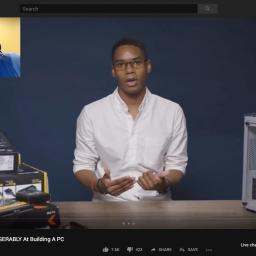
Vox's lawyers convinced YouTube to issue dreaded copyright strikes against two reaction videos that made fun of bad advice given by The Verge (owned by Vox Media) on how to build gaming PCs. The resulting backlash convinced The Verge's editor to ask YouTube to rescind the strikes.From Ars Technica:Last week, The Verge's lawyers suddenly asked YouTube to remove two reaction videos that had been online since September. Both videos reproduced the vast majority of the original Verge video, interspersed and overlaid with commentary, criticism, and ridicule.These takedowns attracted widespread attention. Other prominent YouTubers posted videos weighing in on the controversy, with most blasting The Verge's decision.[Verge editor Nilay Patel] says he wasn't involved in the initial decision to issue the copyright strikes. When he learned of the decision, he says, he requested that the strikes be retracted."When this was brought to my attention a few hours later, I told them that although I fully agreed with their legal argument, I did not think we should use copyright strikes against legitimate channels," Patel wrote in a Friday post.Patel says that at his request, The Verge asked YouTube to retract the strikes against the two videos.Still, Patel said The Verge's lawyers were on solid legal ground."I fully agree with our legal team that these videos crossed the line of fair use," he wrote. Read the rest
|
 |
by Carla Sinclair on (#49F5A)
Take a walk with me down a little garden path in a secluded place; you’ll delight in the discovery of a beautiful mathematical equation. –– TibeessTibees is a blissed out mathematician who likens her style to Bob Ross. And I definitely see it. She's soft spoken, easy to follow, and has described math as beautiful and fun. When introducing this video, she says we'll be "exploring the square root of i. It's a curious question with a delightful answer."So get out your "pen, some paper, and a vision in your mind," and let's get started! Read the rest
|
 |
by Jason Weisberger on (#49F5C)
Measles is a global epidemic.Nearly half of the 136 people who have died of measels in the Philippines are children under the age of 4.The Centers for Disease Control currently reports ten US states with active measles outbreaks: California, Colorado, Connecticut, Georgia, Illinois, Kentucky, New York, Oregon, Texas, and Washington. Ohio appears ready to make measles go to 11. Read the rest
|
 |
by Mark Frauenfelder on (#49F2H)
Do you want to try on a pair of shoes... in cyberspace? Do what this guy did:This guy is living in 3019 😂 pic.twitter.com/vxv433Xbcx— Memes 😈 (@memetiddies) February 15, 2019Image: Twitter Read the rest
|
 |
by Jason Weisberger on (#49F1P)
These Edifier R1700BT speakers are perfect for my home office and bedroom.I had been using Amazon Echo Dot's to play music and podcasts. The sound quality was less than exciting. A friend pointed me to these Edifier R1700BT speakers and I couldn't be happier.Built solidly and super sharp looking, these little Edifier boxes put out pretty good sound. Warm, rich, bright and chipper would be my attempt at description. The bass is a bit on the thuddy and undefined side, but for $150 there really isn't much to complain about.Easy to set up, the Edifier's competently handled mp3's of varying quality over the Bluetooth stream. You can plug in RCA analog devices if you want, there are two sets of ports. For another $50 there is a model that does optical-in and subwoofer-out. I didn't need this for my use.The grills are also removable if you want to show off the drivers.Budget Bluetooth sound that is plenty good.Edifier R1700BT Bluetooth Bookshelf Speakers - Active Near-Field Studio Monitors via Amazon Read the rest
|
 |
by Jason Weisberger on (#49F0M)
LA radio and tv host David Horowitz has passed away at the age of 81.Fight Back with David Horowitz taught me to question marketing and advertising. Working in advertising taught me to doubt everything. Read the rest
|
 |
by Jason Weisberger on (#49F0P)
This 90s video on the milkcap fad is totally awesome. I was baffled that kids wanted to collect POGs but my younger brother was all about his cool slammers.Head right back to the decade that kicked off the Netscape thing with a host mimicking Nickelodeon! This "dude" manages to make a backward hat and sweatshirt speak for an entire generation.VHS quality everything and weak as hell video overlays will help you remember a game that never should have been. Read the rest
|
 |
by Carla Sinclair on (#49F0R)
When a teenage girl in China was traveling over her Lunar New Year break, she shocked her mother. The resourceful student somehow managed to squeeze in a ton of homework, including the grueling work of essays and copying passages from textbooks, all while packing her days with holiday festivities. And the work was amazingly accurate and neat, with perfect handwriting.Her suspicious mom, Zhang, went through the girl's belongings and found an explanation: a strange device with a "metal frame and pen," that turned out to be a "copying robot," according to South China Morning Post. The teen had bought it online for approximately $120. Furious, the mother destroyed the robot and went straight to social media to complain.Via Oddity Central:After her daughter admitted to using the device to complete her holiday homework a lot faster, the woman reportedly broke it and took to social media to complain about the girl’s deceitful tactic. “It can help you with homework, but can it help you on tests?†Zhang was quoted as saying.Perhaps surprising to her mother, a rush of commenters came to the girl's defense. From South China Morning Post:Most of the comments on the newspaper report’s social media posts enthused about the robot. Some said they wished they had owned such an item when they were younger, while others compared the girl’s short cut to their own, including tieing three or four pens in a row so they could write multiple words at once.Some argued that the girl should no longer be made to copy texts at her age, while one called for education reform allowing teachers to set challenging and creative homework rather than boring the pupils and adding to their burdens. Read the rest
|
 |
by Rob Beschizza on (#49EVS)
English is a dragon of a language, dozing atop an enormous mountain of phonemes. What if they were all melted down and minted into something more consistent? And then we tried to speak it? The results sound a bit like a Welsh accent. [YouTube] Read the rest
|
 |
by Rusty Blazenhoff on (#49E9D)
Ever dreamed of escaping the desk job life and jumping into a more hands-on, labor-intensive career? Mike Rowe, the former host of the eight-season-long Dirty Jobs and outspoken advocate for skilled laborers, can help. For the past 11 years, he's been offering scholarships to wannabe tradespeople to formally learn the ropes of blue-collar work. Training for jobs in such trades as plumbing, automotive technology, construction, and lots more are covered. Slackers need not apply:We’re looking for the next generation of aspiring workers who will work smart and hard. This program doesn’t focus on test scores, grades, or grammar. It’s about the people who share our values and understand the importance of work ethic, personal responsibility, delayed gratification, and a positive attitude.Applicants must first enroll in a trade program and sign his S.W.E.A.T. Pledge ("Skills and Work Ethic Aren’t Taboo"):click to embiggenApplications for Rowe's 2019 Work Ethic Scholarship Program opened January 28 and will close on March 28, 2019. Read the rest
|