Running chemical reactions in liquid metal makes atomically thin materials
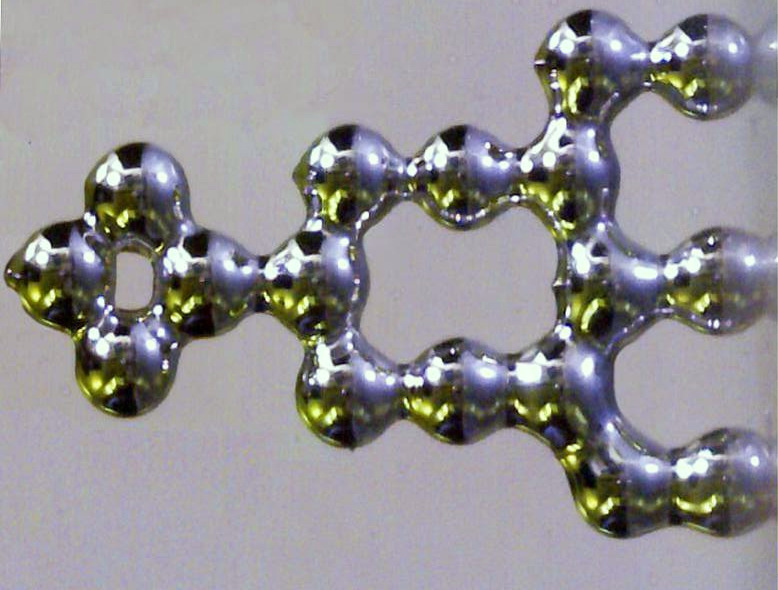
Enlarge / Droplets of a gallium/indium alloy. (credit: Collin Ladd, NC State University)
The discovery of graphene-a one-atom-thick sheet of covalently bonded carbon atoms-inspired the research community to generate a variety of 2D materials. Graphene, MoS2, the silicon equivalent of graphene, and more all have distinct properties based on the chemical bonding among their component atoms. And it's possible to leverage these properties to create commonplace devices on an unprecedentedly small scale, like a three-atom-thick LED.
Obviously, the more materials we have to work with, the better we can fine-tune one of these devices to our needs. But producing 2D materials is a challenge, as there are a limited number of substances that lend themselves to the chemically bonded layers we know how to work with. Now, an Australian-US team (writing in Science) has devised a way to make a broad class of atomically thin metal oxides, including 2D versions of materials already in use by the electronics industry. Their secret? A room temperature liquid metal.
SelectiveThis is one of those cases where a series of simple observations led to a major development. In many cases, pure metals will react with oxygen in the air to form a thin oxide layer on their surface. This, it turns out, is true for one of the metals that is liquid near room temperature: gallium, which melts at 30 degrees Celsius. Leave some liquid gallium exposed to the air, and it'll form a thin film of gallium oxide on its surface.
Read 10 remaining paragraphs | Comments