Who needs a CPU? Phase change memory acts as an analog computer
Enlarge (credit: IBM Research)
Historically, one of the larger bottlenecks to computing performance hasn't been processor speed; it has been getting data and instructions to and from the processor. Working with memory isn't only a performance bottleneck, as the multiple layers of caches and high-speed memory add significantly to a computer's power budget. Other systems, like the extremely power-efficient neuron, mix processing and memory in individual cells.
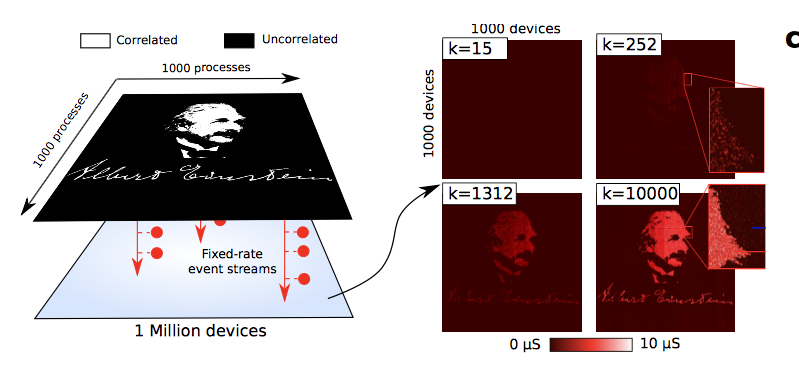
That has inspired some computer scientists to try to figure out if we could do the same. Resistance-based memory, like memristors and phase-change memory, operate based on physics that make them amenable to performing calculations, and a few proof-of-concept demonstrations have been done using them. But a team from IBM Zurich has now gone beyond proof of concept, and it has used an array of a million phase change memory bits as an analog computer, performing tests for temporal correlations on real-world weather data.
Memory as an analog computerPhase change memory is based on materials that can take two different forms as a solid. When cooled slowly from a liquid state, they'll form a crystalline material that is a decent conductor of electricity. If cooled quickly, they form a glassy, disordered structure that's an insulator. Once set, the states remain stable, allowing it to provide long-term memory storage even in the absence of power.
Read 9 remaining paragraphs | Comments