Excessively large laser is key to creating gamma ray sources
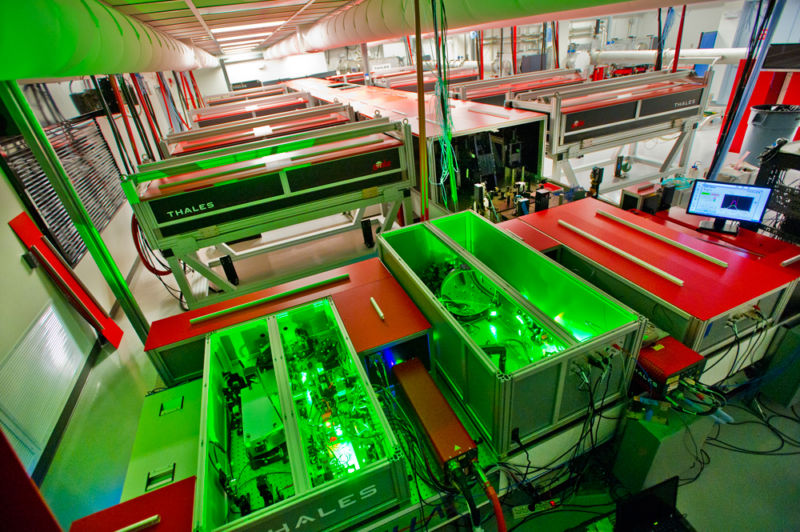
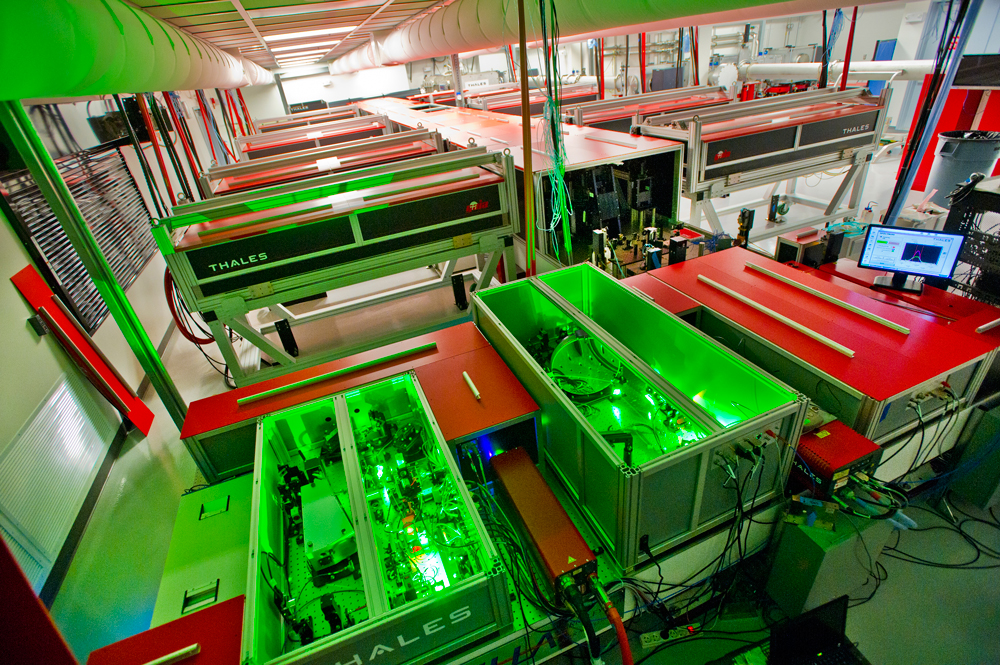
Enlarge / Room-sized lasers should always glow green. (credit: Lawrence Berkeley Lab)
In the dark and distant past, I called myself a laser physicist. I would speak with pride of lasers that produced incredible power: the thought of a petawatt laser system would bring a tear to my remaining eye.
But I have to admit that our best hardware is relatively wimpy when compared to natural sources of energy that output far more power. Of course, it is really hard to convince a neutron star to sit in the lab and not destroy the planet. But now, out of the minds of theorists and into a lab hopefully not-too-near you, we may have the chance to match astronomical radiation sources at the press of a button.
Our petawatt laser systems involve collecting a lot of photons (about 1018 of them) and then releasing them all at once (in about 10-15 s) to make one. For comparison, a simple nuclear decay can release a photon pretty damn close to the same power. If you could convince all the nuclei in a nanogram of material to decay simultaneously, you'd hit the same power flow.
Read 10 remaining paragraphs | Comments