Far Cry 5 review: Five steps back
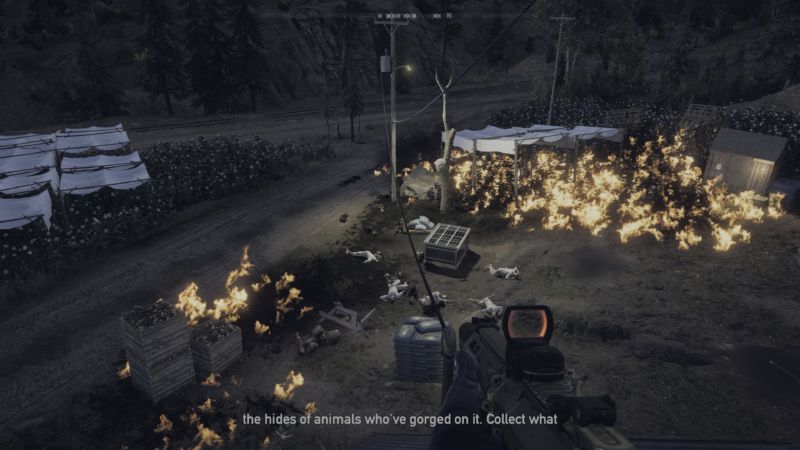
Enlarge / Sadly, the fire doesn't spread quite as widely as it does in Far Cry 2.
Far Cry 5 is a disappointment largely of Ubisoft's own making. The publisher may well have set unrealistic expectations for the game's story, which features a villainous cult that clearly draws from the current and complex state of the political far right in the US. After a marketing campaign that leans on evangelical and militia imagery, players could be forgiven for expecting some smart political statements (or at least biting satire) from the game. However you expected to feel about the game's portrayal of gun culture, militias, and weaponized evangelism going in, though, you'll probably come away let down by the game's lack of follow-through on that promise.
That's not to say that Far Cry 5 is all bad. Once I packed up my last shred of hope that the game had anything interesting to say (which happened about 30 minutes in), I was able to uncover some genuinely smart changes to the series' increasingly stagnant gameplay formula.
The game is set in Hope County, Montana, and for the first time in a long time, you won't need to reveal the lovely looking locale by scaling towers. Ubisoft has finally put away that stale gameplay structure, which once belched thunderclouds of mind-numbing objectives onto the map every time you got to the top of a lookout. The result is definitely an example of addition by subtraction.
In Far Cry 5, all but a few side and primary objectives crop up organically. On your mission to stop a vaguely menacing, vaguely Christian cult that's taken over Hope County (the evocatively named "Project at Eden's Gate"), you'll run across hotspots of activity just by exploring. The biggest of these mimic the classic "outposts" that have shown up in the series since Far Cry 2. Once you clear out an outpost, it becomes a hub of non-player characters that can join your bloody quest-or simply chatter about other minor activities.
Read 21 remaining paragraphs | Comments