This spacecraft will get closer to the Sun than any before it—without melting
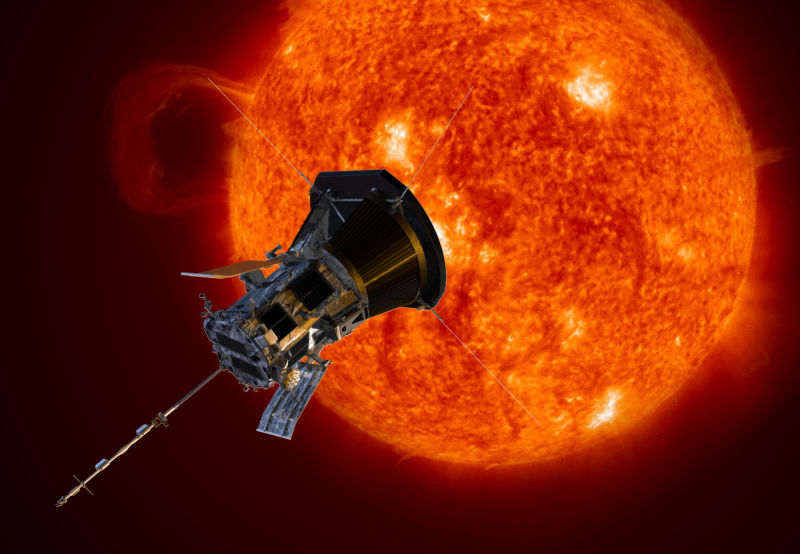
Enlarge / Artist's concept of the Parker Solar Probe spacecraft approaching the Sun. Launching in 2018, Parker Solar Probe will provide new data on solar activity and make critical contributions to our ability to forecast major space-weather events that impact life on Earth. (credit: NASA)

It has taken 60 years, but scientists and engineers are finally ready to reach for the stars-our star, that is. And they're confident they won't get burned.
This summer, NASA will launch the Parker Solar Probe, an impressively heat-resistant spacecraft destined to glide closer to the surface of the Sun than any spacecraft before it. It will fly within about 6 million kilometers of the searing surface, more than seven times closer than earlier craft. If all goes to plan, the craft will be hurtling at 724,205km per hour and have its one-of-a-kind heat shield perfectly facing the surface as it makes those closest approaches. In about seven years, it will complete 24 orbits around the Sun and pass by Venus seven times.
All the while, the Parker probe will collect a constellation of data to help answer scientists' burning questions-and solve some sizzling mysteries-about the orb of hot plasma that lights up our Solar System. Namely, it will try to help us finally understand why the Sun's atmosphere is 300 times hotter than its surface, which itself is a balmy 5,727 degrees Celsius. This fact defies basic physics and to this day is unexplained. One of the leading hypotheses to account for the heat shift comes from famed physicist Eugene Parker, after whom the probe is named. In the mid-1950s, Parker theorized that the Sun's super-heated corona could be explained by a complex system of plasma, magnetic fields, and energetic particles that spark solar explosions called "nanoflares."
Read 18 remaining paragraphs | Comments