Neanderthals etched a message on this 36,000-year-old stone tool
Enlarge (credit: Majkic et al. 2018)
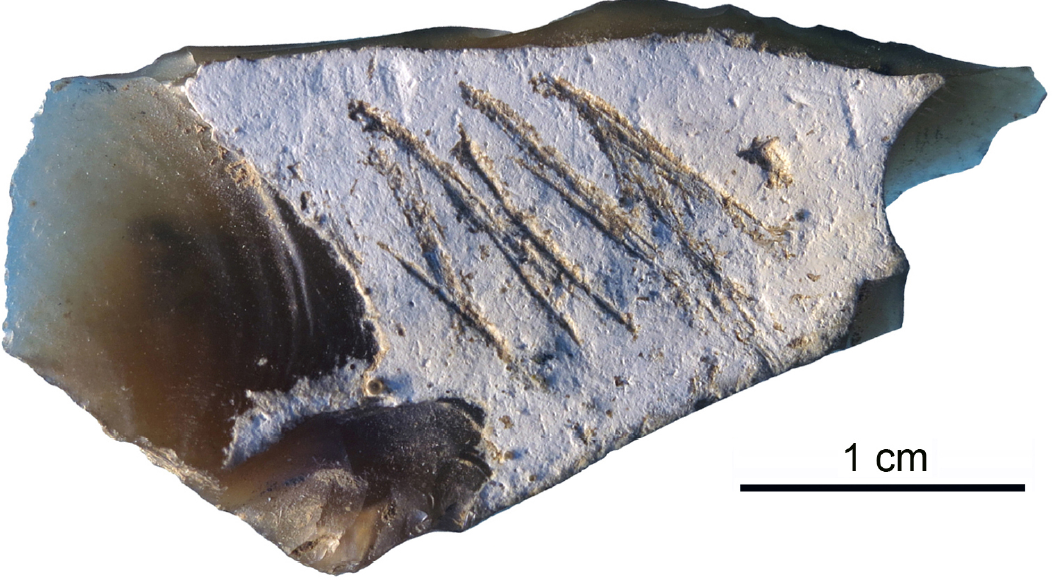
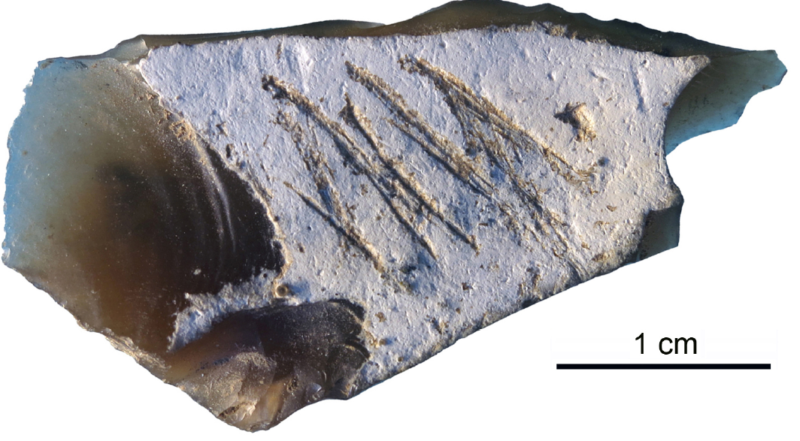
At first glance, it doesn't look like much: a few uneven lines etched into the soft, chalky outer layer of a small, thin flint flake. But a group of archaeologists claims those uneven lines are a deliberate marking, making the 3.5cm-long flake the latest piece of evidence for symbolic thought among Neanderthals.
Kiik-Koba Cave overlooks the Zuya River in the Crimean Mountains. First excavated in the 1920s, the sediment layers that filled the cave contained evidence of a long history of Neanderthal occupation. The engraved flake came from a layer dating to between 35,486 and 37,026 years old. Archaeologists found the skeleton of a Neanderthal infant in the same layer, leaving no doubt about who lived at Kiik-Koba when the stone tools were made and used.
Several recent discoveries, including cave art and shell jewelry at sites in Spain, leave little doubt that Neanderthals were capable of symbolic thinking. Archaeologists want to understand more about the origins and development of symbolism in both modern humans and our hominin relatives. But interpreting the evidence is sometimes a challenge, because early symbolic objects are, by their nature, relatively simplistic. That makes it easy to dismiss a real symbolic marking as an accident or to make a fuss over the symbolic meaning of an accidental mark.
Read 18 remaining paragraphs | Comments