How Intercity Transit Redesigned its Network
 Intercity Transit Route 13 near the Washington State Capitol Building. (Joe A. Kunzler Photo)
Over the past decade, Intercity Transit has worked on completely redesigning its bus network in Thurston County (Olympia, Lacey, Tumwater, and Yelm). Between 2016-2018, the agency solicited feedback on the priorities for future transit and received over 10,000 ideas from the public. Using these data, Intercity Transit devised three future scenarios and asked the public which path they prefer.
- Service Reductions
- Status Quo System
- Transformational System
Unsurprisingly, the transformational system was supported by 83% of survey respondents. The community preferred a redesigned system with:
- Earlier and later service on high capacity (arterial) roads and moderate capacity (collector) streets
- Service to new areas
- High-frequency corridor service similar to bus rapid transit (BRT)
- Enhanced commuter services
To help fund the redesigned network, voters approved Intercity Transit Proposition 1 in November 2018. The ballot measure also provided funding for a five-year zero-fare demonstration project. This went into effect on January 1, 2020, and was extended by three years due to the pandemic (until 2028).
Intercity Transit observed a change in ridership patterns after the pandemic. Transit ridership shifted from morning and afternoon peaks to more even ridership throughout the day. This dramatic shift paused the system redesign work and more community feedback was collected on post-pandemic travel behavior. The agency adjusted the redesigned bus network based on this feedback and the new network will launch on May 3, 2026. Key changes and unique components of the new system are discussed below.
 Intercity Transit's new system map. The old map is available here. (Intercity Transit)Route 9X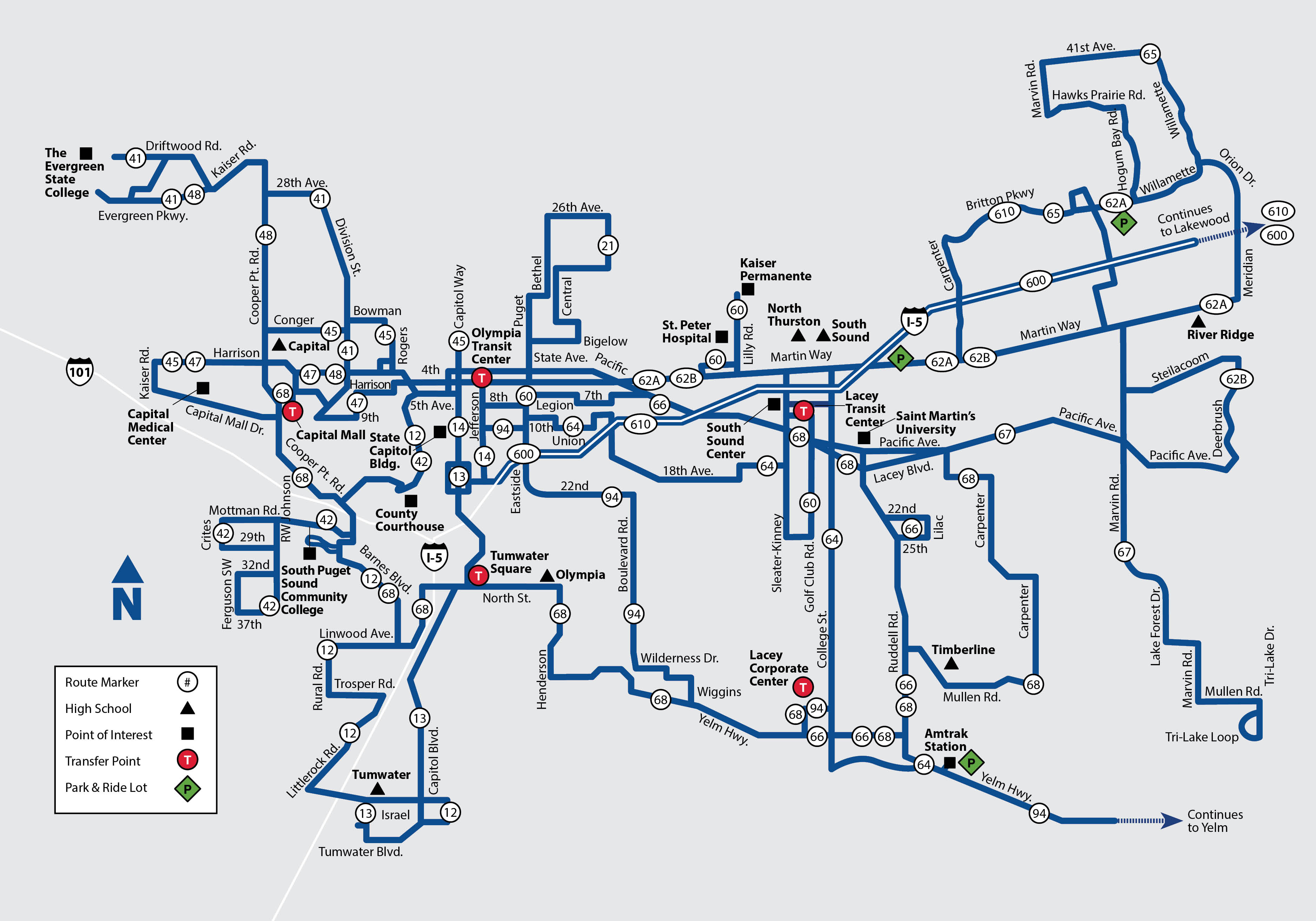
On the map above, Route 9X stands out as the spine of Intercity Transit's fixed route network. This BRT-like route offers frequent (every 15 min), limited-stop service between four key transit hubs: Capitol Mall Station, Olympia Transit Center, Lacey Transit Center, and Hawks Prairie. Every other fixed-route service connects to at least one of these stations. The fundamental intent of the new 9X is to link together the four nodes with frequent service while supporting connections with other routes at common stops and transit centers." Rob LaFontaine, Planning Deputy Director at Intercity Transit, told Seattle Transit Blog.
Between 2019-2022 and 2024-2026, Intercity Transit has operated a grant-supported demonstration BRT-like line called the One along Martin Way. The One has limited-stop service, but only runs on weekdays from 11am to 5pm. Intercity Transit has used the One to understand how such a route can serve the corridor as an alternative to a local route. Both the One and Route 9X have shadow local routes that run less frequently and have more stops.
LaFontaine added that Intercity Transit expects to adopt BRT-specific branding (similar to Swift or RapidRide) in the future for Route 9X and all new BRT routes.
Service LoopsIntercity Transit is introducing a few bi-directional loops that are served by one route in the clockwise-direction, and another route counter-clockwise. Examples of this include routes 20, 22 in downtown Olympia and routes 77, 78 in Hawks Prairie. Since loops don't offer a clear inbound/outbound distinction, using different route numbers will help passengers quickly tell which direction a bus is running. This also allows Intercity Transit to end one of the loop routes earlier in the evening without much confusion. In the case of routes 20 and 22, Route 22 ends weekday service at 6:15pm, while Route 20 continues until 10pm.
One Seat RidesThe new Intercity Transit network takes more advantage of interlining bus routes, especially outside of the major transit centers. Interlining routes (when the same bus runs two routes back-to-back) offer one seat rides for more trips. This pattern is most noticeable with Route 9X and routes 34, 35 in west Olympia and routes 77, 78 in east Lacey. LaFontaine also highlighted interlining between routes 32 and 76 at the South Puget Sound Community College. This combination will offer direct trips for passengers traveling around, but not to, the College. Likewise, routes 15 and 16 which will be interlined together at the Washington State Labor and Industries stop in Tumwater. This route pair will finally provide a one seat ride between destinations on either side of I-5.
Final ThoughtsNear-complete redesigns of a transit network are not very common and it is exciting to see Intercity Transit take on the challenge. Of the agency's 20 current routes, only four will remain untouched (13, 21, 600, and 610). The other 16 routes will be replaced by 25 new routes that serve an additional 130 stops. To support the new network, Intercity Transit is increasing the number of annual service hours by 14%. Intercity Transit will use community feedback and ridership data to adjust the network in the years to come.