Starship shows it can deploy satellites, but Moon mission clock still ticks
by from www.theregister.com - Articles on (#75WQP)
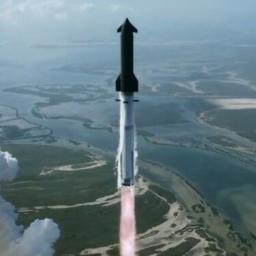 SpaceX has successfully demonstrated that Starship will be just great at deploying Starlink satellites. But a return to the Moon still looks some distance off. Starship's twelfth flight test started swimmingly on Friday, May 22, at 1730 CT as all 33 Raptor 3 engines on the Super Heavy Booster were ignited, and the vehicle leaped off its Texas launch pad. The flight test was scrubbed in the final seconds of a launch attempt on the previous day, but the countdown proceeded without significant hitches this time around. All went well for the first few minutes of flight. One of the Raptor engines shut down, but the remaining 32 continued burning. Things began to go awry at the hot-staging maneuver. The maneuver avoids a loss of acceleration by igniting the second-stage engines before the first-stage engines are completely cut off. Things deviated from nominal rapidly after this point. First, the Super Heavy Booster flipped to perform its boostback burn, but after a flash was visible at the rear of the vehicle, the engines shut down, and the booster tumbled back into the Gulf of Mexico. It attempted to reignite its engines for the landing burn, but broke up. Still, SpaceX hadn't planned to recover the booster, so its loss was not a disaster. It will mean, however, that the company will need to give serious thought to what happened to those engines before it attempts another crowd-pleasing catch maneuver. That left Starship to continue its suborbital trajectory on its six Raptor engines. Except that one of the big Raptor 3 vacuum engines failed, meaning that the remaining engines had to burn longer to keep the vehicle on its trajectory. SpaceX put a brave face on things and stated that the vehicle had "demonstrated its engine-out capability and achieved its planned trajectory." Indeed, it had, but the company also opted to cancel a critical test - reigniting a Raptor engine in space, meaning there was no demonstration to prove Starship was capable of performing a deorbit burn. Starship did, however, successfully deploy 20 Starlink simulators and two modified Starlink satellites to image the vehicle in space. All were on the same suborbital trajectory as Starship, and so burned up harmlessly in the atmosphere. As for Starship itself, it demonstrated impressive attitude control, reentered the atmosphere as planned, and performed a maneuver to deliberately stress the vehicle before guiding itself to a pre-planned splashdown zone in the Indian Ocean using two Raptor engines. So a success? It depends on which mission goals you were most interested in. A failure to reignite a Raptor engine in space means that there could be at least another sub-orbital mission before Starship ventures into orbit. Yes, the vehicle splashed down as planned, and the Starlink simulators were deployed, but something went seriously awry with the Super Heavy Booster. The US Federal Aviation Administration had to get involved and activate a Debris Response Area, which resulted in six departure delays and five airborne holding events. The FAA has not yet made a mishap determination. Still, it's a new rocket off a new launchpad, and there are bound to be teething issues. The bugs can be worked out. Time is very much against SpaceX. NASA currently targets Artemis III for late 2027, giving Musk's rocketeers precious little time to prove the Human Landing System variant of Starship can safely rendezvous and dock with Orion in low Earth orbit before the program moves on to lunar operations. A flawless flight test would have helped. But, alas, it wasn't to be. (R)