Bonus Movie: Process
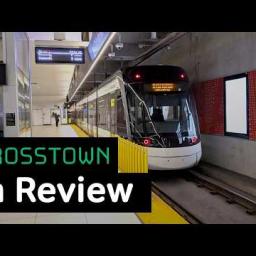
Reece Martin (RMTransit) resurfaces with a discussion with Dr Jonathan English on how process issues affect the quality of transit projects. They call it engineering issues" vs phone call issues". Engineering issues are straightforward technical problems, like building Link on a floating bridge or a tunnel in dubious soil. Phone call issues are those where a phone call could fix the problem or reduce costs: a call between politicans or agencies or with environmental-impact stakeholders. It might be more than one call or another communication method or a series of meetings meetings, but a phone call is a nice symbolic image.
They look at the goods and bads of Toronto's transit: the recent east-west subway/light rail lines - Eglington Crosstown (#5), Finch West (#6), Sheppard East (#4) - platform screen doors or short fences, streetcars, too-close stop spacing, or insufficient street priority or signal priority. They look at why these happen, and how a phone call" could have made these better. They also posit that social media played a key role in getting politicians to commit to fixing the notorious Finch West line slowness. And also that proposing to fix a problem throughout the city can overcome opposition more than proposing one of the same fixes at a time in a few individual locations.
Ideas they suggest include engaging with environmental-impact stakeholders in a neighborhood to come to a compromise or win-win deal, buying off impacted businesses in construction zones, or looking at how other countries can build the same thing much cheaper.
Compromise engagement could be a way to deal with the CID station alternatives issue, opponents of DSTT2, etc, rather than the board simply making a decision favoring one neighborhood faction and ignoring everything else including passengers' needs.
Buying off impacted businesses could look like, if they demand lowering the line into an expensive tunnel for $1 billion, instead give 2% of that amount to the businesses to have a year-long vacation during construction. This may not be legally possible here due to a prohibition against giving public money to private businesses beyond EIS mitigation, or distributing it unequally to certain businesses. But it would be a way to build a better project at lower cost that opens sooner.
For comparisons with other countries they look at how Toronto couldn't build full platform screen doors like Paris because it would cost too much, so instead they installed low metal fence panels, which you can still fall between or get pushed over onto the track. Part of the issue is that adding full-height screen doors can require a ventilation system upgrade, because older stations were built depending on whole-room air circulation. Still, Paris solved that problem and can retrofit stations at much lower cost, closer to the cost of Toronto's lame fences. So maybe a phone call" to Paris could allow Toronto's subway authority to learn how Paris did it so that they could do it too.
The throughout the city" issue is for something like stop diets. If you propose deleting one station or bus stop in one location, or three in different locations, then the people who would be negatively impacted overwhelm the public response and defeat the project. But if you propose to prune excessive stops citywide, then the larger number of people citywide who would benefit with faster transit trips would notice the issue and speak up to defend it, outnumbering those who complain. The net result is a better and more popular transit network citywide.
Another issue is TOD vs bus transfers. They make a case that a couple large TOD towers have only a thousand residents, only some of whom would use transit. A popular bus route brings tens of thousands of people to the stop, and all of them are already on transit, so more of them are likely to transit to the subway to all the destinations the subway goes to. In the case of Toronto's streetcars at their peak (before their service degraded with slowdowns), it was hundreds of thousands of people per line. So agencies should prioritize connecting to popular bus routes and having a good bus-feeder network. Applicability to Link includes DSTT2's bad downtown transfers, the lost midtown transfer to RapidRide G at Madison Street, dropping Avalon station (route 21), the bad Overlake Village station location (and Metro not rerouting the 226 to Spring Blvd near two Link stations), Capitol Hill station being at John Street instead of Pine Street (the primary east-west bus corridor), and probably other station issues I've forgotten.
They also fault Sheppard East for being too short (five stations). They say it could be extended a few stations to a busy bus route, and that would significantly increase ridership. Conversely they praise Eglington Crosstown as being decent sized and fast so you can travel across a large percent of the city in twenty minutes.
Note that this is citywide": in an area as dense or denser than the inner half of Seattle. Toronto is dense over a much larger area than Seattle, and all these subway lines and streetcars are within that dense area for the most part. When you get out beyond say Northgate or Lynnwood, there are fewer people, bus ridership is lower, and the problem of a few small dense islands in a sea of low density" becomes more acute. Those all make the issue less applicable. The closest comparison to Sheppard East may be extending Lynnwood Link to Alderwood Mall or Ash Way (as earlier proposals for ST2 would have done, although that's not really about busy bus routes. A better comparison would be if Link ended at U-District and there were a proposal to extend it to Roosevelt or Northgate: that would bring in the 45 and 62 and all the Northgate routes. That would be a significant benefit, although none of them are probably as busy as the Toronto crosstown route, and none are BRT (RapidRide) lines. But still, extending a U-District terminus to Northgate would be a significant benefit. That doesn't work for extending Federal Way to Fife.
This is a semi-open thread, for process and network issues, or transit during the World Cup month. A full open thread will be tomorrow, or the last article before this.