South Korean chip startup FuriosaAI invades European datacenters
by from www.theregister.com - Articles on (#76TSS)
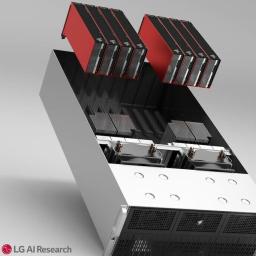 Power-efficient South Korean AI chip startup FuriosaAI has landed on European shores. On Tuesday, the chip biz revealed that it had begun fielding its RNGD - pronounced renegade" - line of AI accelerators at colocation giant Equinix's LS2 datacenter in Lisbon, Portugal. Founded by June Paik and Hanjoon Kim back in 2017, before LLMs were cool, Furiosa has largely focused its attention on the South Korean domestic market, scoring wins with the likes of LG Electronics. Now the startup is looking to bring its RNGD-based inference platform to Europe, where it sees an opportunity to capitalize on growing sovereign AI compute demand. We looked at Furiosa's tensor contraction processor (TCP) architecture at this time last year. Fabbed on TSMC's 5 nm process tech, RNGD is rather modest compared to chips from Nvidia or AMD. Each PCIe card features 48 GB of HBM3, 1.5 TB/s of memory bandwidth, and, according to Furiosa, is capable of churning out 512 teraFLOPS of dense FP8 performance. The main thing going for these parts is that, compared to the competition, they're not particularly power hungry. Each card has a TDP of 180 watts. For reference, the RTX Pro 6000, Nvidia's closest competitor, offers twice the memory capacity and compute, and comparable memory bandwidth, while consuming 3.33x the power. Eight of these accelerators form Furiosa's NXT RNGD Server, a 3 kW system that boasts up to 384 GB of HBM, enough to run relatively large enterprise models like OpenAI's gpt-oss 120B, LG's Exaone 236B, or Qwen 3-30B-A3B at large context sizes and concurrency. And because the systems are air-cooled, they can be deployed in existing datacenter racks. Furiosa's foray into the European market may have more to do with brand recognition and software familiarity than offloading RNGD excess accelerator stock. As we previously reported, Furiosa is working with Broadcom on a third-generation AI accelerator. The tie-up will see the two companies adapt Furiosa's Tensor Contraction Processor tech into a multi-die system-on-package utilizing faster HBM4 or HBM4e memory. The new chip will also use Broadcom's Ethernet and PCIe switching tech to support larger scale up clusters than the eight-way systems Furiosa is already building. Furiosa is one of several companies licensing technologies from Broadcom to support its next-generation accelerators. Earlier this year, Meta unveiled its latest generation of MTIA chips built with Broadcom's help. OpenAI and Google have also disclosed chip collaborations with Broadzilla, though details remain light. Furiosa's third-gen accelerators should offer much higher performance and scalability, but their reliance on HBM4 and HBM4e memory, which are only hitting the market this year and next, means we probably won't see them in the wild anytime soon. (R)