NASA calls time on CAPSTONE after four years of lunar orbit lessons
by from www.theregister.com - Articles on (#76TSV)
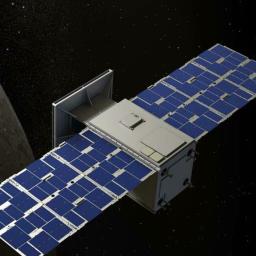 After four years of operations around the Moon, NASA's CAPSTONE mission has bitten the lunar dust, in a manner of speaking. The Cislunar Autonomous Positioning System Technology Operations and Navigation Experiment (CAPSTONE) was launched in 2022, with a primary mission to validate the near-rectilinear halo orbit (NRHO) intended for NASA's "paused" Gateway space station. Launched in June 2022 on a Rocket Lab Electron rocket, CAPSTONE had a troubled start to life, briefly giving controllers the silent treatment before slipping into lunar orbit in November 2022. The diminutive spacecraft was the first US commercial mission to orbit the Moon and spent an initial six months checking out the NRHO planned for the Gateway before its mission was extended and the spacecraft became, according to NASA, "a testbed for advanced communications, networking, autonomous navigation, and software-defined satellite technologies." The spacecraft was used to try out autonomous navigation software, which is useful when NASA's Deep Space Network (DSN) has limited availability. During the Artemis II mission, for example, communications passes dropped to just a few per week. CAPSTONE was also used to test delay/disruption-tolerant networking (DTN), designed to handle lengthy communications delays and frequent signal gaps. "CAPSTONE became the first to fly the latest DTN protocols beyond Earth orbit and the first to run them in NASA's core Flight System, an open source framework that can be implemented on any spacecraft," NASA stated. However, continued NASA funding appears to have required justification after CAPSTONE completed its primary mission. On July 6, the agency announced that its CAPSTONE activities ended last month. While the spacecraft had a productive second life, hosting new applications and experiments, uncertainty around Gateway's future could have put a question mark over continued operations, although NASA has not stated that this was the case. It is unclear what a NASA-free future looks like for CAPSTONE. The spacecraft was designed and built by Terran Orbital and is owned and operated by Advanced Space. "Advanced Space will continue to use the spacecraft as a technology development testbed," NASA said. (R)