Hugging Face offers $399 robot duck to help you quack the AI code
by from www.theregister.com - Articles on (#7803D)
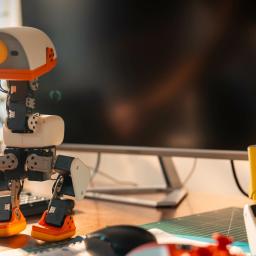 If it walks like a robot duck and quacks like a robot duck, it's probably a Microduck robot from Hugging Face subsidiary Pollen Robotics. And it's ready to work with AI. Bordeaux, France-based Pollen announced the Microduck on Thursday, describing it as a robot designed for immediate action, as well as being ready for training via reinforcement learning in an open-source physics simulator to teach it new tasks. Microduck is tiny, mind you: It's a mere 25 cm tall (a little under 10 inches), and weighs in at about 800 grams (1.76 pounds), so don't expect this to serve as your own in-home AI butler or cleaner. It's more of a cheap (just $399) testbed designed to teach users about hardware AI, machine learning, and the potential of modern robotics. Microduck sets out to make building AI on real hardware as approachable as running a model: complex behaviours out of the box, then an open-source stack covering robot control, simulation, RL training and sim-to-real deployment, so new skills can be trained in simulation and transferred to the robot," Pollen writes on Microduck's website. That's not to say that Microduck can't be trained to do real work, of course. A video on the bipedal bot's website shows it picking up socks and a marker with its articulated beak and placing them in a box, which it's able to see with its front-facing camera and determine distance thanks to a built-in LiDAR unit. That hardware isn't open source, mind you, but the entire software stack Microduck is built on is, and Pollen is encouraging users to share skills once the entire Microduck system goes live later this year. A Pollen rep told us that the company has no plans to open source the hardware. Microduck should be able to handle a pretty robust library of tasks, too: It'll ship with 1 GB of RAM, 32 GB of onboard storage, and a 50 Hz onboard policy loop for connecting its onboard AI to sensors to determine its next action. Like any good bipedal robot, Microduck is able to get back on its feet when knocked over, as demonstrated in videos on the minuscule machine's website. It's also able to roller skate, with a pair of wheeled feet available in an optional accessory pack that includes a ball it can play with, an NFC chip and NFC tags, and a laser pointer it's able to follow with its eyeball camera. Anyone can train new behaviors ... in simulation using reinforcement learning," Pollen representative Santiago Pavon explained to us in an email. Adding purpose and autonomy to the robot is something we are still working on, and we expect the community to pick up and contribute." Pavon explained that Pollen hopes it and the community it wants to build with Microduck will achieve autonomous behaviors such as voice recognition, simultaneous localization and mapping, navigation and grasping," though he admits its grasping capabilities will likely be limited given the small size of the robot. Pavon estimates Microduck probably can't lift much more than 100 grams. Regardless of its ability to lift, Pollen wants Microduck to serve as an open platform for training tiny autonomous robots to do both practical and fun things. We find the autonomous behaviors as a community objective' to be very exciting," Pavon noted. Microduck is available for preorder now, with units planned to ship sometime before Christmas 2026. Now about that acquisition ... El Reg readers are likely aware of the hubbub brewing around Pollen Robotics' parent company, AI model hosting platform Hugging Face, and Nvidia. The GPU giant has reportedly agreed to buy the AI biz for somewhere in the neighborhood of $13 billion. The deal remains unconfirmed, with Business Insider saying its exclusive was based on a person familiar with the matter" and that an agreement had not been finalized. If true, it would mean that Nvidia is putting its money where CEO Jensen Huang's mouth is in regard to open-weight AI models. Nvidia's own Nemotron AI models are fully open source and available on Hugging Face, and Huang has come out in support of open source and open weight AI models during the recent back-and-forth in the industry between frontier labs and open model makers located largely in China. Pollen Robotics itself was only acquired by Hugging Face in April 2025, and it's unknown how the acquisition by Nvidia would affect the Microduck maker. While Pavon was willing to answer plenty of questions about Microduck, he didn't respond to our inquiry about the rumored Nvidia deal. Neither Nvidia nor Hugging Face responded to our inquiries, and both have been silent on the matter since BI's story broke. (R)